Breed Conservation

2020

What Is a Heritage Breed?

“Heritage Breed” is easy to say and tough to define. Heritage is basically where we came from, and heritage breeds reflect that long history of the interactions of place, people, and livestock. These breeds are part of who we are, depending on our own origins.

Local breeds are the easiest to categorize as “Heritage” because the linkage to a specific place is strong and obvious. The link with local breeds is one reason “Heritage” has increasingly become a synonym for “rare” because it is within this group of breeds that breed loss is most obvious and threatening.

English Longhorn Cow

English Longhorn Cow

Criolla Saavedreña cattle

Criolla Saavedreña cattle

It is equally true that selection pressures, short-term goals, and breeding practices have put many other, non-local, breeds at real risk of loss, and these are also “Heritage” and have an essential role in maintaining the genetic variation that future generations of farmers and consumers will need.

The Heritage Shorthorn is a good example of the strange path that some breeds take throughout history. The Shorthorn originated within a fairly limited geographic range, and in that sense is very much a “local” breed, at least originally. Its qualities and characteristics quickly became widely appreciated and acknowledged, leading to the Shorthorn becoming one of the first truly international breeds. It is interesting to contrast the trajectory of the English Longhorn, standardized a bit before the Shorthorn, with the trajectory of the Shorthorn. One breed remained local, the other one pretty much traveled the world.

Shorthorns have been widely used throughout the world, not only as their own pure breed, but also extensively to influence many other breeds across wide portions of the globe. The case can be made that they have been the most influential of all cattle breeds when considering the number of breeds and regions they have influenced.

The fate of the breed then changed, being eclipsed by other breeds. This included the Angus for beef production and the various dairy breeds for specialized milk production. In order to meet the challenges of this changing market, many Shorthorn breeders then opted for adding influences from other breeds in an attempt to enhance the breed for more contemporary demands. It is ironic that what was once a breed that served as the foundation for others now became influenced by so many that its own status as a pure breed became threatened. This is a sobering situation when reflecting on breeds, their importance, and the pathways they can take through history.
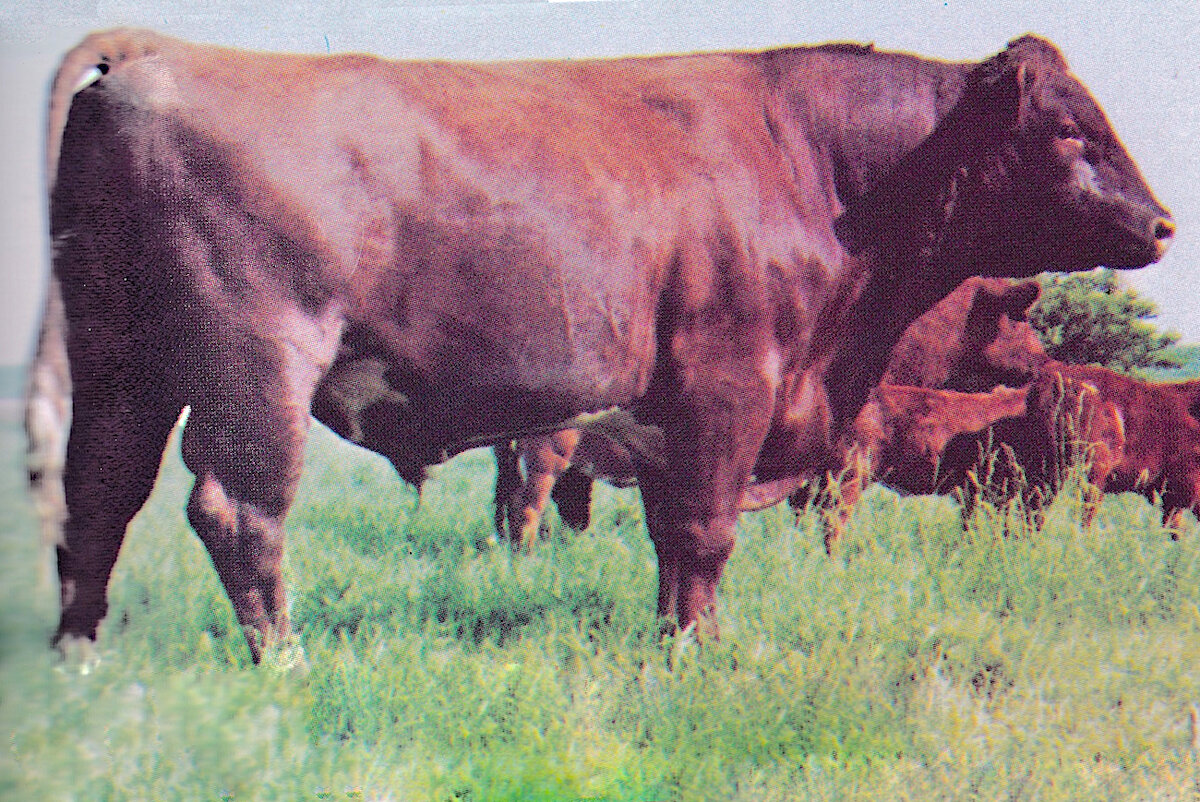
Tea For The Tillerman,  Shorthorn bull

Tea For The Tillerman, Shorthorn bull

The Shorthorn, because of its unique position among cattle breeds, can lay claim to being an especially important foundation breed, and one that is therefore important to maintain on into the future. It is one of a few breeds whose genetic makeup is somewhat peripheral to other breeds, which is somewhat surprising given its role in influencing so many other breeds. Its genetic position out there on the periphery makes for an especially important contribution to the biodiversity of cattle genetics.

Fortunately many Shorthorn breeders remained loyal to the original breed despite the various pressures to add this or that into the breed. These breeders have not only continued to successfully breed pure Shorthorns, but have also used frozen semen from decades ago to assure that the broad genetic variation available in the past is brought into the present and then on into the future. This is an important part of the heritage of the breed, and is being conserved successfully and at just the right time.

When we lose a heritage breed, we lose a piece of who we are and of how we interacted with the land and its systems. Saving all these pieces is a way to assure that we can put the puzzle together for future generations to benefit from the genetic wealth that our own ancestors provided for us.


Author Profile: Dr. D. Phillip Sponenberg

Dr. Phillip Sponenberg (DVM Texas A&M University, PhD Cornell University) is a Professor of Pathology and Genetics at the Virginia-Maryland Regional College of Veterinary Medicine. He teaches pathology, genetic resources, and small ruminant medicine. His interests in coat color genetics include several species, and have resulted in journal articles, book chapters, and books.
Phil’s breed conservation endeavors include being a technical advisor for the Livestock Conservancy since 1977. This work has been pivotal in saving several endangered livestock breeds, with a special emphasis on breeds that are uniquely American or those for which the USA holds the greatest genetic diversity. These efforts are complemented by a personal herd of Tennessee Myotonic Goats in a wide variety of colors. He is also an avid spinner, and appreciates natural fibers and their color array.

2020

Quality Matters!

Conservation of Heritage Livestock is a complicated (and essential) endeavor. No one blanket recommendation can cover all of the situations that range from rescuing rare breeds from extinction to assuring that rare breeds have a good market demand that assures their future. While each situation is unique, they all do share some common concerns.

As with most of life, the devil is in the details. Issues of selecting heritage livestock for quality varies along a long continuous line. The various stops along the way are each appropriate for specific situations. The challenge for breeders of Heritage Shorthorns is to figure out where their own program and goals fit along that line.

At one extreme of this line is a point where immediate rescue is the most important issue, with expansion of a truly rare population overriding any other concerns. In that situation, selection has to be minimal or the genetic pieces for a sound future are likely to be lost. Very few breeds fit into this category, but certainly the Randall Lineback Cattle did when they were first rescued from that original group of two bulls and ten cows. At that point, anything alive had a contribution to make! Such extreme situations are rare, but occasionally a rare bloodline within a breed might fit into this general category.

Way over at the other extreme are the common production breeds, where quality and productive potential trump just about all other issues. This is taken furthest in dairy breeds, most notably the Holstein, where individual bulls can sire tens of thousands of calves. Intense selection for the desired qualities (milk production) has resulted in very productive cows, but an unfortunately narrow genetic base that is now starting to have consequences in general viability and longevity.

Looking at these extremes can teach a few lessons. At the one extreme (no selection) it is possible to assure decent genetic variation, but usually at the expense of production and overall quality. At the other extreme (high selection) it is possible to have productive high quality animals but for the breed to collapse in on itself through inbreeding depression.

For most breeds, and the Heritage Shorthorn is among these, it is essential to find a point where selection for quality can be balanced against the genetic structure of the population. One way to do this is to always practice selection for quality, but to always balance this with selection for genetic representation. For example, if a calf comes from well-represented family lines, then selection for quality should have a high priority. If a calf comes from lines that are very rare, then it is appropriate in some cases to relax the selection for overall quality a bit, but only for that generation.

Buttergirl.jpg

There is an important warning, though. There is a category that can be called “rare for a reason.” These are bloodlines, animals, or even entire breeds that are just not all that productive, hardy, or well-made. In the case of entire breeds, this situation puts them at risk of extinction. In the case of bloodlines, there are still some potential strategies that might work to salvage the more positive aspects of their potential genetic contribution. One strategy is to blend a few of these rare bloodlines together, playing off the weaknesses of one with the strengths of another. Success might take a few generations, but the reward is the genetic contribution that comes from having these diverse genetics represented in the breed.

The goal of breeders should always be to have high quality animals, regardless of how rare the breed is. That goal always needs to be undertaken with a view towards the long-term future, and a healthy genetic structure is an essential part of that. When healthy genetic structure of the population goes along with attention to selection for quality, it is indeed possible for the end result to be high quality, sound, productive Heritage Livestock long into the future. Indeed, the Heritage Shorthorn is a great example of just what is possible, over centuries, when breeders pay attention to these very details.


Author Profile: Dr. D. Phillip Sponenberg

Dr. Phillip Sponenberg (DVM Texas A&M University, PhD Cornell University) is a Professor of Pathology and Genetics at the Virginia-Maryland Regional College of Veterinary Medicine. He teaches pathology, genetic resources, and small ruminant medicine. His interests in coat color genetics include several species, and have resulted in journal articles, book chapters, and books.
Phil’s breed conservation endeavors include being a technical advisor for the Livestock Conservancy since 1977. This work has been pivotal in saving several endangered livestock breeds, with a special emphasis on breeds that are uniquely American or those for which the USA holds the greatest genetic diversity. These efforts are complemented by a personal herd of Tennessee Myotonic Goats in a wide variety of colors. He is also an avid spinner, and appreciates natural fibers and their color array.