2026

Shorthorn Travels in Argentina, Nov. 2025

By: Joseph Schallberger, DVM PhD & Susan Schallberger DVM
Overview:

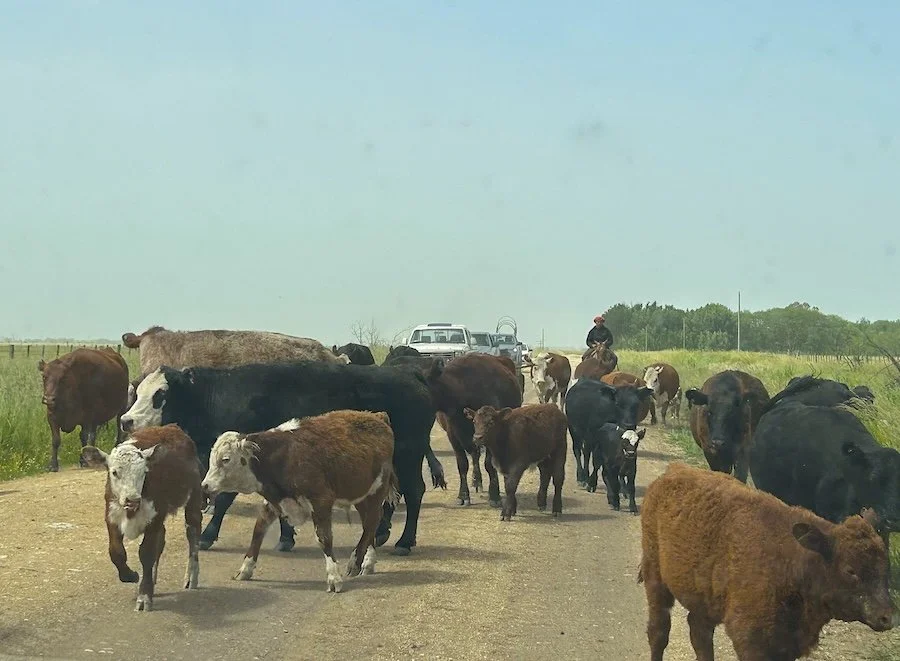
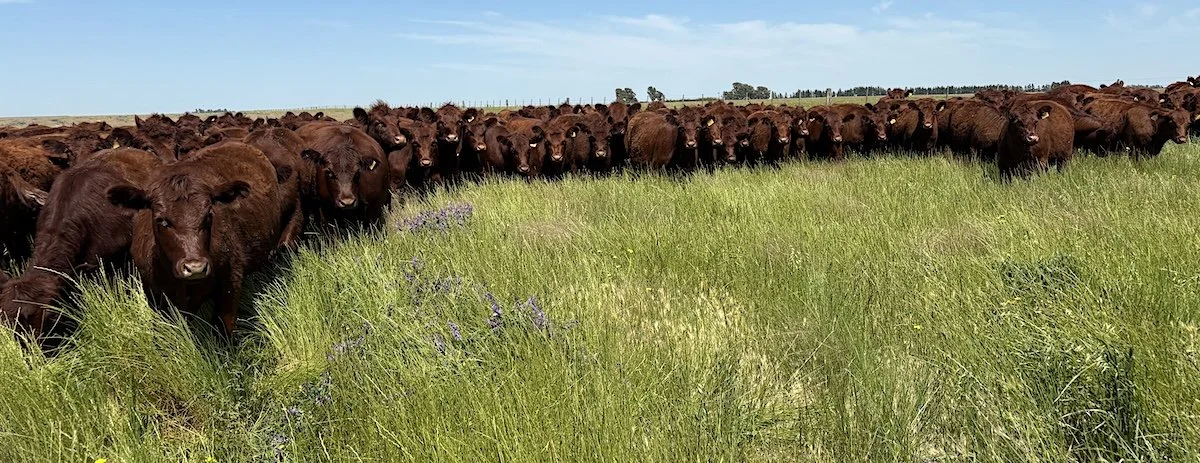
It had been almost 30 years since we previously visited Argentina. At that time we were only in the Suffolk sheep business so cattle ranches had not been on our list of places to visit. Many changes to Argentina were expected and we were not disappointed when we took a trip to Argentina this November (2025). Since almost all of this new trip was in rural Argentina, Sue’s ability to speak Spanish was extremely helpful in navigating the many cultural differences and gleaning additional insight into the thinking of the average Shorthorn breeder in Argentina. During our trip we transversed almost 2000 miles in our rental car. When we initially traveled SW from Buenos Aries we noticed a lot of water in fields. As suspected they were having a very wet Spring (November in the Southern Hemisphere) which at times made the driving “interesting” particularly since a number of the rural roads were dirt roads. After several recent dry years, the wet Spring also accounted for the very lush pastures we saw everywhere.
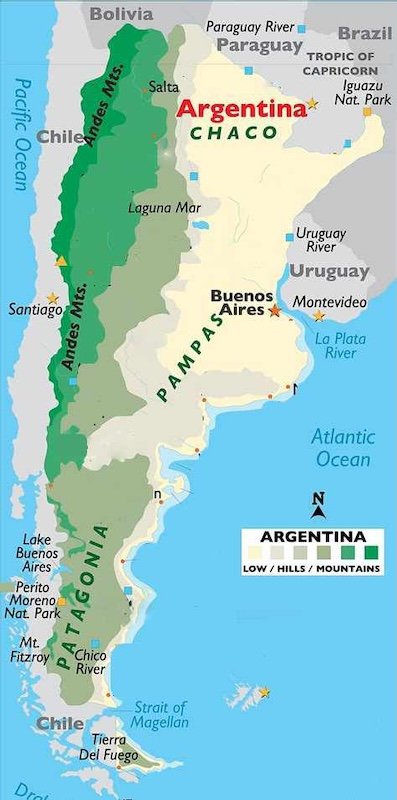
For those not familiar with the cattle raising area of Argentina it primarily consists of the Pampas which runs through central Argentina from the Atlantic coast to the Andean foothills. Annual moisture decreases moving West and is quite dry close to the Andes. To the South is Patagonia. The fertile grasslands are the perfect environment for raising grass-fed beef. There is some utilization of field oats in overseeding pastures. The predominant form of cropping in Argentina is no till. Similar to other countries, Black and Red Angus are the predominant cattle. As in Brazil more of the land is now being used for row cropping which undoubtedly will reduce the cattle raising area and result in additional beef being raised in feedlots.

Dr. Juan Martín Narbaitz arranged our itinerary and put us in contact with the different Shorthorn breeders we met. His help and friendship, along with his wife Monica, was instrumental to the success of our trip. We found all Shorthorn breeders we met in Argentina to be knowledgable, welcoming, helpful, innovative, and with exceptional dedication to the Shorthorn breed. Some families have bred Shorthorns for over 100 years.

Argentina’s great expansiveness results in a multitude of different cattle growing regions and management techniques. When it comes to Shorthorn breeders there are several overriding principles that apply to most Shorthorn operations in Argentina. They are all grass-fed with minimal supplementation. The preferred color of most Shorthorns is red. Average cow and bull size is much smaller than in the USA. Most breeders prefer a cow size of 450-500kg (1000-1100#) and bull size 800-900kg (1750-2000#). Small birthweight and calving ease are mainstays of their production model because all calving is done outside in a natural setting. Most calves are born in the Spring (September-November) with little fall calving. There is limited use of artificial insemination although it is increasing with subsequent interest in introducing foreign Shorthorn genetics which can complement/improve the Shorthorns in Argentina. Argentine Shorthorn breeders are not interested in Dual Purpose or Milking Shorthorns. Breeders want beef Shorthorns that historically compare to some of the old Scottish Shorthorn bloodlines in both size and type. EPDs and EBVs are not regarded as important in their selection process. One breeder indicated EPDs were about 15th in his list of criteria for selecting breeding stock. Much emphasis is placed on phenotype when selecting replacements. Longevity is higher in most Argentine Shorthorns, in comparison to Modern Shorthorns in the USA, which is due to hardiness being another of the prime selection traits. Besides color, two other phenotypic traits that were consistent in Argentine Shorthorns were level top lines and great depth of body. Because of the Argentine focus on the production of hardy, functional beef cattle, the current type of Modern Show Shorthorns in the USA with their high tail set, low slung backs, and diminished livability are totally opposite to what the average Argentine breeder wants in their Shorthorns. Medium frame beef Heritage Shorthorns from the USA and Canada could effectively be used in Argentine Shorthorn herds to complement them both in phenotype and to add genetic diversity.

Two negative traits seen in some Argentine Shorthorns, that were communicated to us by several different Argentine Shorthorn breeders, included udder/teat issues and not shedding their hair coats in the Spring. Some attributed the inclusion of Lincoln Reds in the herd books at one point to be the causative factor for the shedding problem.

It is important to note: There are a large number of Shorthorn breeders throughout Argentina, and we only had time to visit a small number of ranches. In order to limit the length of this article we elected to only hit the high points from each herd that we visited and to include only a few photos. (There is a picture folder associated with this article that has many more photos.) We have more information available on Argentine Shorthorns and breeders than what is included in this article. If anyone is interested in more insight and contact information on any breeder that we visited, please contact the HSS office (office@heritageshorthorn.org).

Also note: We have tried to be as accurate as possible in writing this article. There may be inaccuracies because of the many photos we took, the extensive information we had to assimilate, and difficulties with language translation, so we want to apologize ahead of time to the Argentine Shorthorn breeders we visited if we have made any mistakes. Please contact us if a critical correction is needed.

The Shorthorn breeders are listed in the order they were visited.


1. Jorge, Charlie, and Philip Dawney (brothers)

Ranch: Cabaña El Chajá 9 de Julio, Argentina

The Dawney family has been raising Shorthorns for over 100 years. Jorge runs the purebred cattle herds (Shorthorns, Criollo, and Angus), their feedlot, and some cropping land (which is close to 9 de Julio). The purebred herds are primarily used for the production of bulls to use on their own commercial herds as they utilize a unique crossbreeding program to maintain their beef quality, increase hybrid vigor, and the positive phenotypic traits they have in their herds. Charlie is in charge of accounting, record keeping, and dealing with the many government regulations that exist in Argentina. Phillip runs the western ranch which is 27000 hectares and is mostly commercial cattle. In total they have over 2000 cows and primarily sell market steers. Their crops include soybeans, wheat, and corn. They also raise polo ponies as a sideline. Horses have a long and important history throughout rural Argentina, and Polo is an extremely popular sport in Argentina. Many stables engage in raising and selling polo ponies.
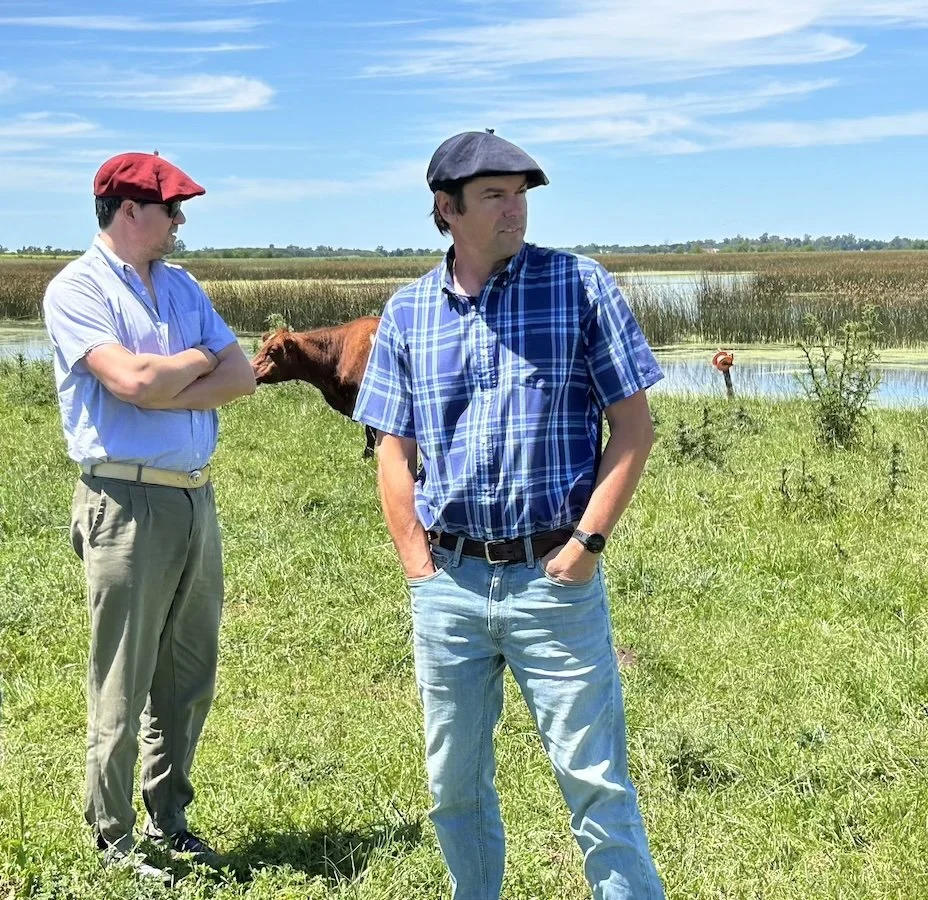
Charlie (L.) and Jorge (Rt.) Dawney

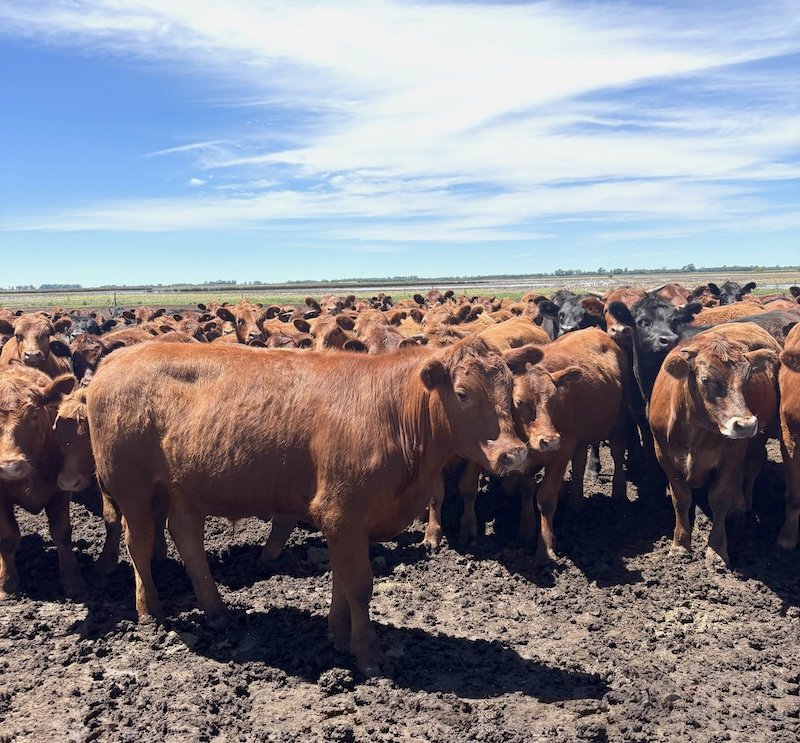
The Dawney brothers utilize extensive record keeping to measure “in house” production in their herds. There is an emphasis on rate of gain, fertility, weaning weights, and longevity. They prefer a slightly larger cow at 550kg (1200#) leading to higher weaning weights, compared to many other Argentine Shorthorn breeders. Cows must settle in a 65 day window or they are culled. They have a 3000 head capacity feedlot that they use to finish higher value steers. This aspect of their operation has expanded and they are looking to create more value in the export market if the Argentine government opens up to allow export of beef.

Overall the Dawneys are to be complimented because of their adherence to selection standards which are based on their market, the type of genetic traits they have inserted into their commercial herd, and their commitment to the Shorthorn breed. They realize how important it is to raise cattle that fit their management system but also have traits, such as significant marbling, to fill an evolving niche in the Argentine beef industry.
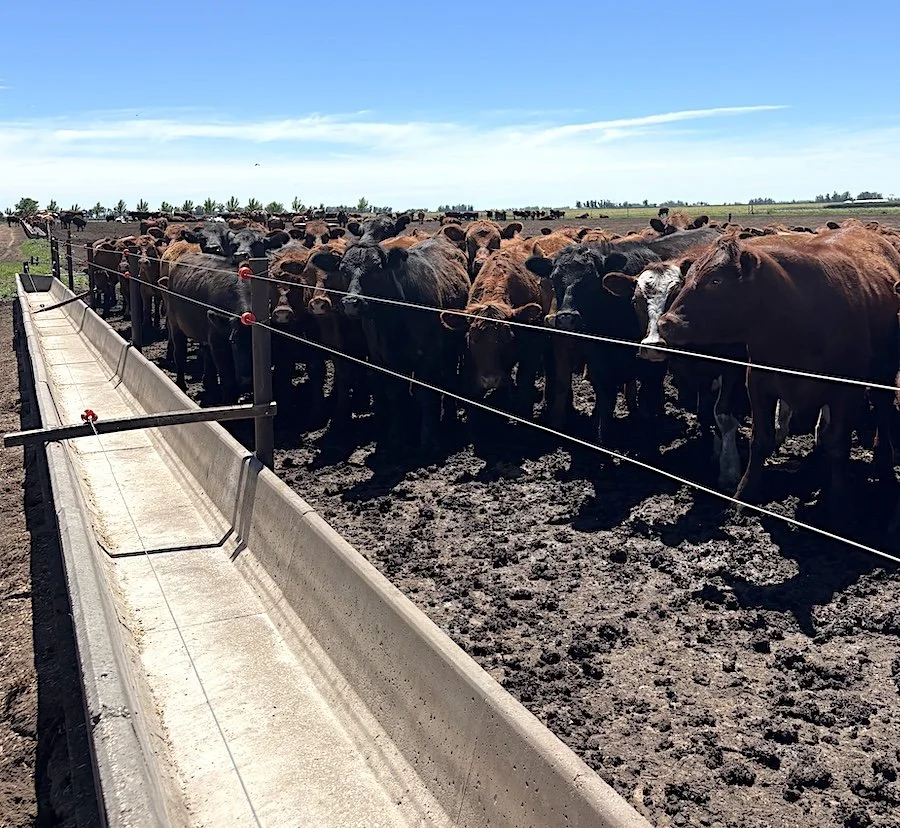
Dawney Feedlot for commercial steers
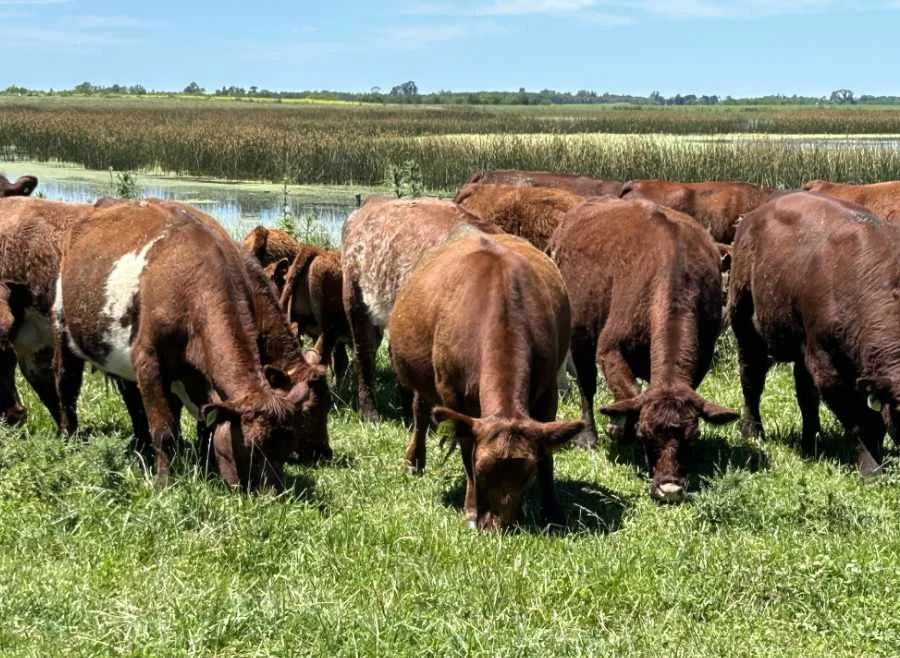
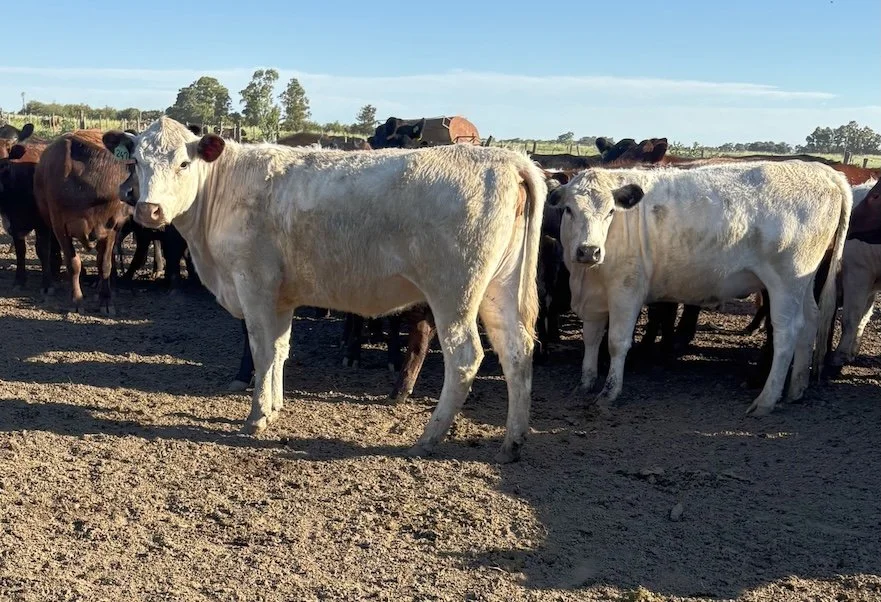
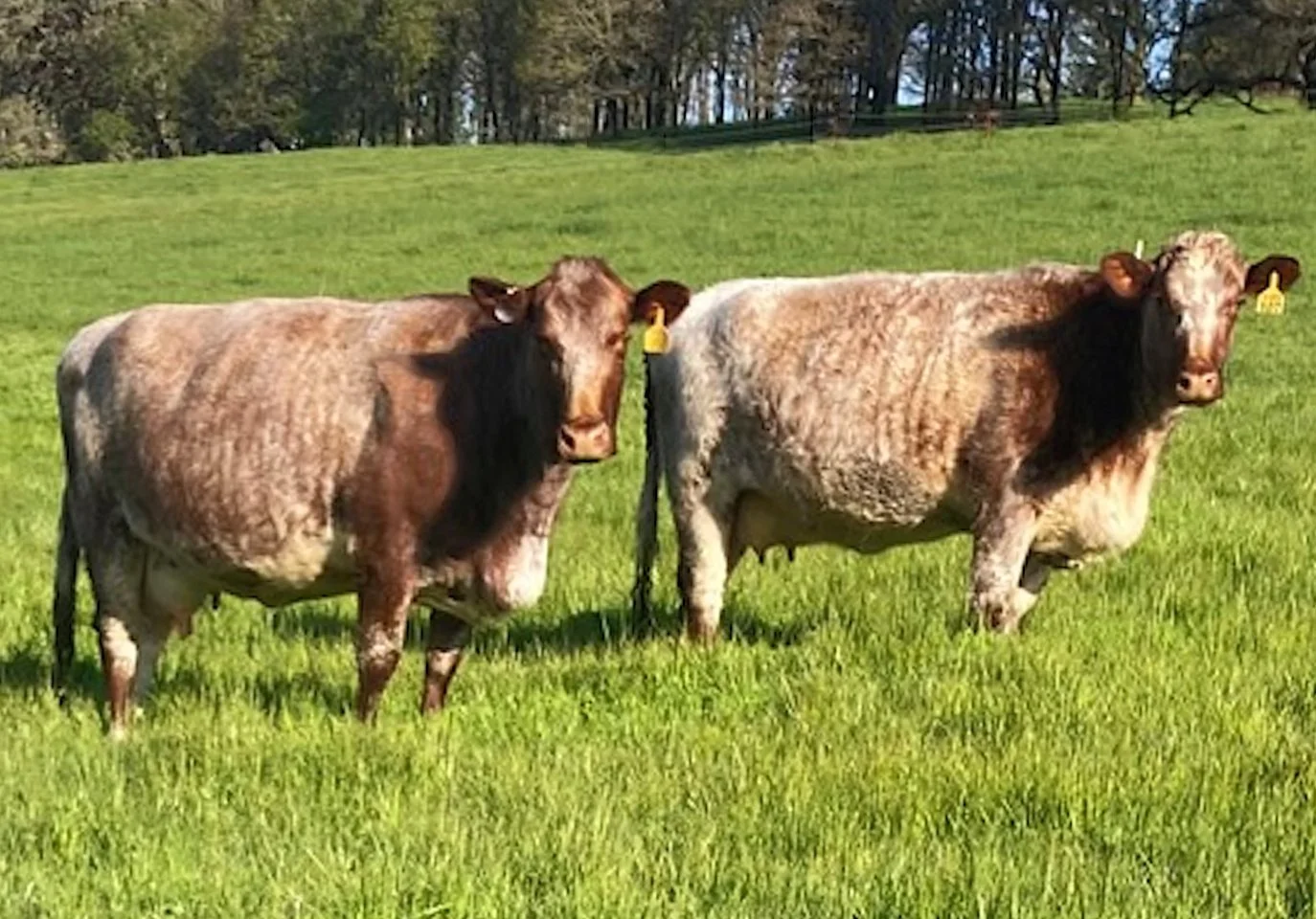
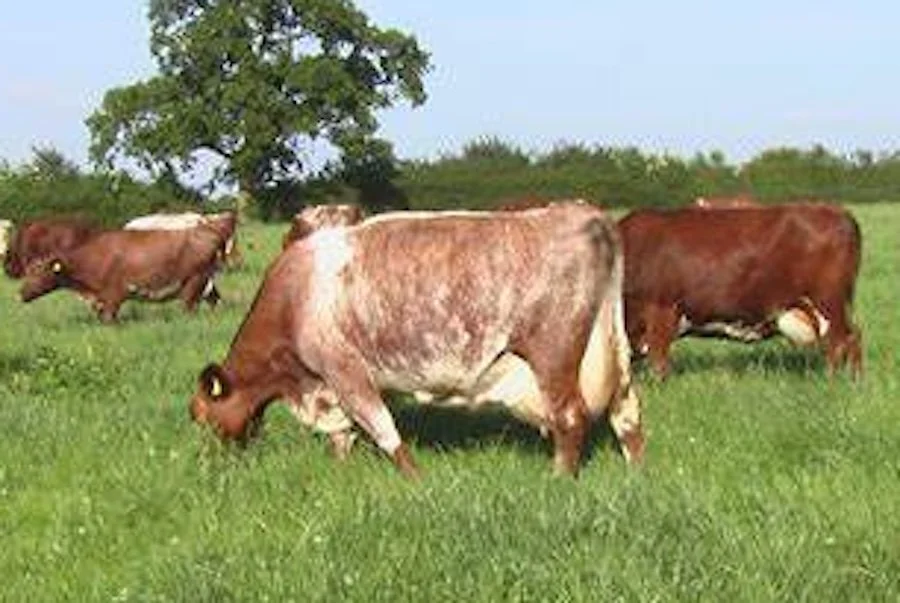
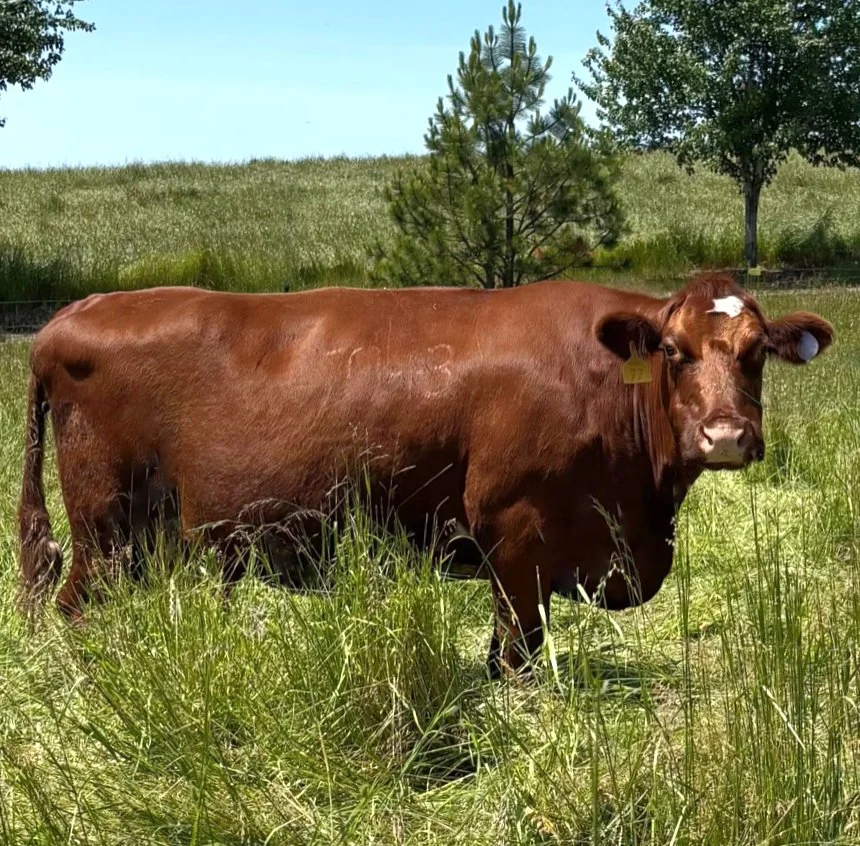
Shorthorn cows
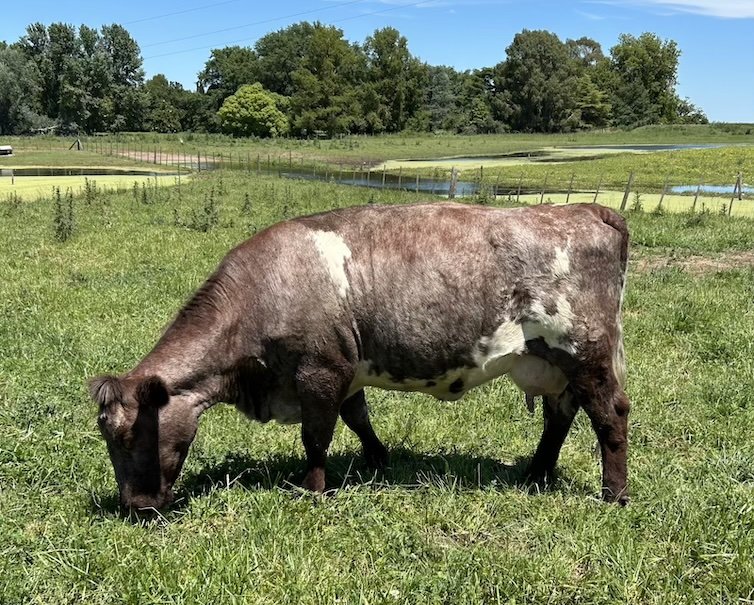
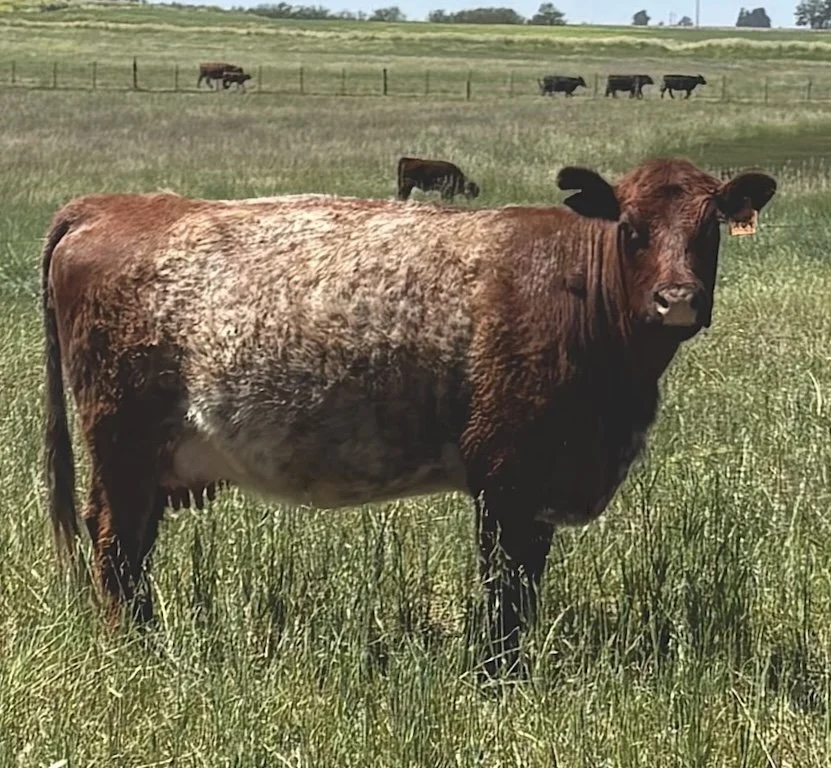
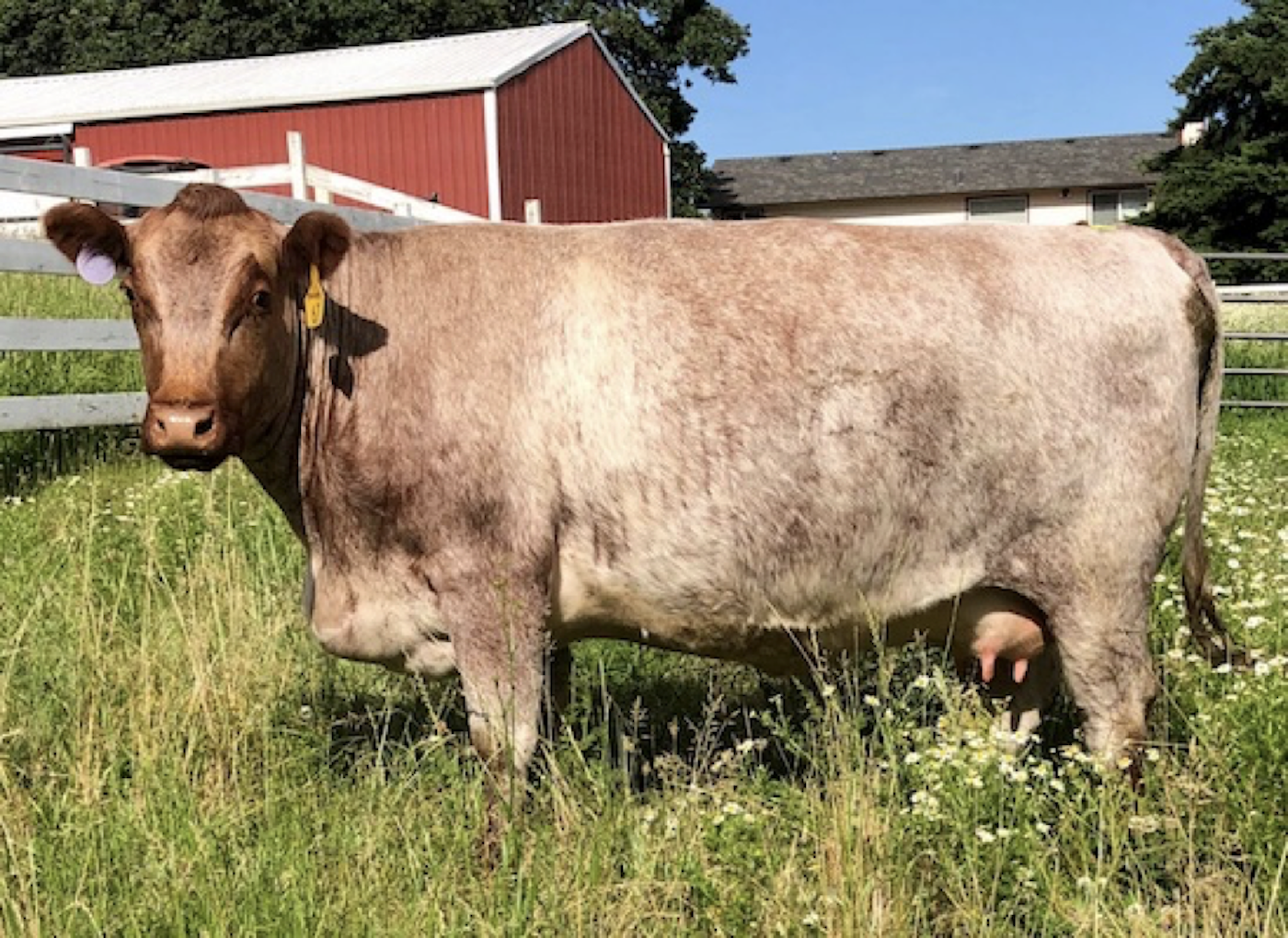
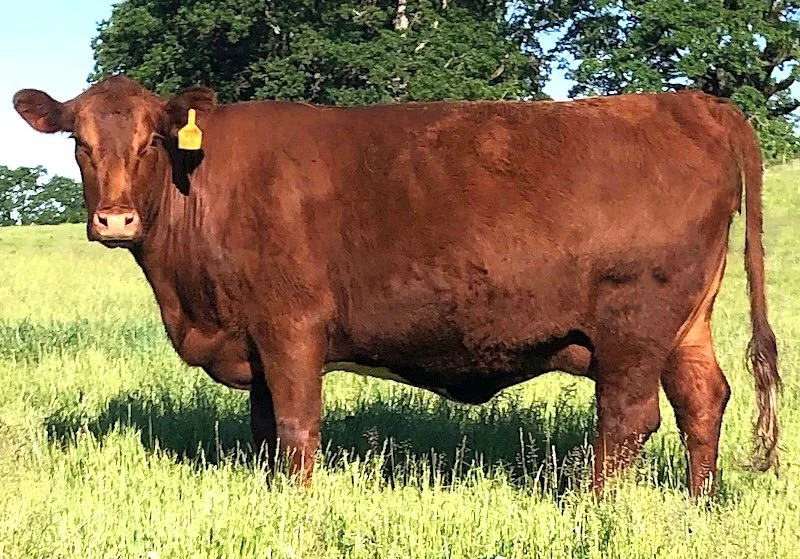
Mature Shorthorn cow

For those unfamiliar with Criollo cattle they are an extremely interesting breed with many positive characteristics. Originally they were brought to Argentina by the conquistadors in the 15th and 16th centuries. Their ancestors were Iberian cattle. For a long time they essentially ran wild especially in Western Argentina. Their hardiness, feed efficiency, longevity (20 years or more), and calving ease are their primary positive traits. They are part of the Dawney’s breeding program for those reasons. They help them produce a better commercial cow. We were quite impressed with their Criollo herd. One surprising characteristic of the Criollo breed, despite the fact that they ran feral for so long, is how calm and gentle they are.
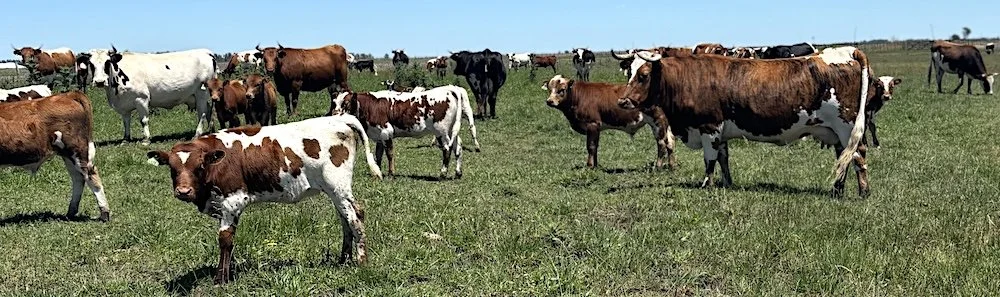
Criollo Cattle, Cabaña El Chaja


2. Dr Juan Martín Narbaitz, Veterinarian

Ranch: Cabaña Urepel Carhue, Argentina

Reproductive center: CABA (Argentine Center for Animal Biotechnology)
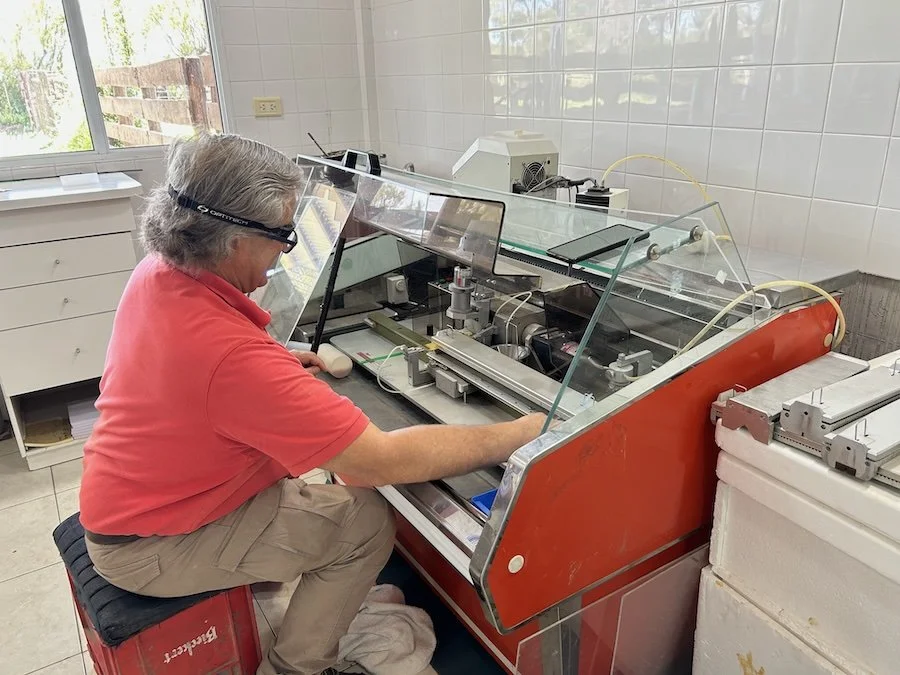
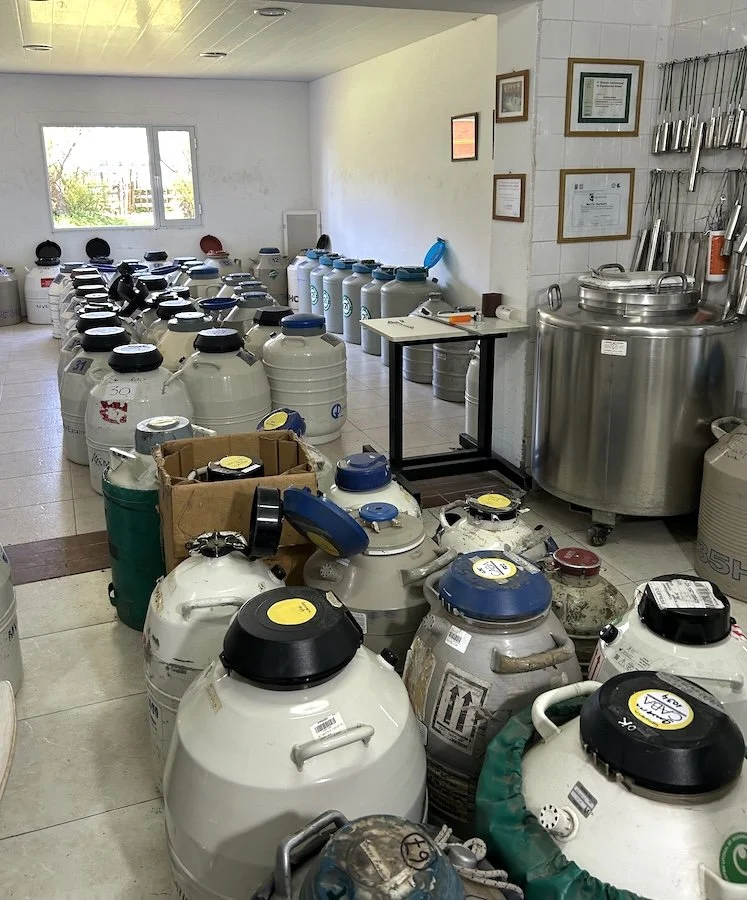
Dr. Martín Narbaitz processing semen at his CABA facility

Dr. Narbaitz has a special place in his heart for Shorthorns which was obvious to us even before we arrived in Argentina. Despite his involvement with many other cattle breeds through his cattle reproduction center, Shorthorns are a priority with him. Eventually his son, who is also a Veterinarian, will be joining him at CABA as they move into IVF embryo production.
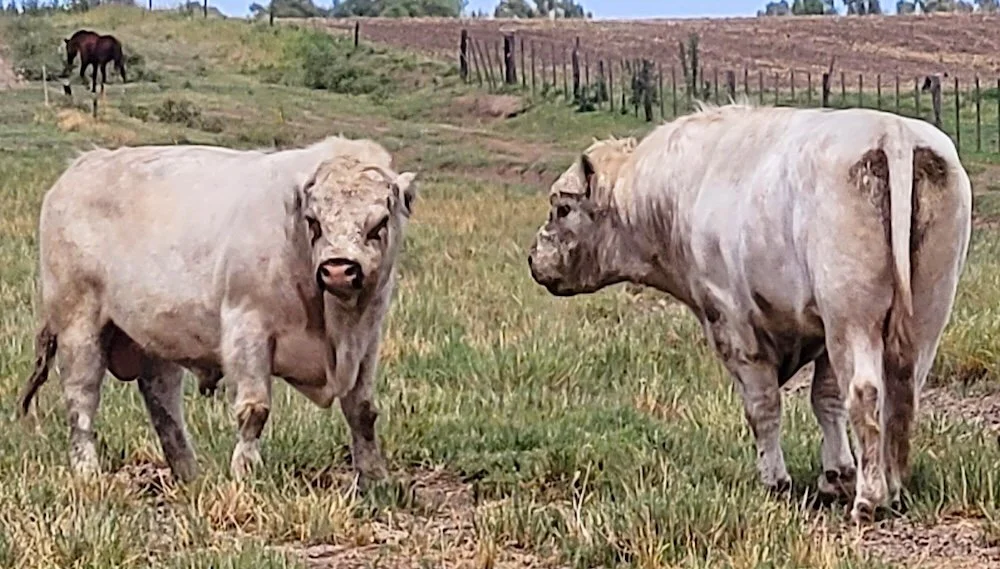
Full brothers out of Kinnaber Leader 9th

At the time we were at CABA there were 90 different bulls being collected. He travels extensively throughout Argentina working with many different cattle breeders to improve their herds. His wife, Monica, handles most of the paperwork for CABA, of which there is a large amount due to the government system in Argentina. Monica is fluent in English and she was very generous with her time in showing us various highlights of the Carhue area. Dr. Narbaitz is quite familiar with Heritage Shorthorns and has such Heritage Shorthorn bulls as Kinnaber Leader 9th, Mandalong Super Flag, Stonmour Thunder Cloud, and Lone Pine Grand Society in his Heritage Shorthorn semen inventory. He maintains that older Heritage Shorthorn genetics are far superior to Modern Shorthorns for many reasons. More importantly he sees Heritage Shorthorns as an important avenue to enhance the diversity in the Shorthorn population in Argentina and to fortify the positive traits that exist in Argentine Shorthorns. Heritage Shorthorns dovetail with the grass fed cattle management systems in Argentina that are the basis of their cattle industry.
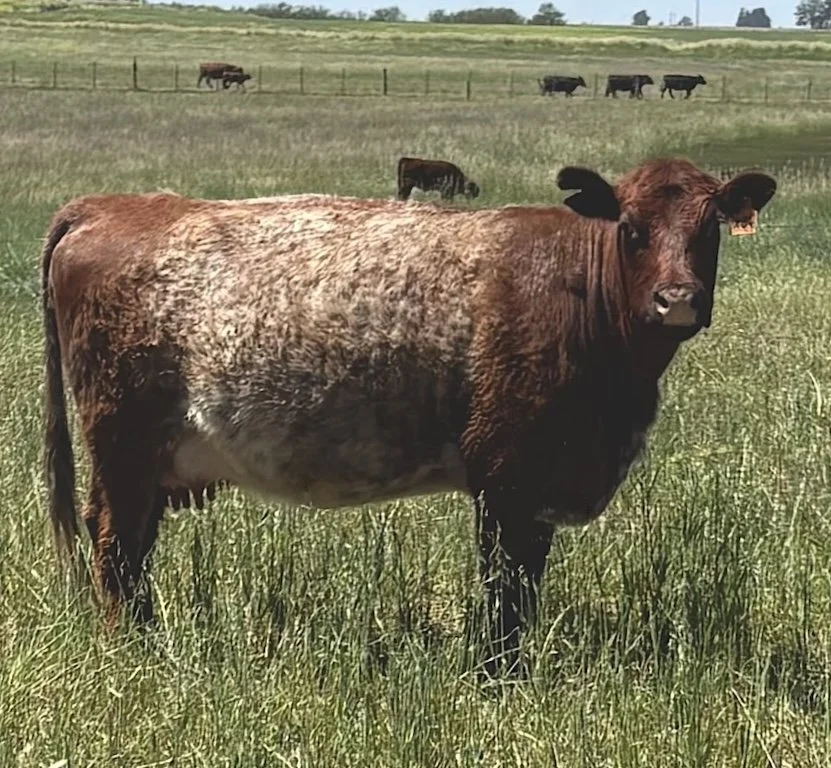
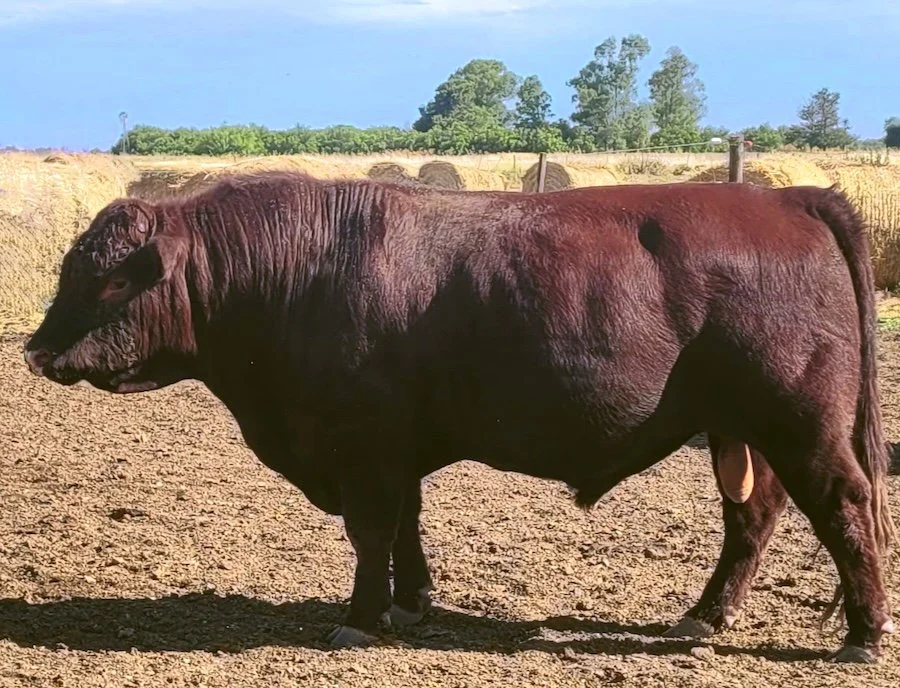
Son of Top Hill Ensign Viscount 23 (Argentine bull born 1970)

Presently Dr. Narbaitz has a small Shorthorn herd (90 head) since his other time commitments limit how much time he can spend on his Shorthorn herd; however he is slowly building it up with older Heritage Shorthorn genetics. He uses timed AI to breed most of his cows which gives him various options to upgrade and strengthen his Shorthorn herd. Most of his calves are sold at weaning. He sells 40-50 Shorthorn and Angus bulls each year. He has used Kinnaber Leader 9th extensively in his breeding program with excellent results. Presently he is producing embryos sired by several Heritage Shorthorn bulls all of which were previously mentioned.
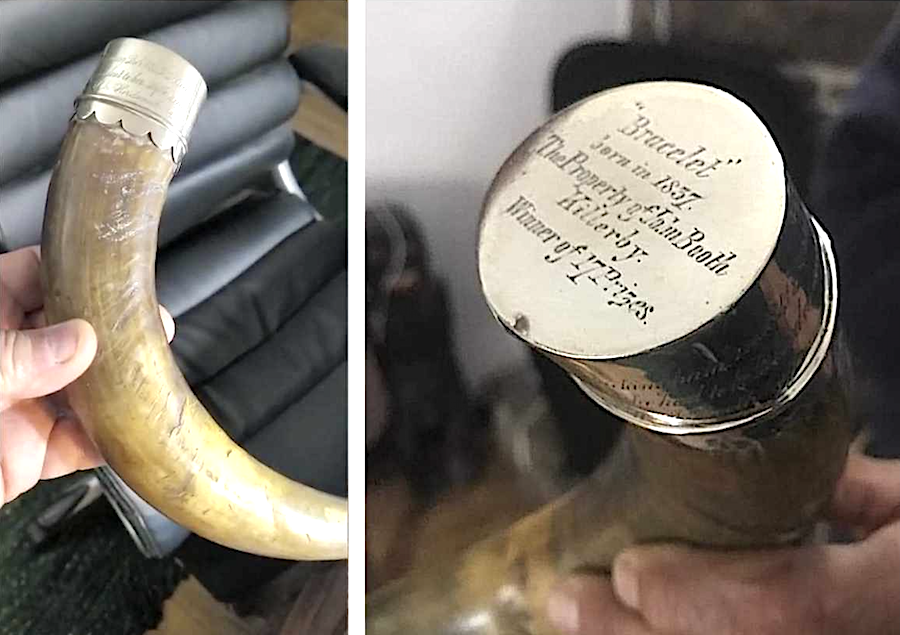
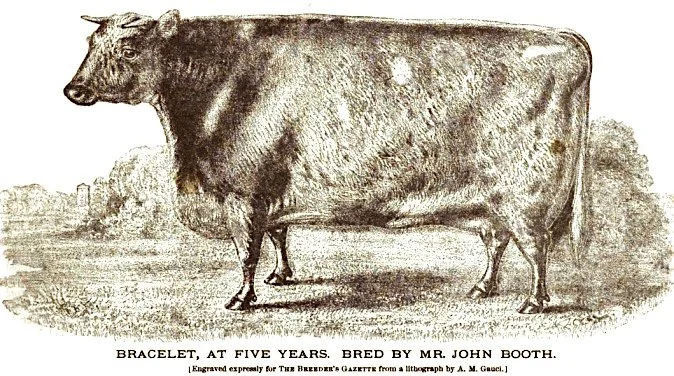
Undoubtably the biggest historical surprise of our trip to Argentina occurred at CABA when Dr. Narbaitz came out of his office with an original horn from the famous Bracelet cow born in 1837. Bracelet and her twin sister Necklace are two of the most famous and influential cows in Shorthorn history. Their story is on the HSS website in the Historical Shorthorns section (Prior to 1890). Bracelet was actually euthanized in 1845 because of a severe knee infection. How the horn ended up in Dr. Narbaitz’s possession is interesting in itself. Reginald Booth, a decendent of John Booth the breeder of Bracelet and Necklace, came to work for the Lahusen family in Argentina in the early 1900’s bringing the horn with him. Through other family connections the horn ended up with Mailhos family in Brazil. Early on they raised Shorthorns, but in the 1990’s they left Shorthorns and currently raise Angus and Herefords. Dr. Narbaitz was invited to give a talk at the Mailhos ranch in Brazil two years ago. The family, knowing of Dr. Narbaitz’s intense interest in Shorthorns, presented him with the horn.


3. Julio Gonzales

Ranch: Cabaña El Cencerro Carhue, Argentina
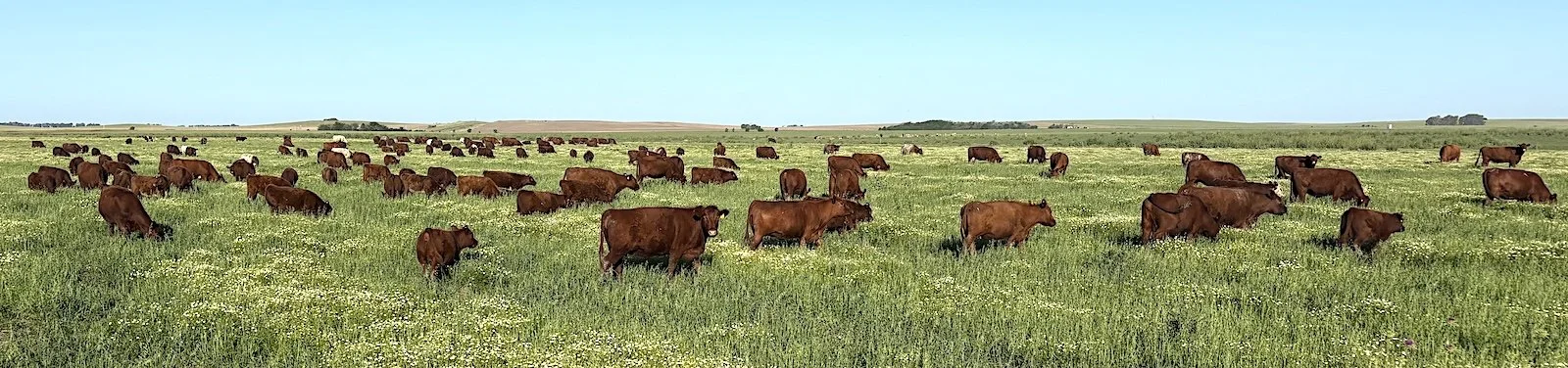
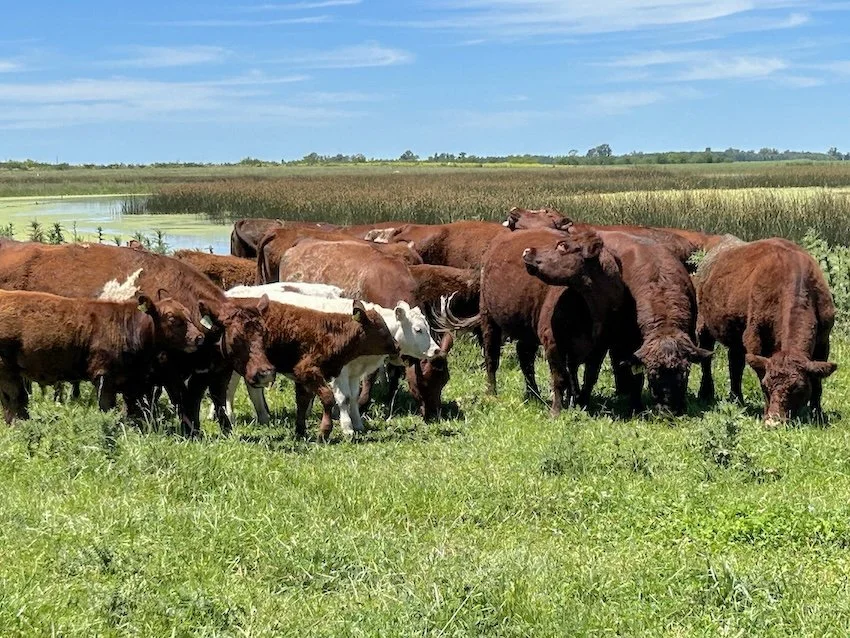
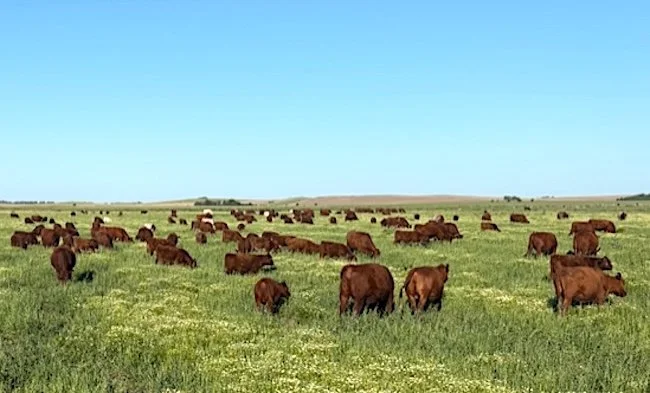
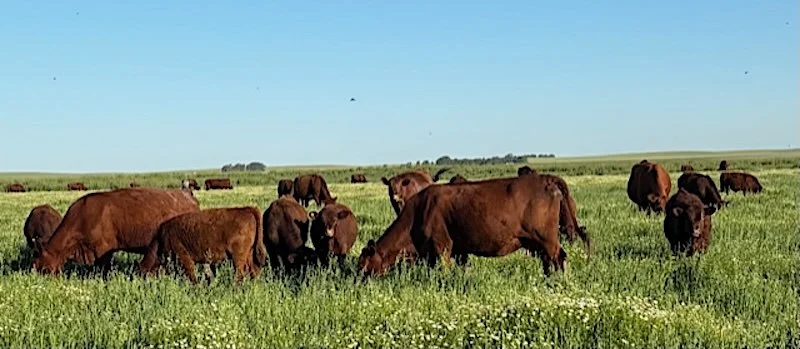
Julio Gonzales has raised Shorthorns for almost 50 years with an emphasis on the commercial side. He prefers a compact, smaller framed animal because of his commercial market. His cows are mostly red and are very similar with level tops, significant depth, and good thickness in their rear quarters. The group of 300 cows we saw, with calves at side, were an excellent group. The thickness in the calves, along with wonderful style, was striking. Also the consistency in his herd is a tribute to Mr. Gonzales’ selection methodology. He does not sell Shorthorn breeding stock. Several of his bulls harken back to the old time Shorthorns in the USA, but instead of being fat, they have muscle which makes a huge difference in carcass yield. The area where Mr. Gonzales pastures his herd has a very sandy soil much like the sandhills of Nebraska. The wear from the sand on his cattle’s teeth does not allow many of his productive cows to get past 10 years of age before it is necessary to cull them.
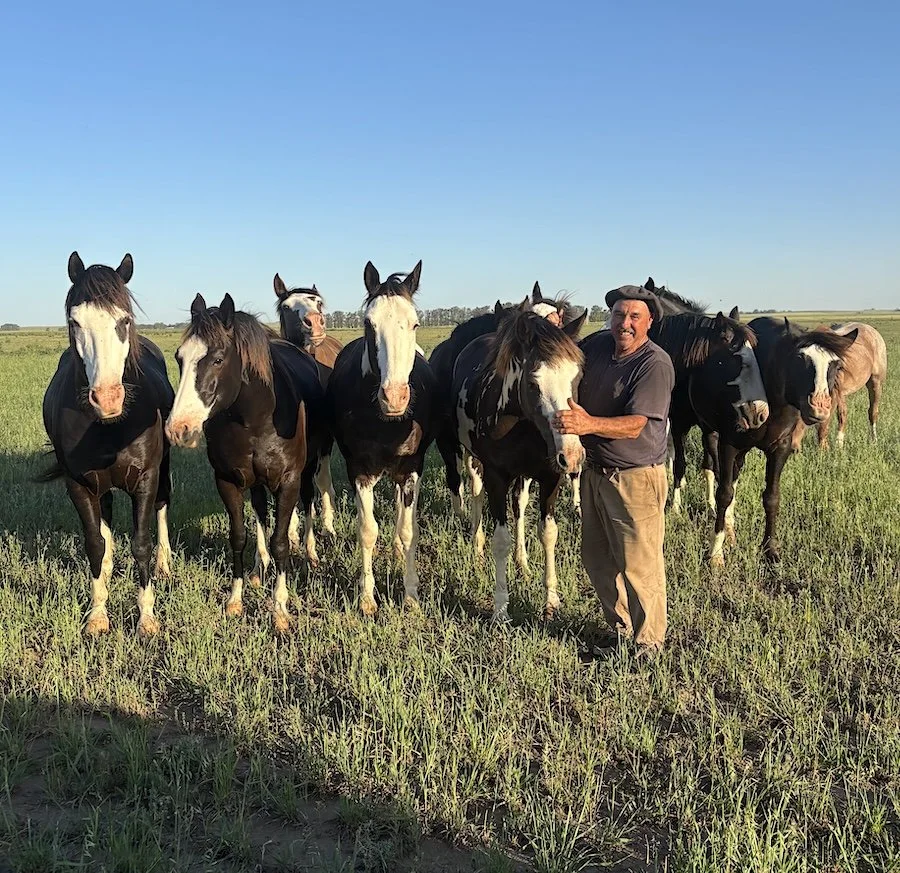
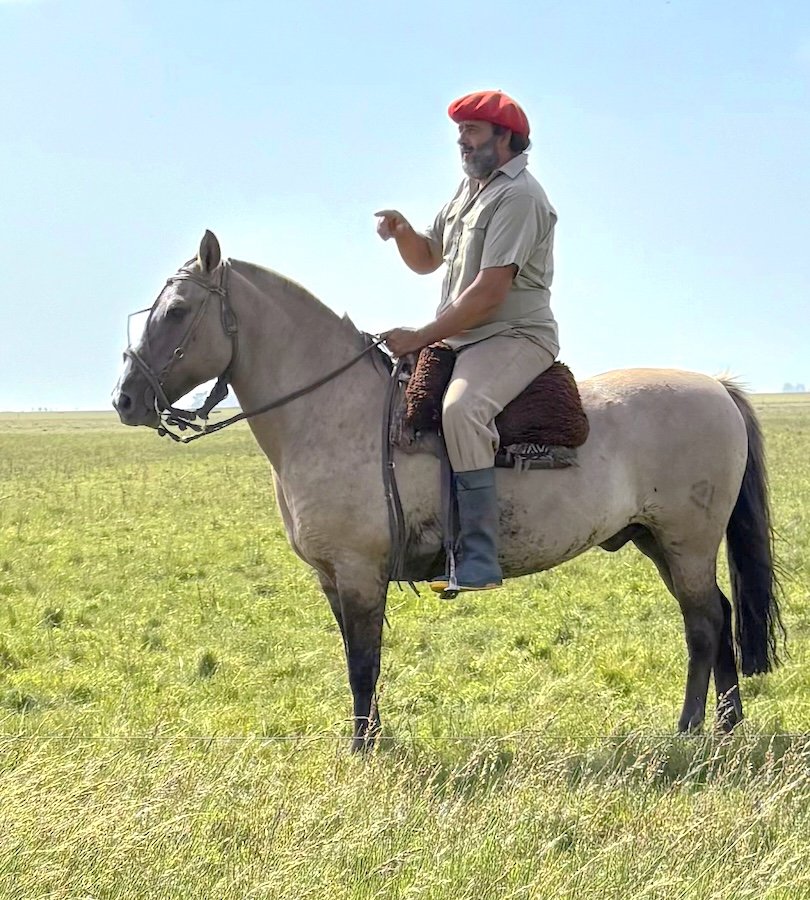
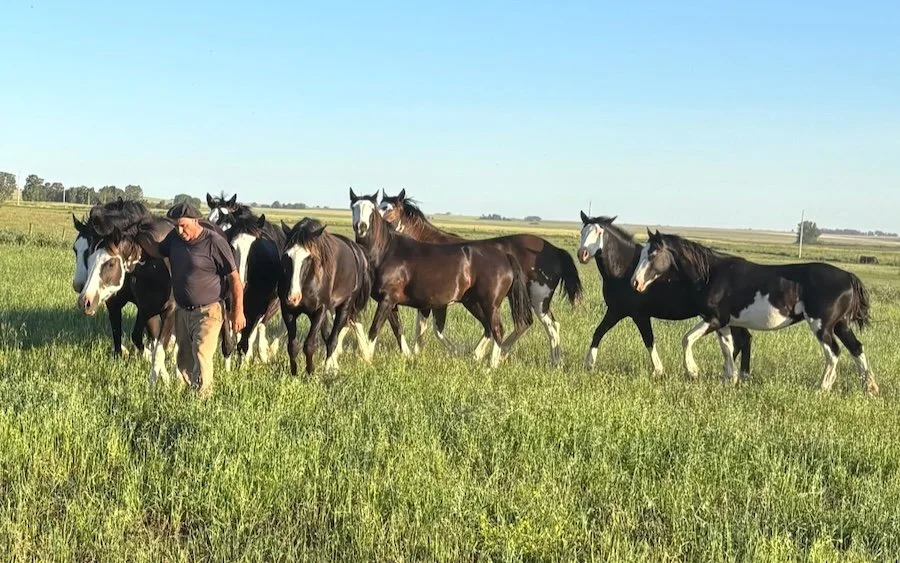
Julio with some of his Criollo horses

He also raises Criollo horses (40) that many say are the finest in Argentina. It is the native horse of the Pampas and has been the main horse used by gauchos in Argentina. The breed dates back to an importation in 1535 of purebred Andalusian horses into Buenos Aries. Eventually they were released into the wild and the horses became feral. In the 1800’s people began capturing them to use on their ranches. They became known for their long distance stamina because of their low basal metabolism—an ideal mount for the gaucho working with cattle. Criollo horse breeders in Argentina have very strict standards they use in maintaining and promoting the Criollo breed. When you see them in person they are amazing looking horses.


4. Dr. Hector Montero & family

Ranches: Cabaña El Campito (main cow herd) Bordenava, Argentina
Cabaña Los Olmos (bulls & finishing steers
Cabaña Don Alejandro (cows)
Cabaña El Canador (cows and heifers)
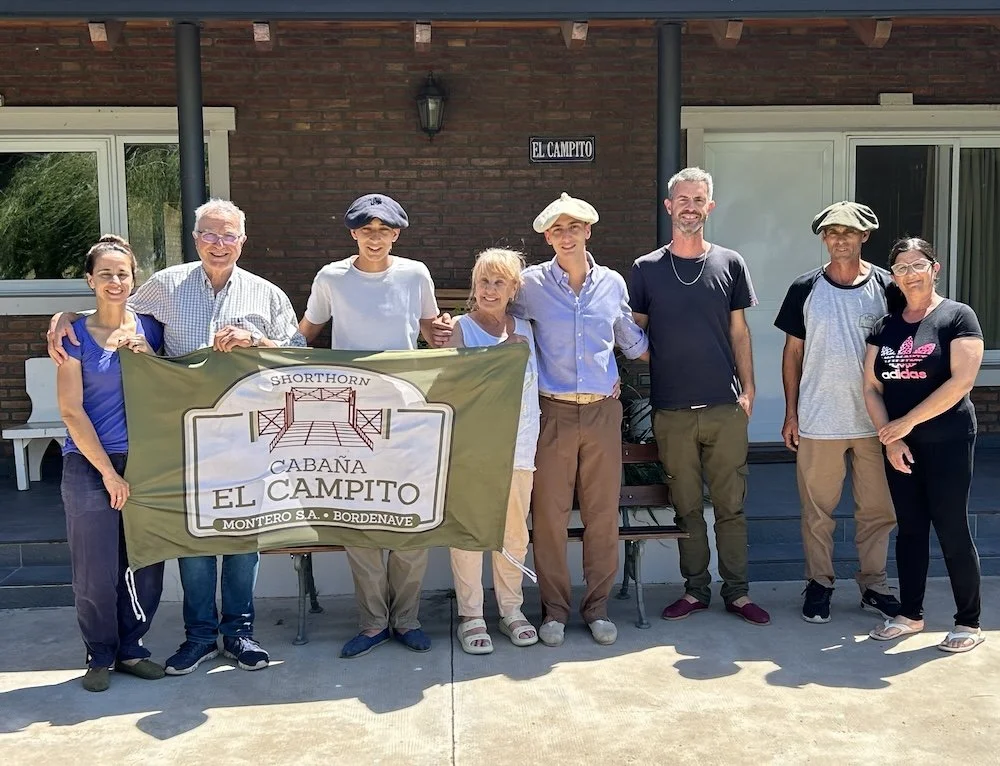
Dr. Hector Montero (on left) and family

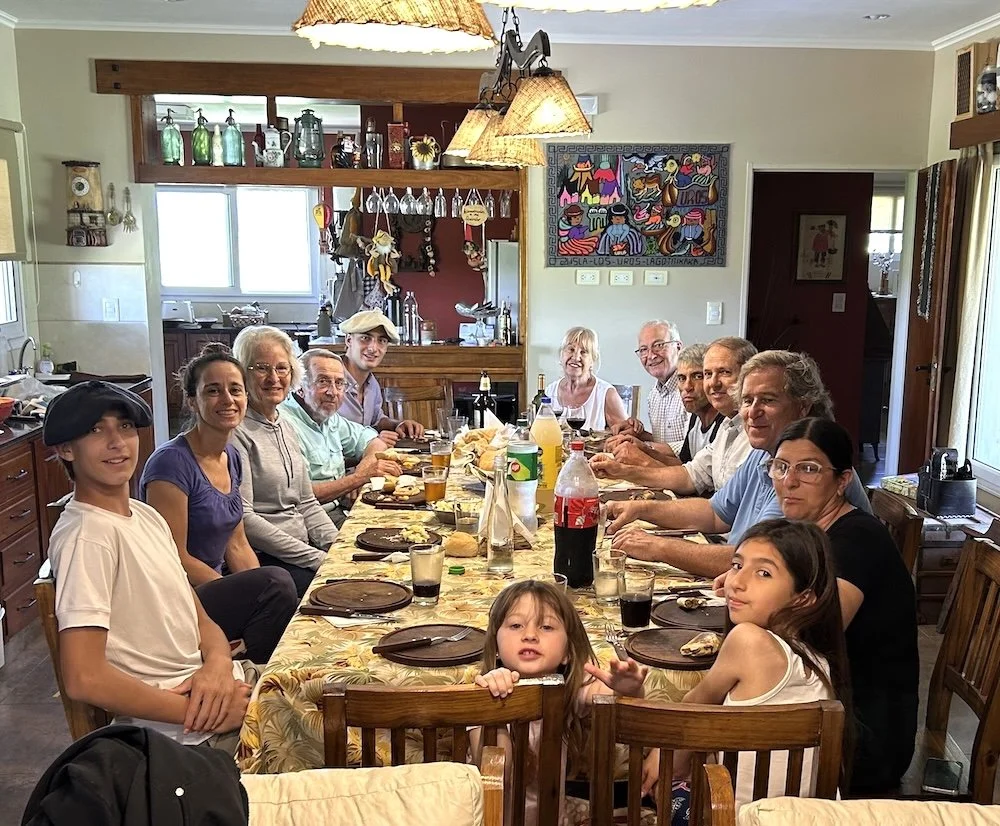
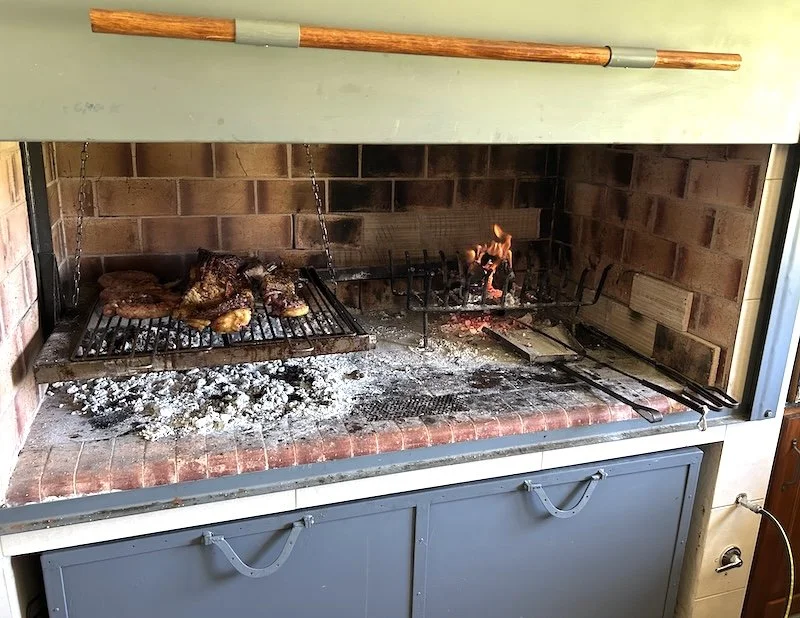
Dr. Montero is an Obstetrician by trade. His family has been raising Shorthorns for over 100 years. Several sons are involved with the cattle operation, and a daughter is a Veterinarian. When we visited their “El Campito” Ranch, the Montero extended family treated us to a delicious traditional asado (BBQ) meal of roasted beef, sausages, salads, and additional side dishes.

Dr. Montero owns about 2300HA with the land divided into 4 different ranches that are overseen by different managers at each Cabaña. He has over 1000 Shorthorn cows and has a progressive overseer that helps to coordinate everything and keeps excellent computerized records on the herd.
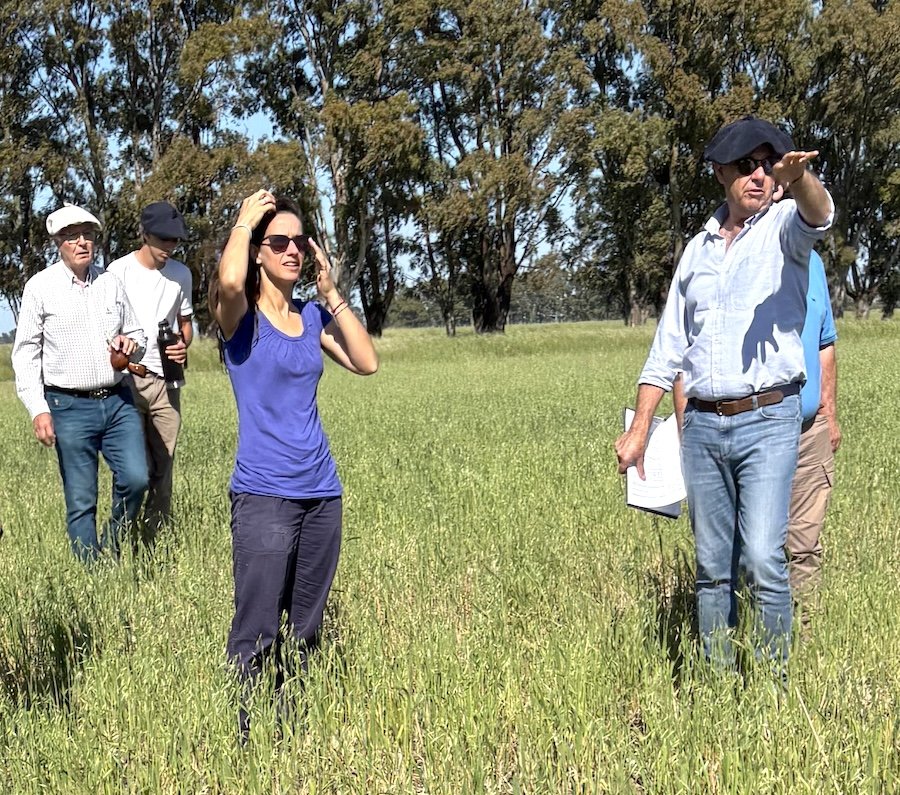
Dr. H. Montero (at left), a grandson, his daughter, and their herd manager (On Rt.)
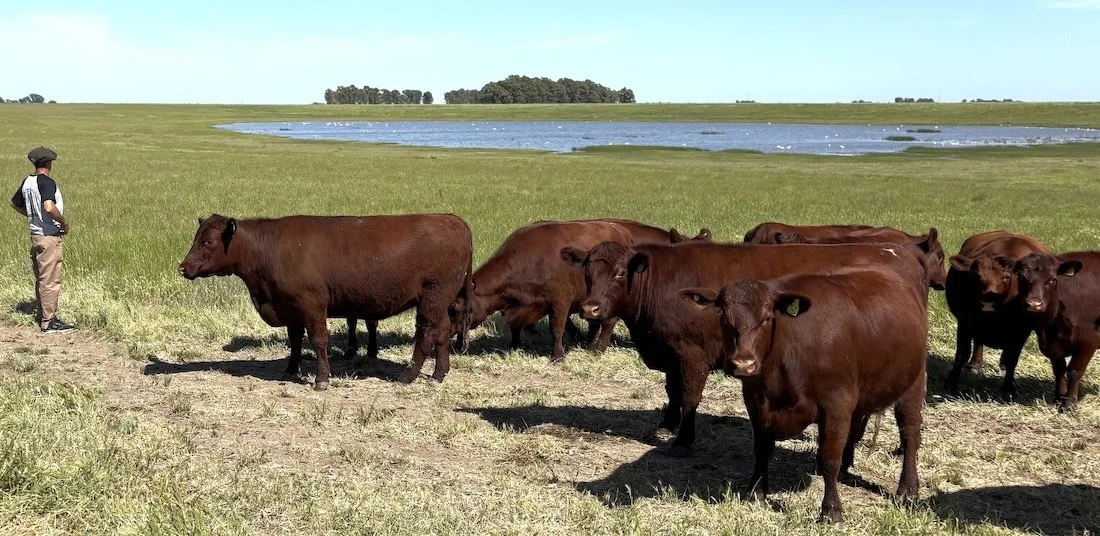
They constantly strive for improvement in the herd by experimenting with different breeds to maximize hybrid vigor, meat quality, growth rates, and weaning weights. Their in-house system is what EPDs were originally designed to do—compare animals in a herd being raised under the same environmental and management system, rather than simply used as a marketing tool with no real relevance in other herds. We viewed their records and they were quite impressive. We saw a large group of replacement heifers which epitomized what a good group of Shorthorn heifers should look like. There was tremendous consistency in the group and they perfectly fit the type of cow that Dr. Montero seeks to produce.
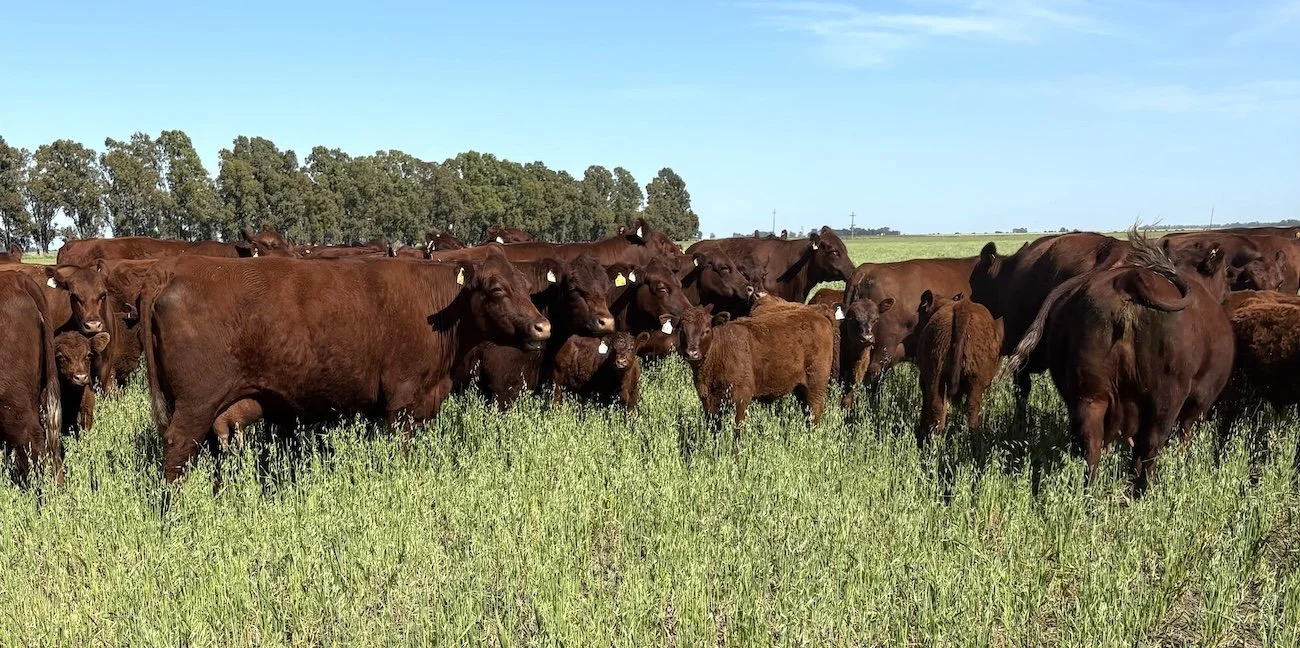
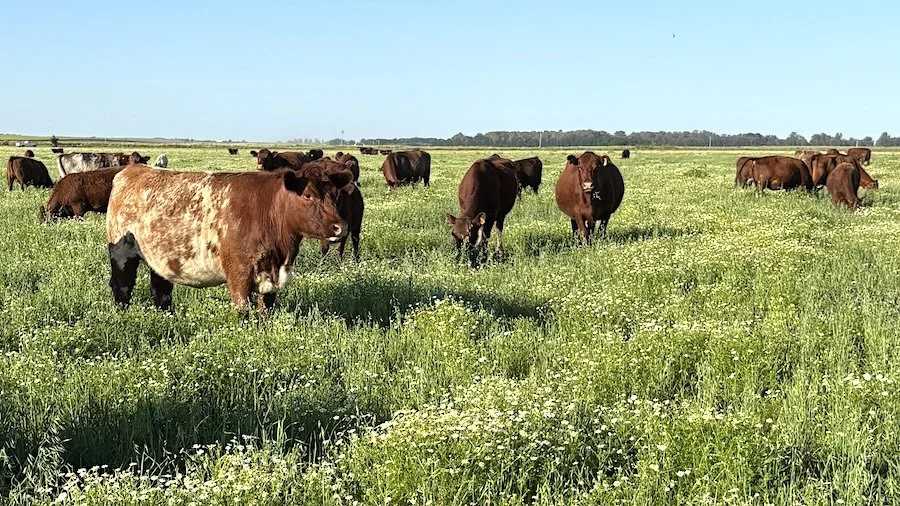
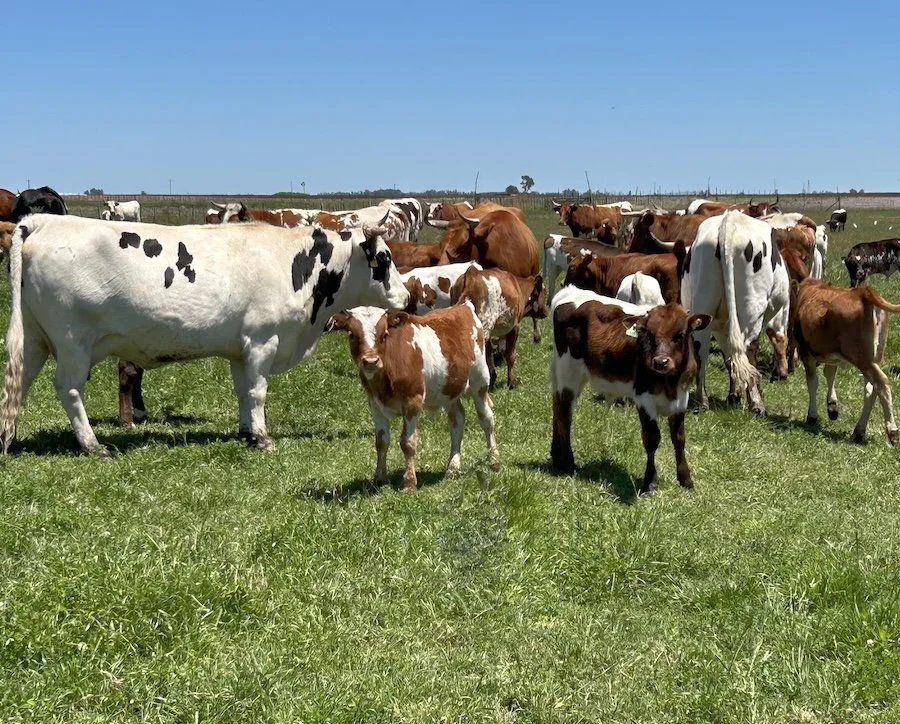
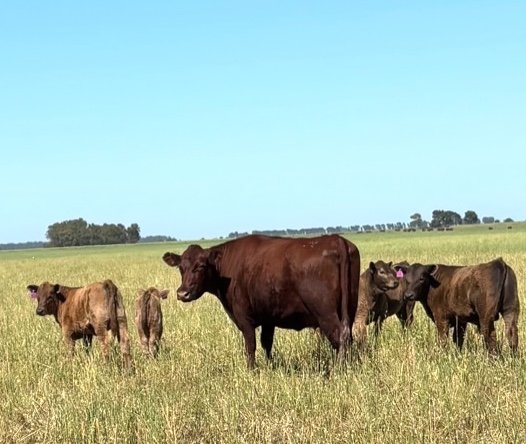
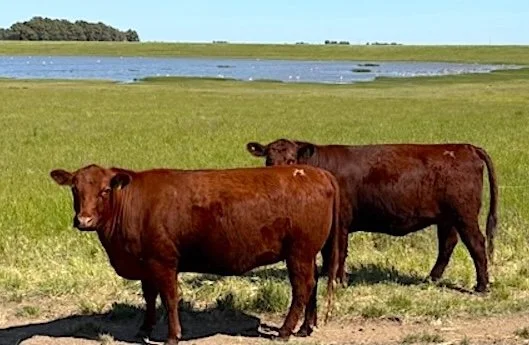
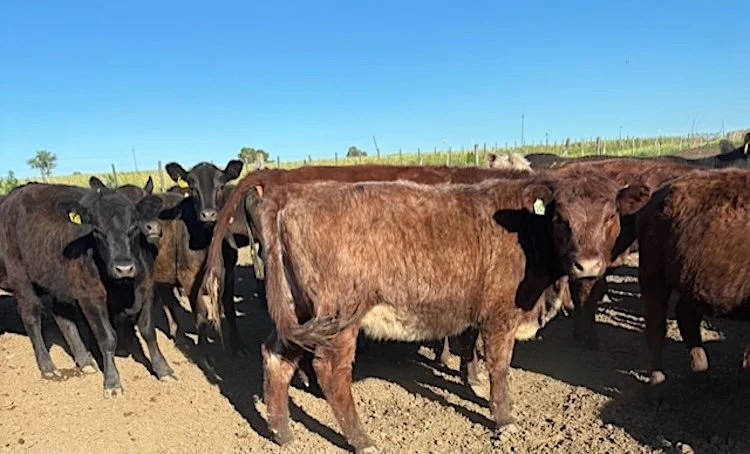
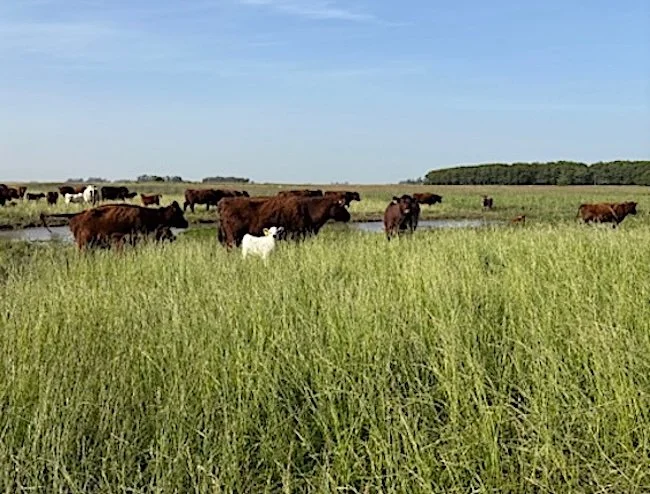
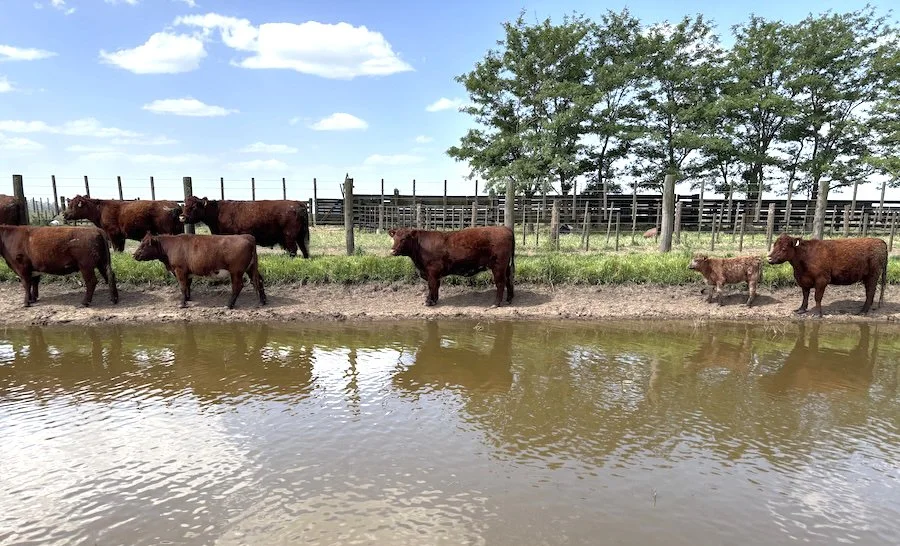
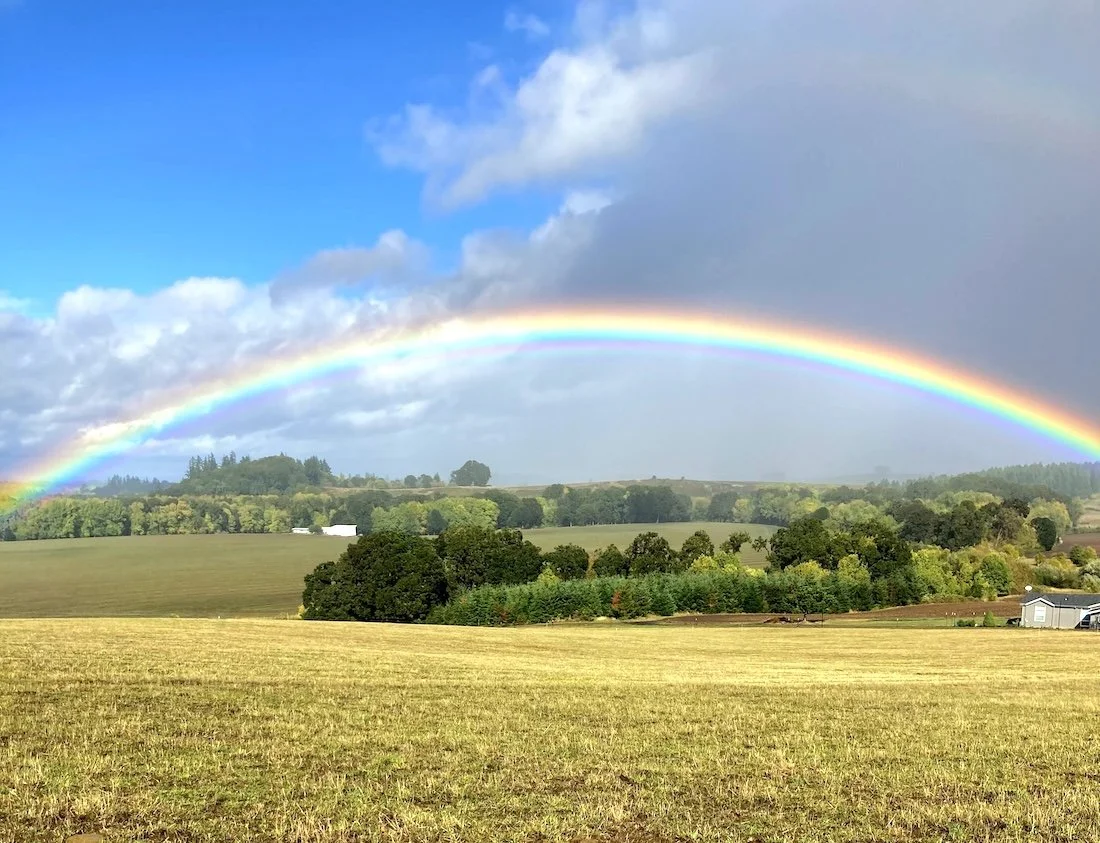
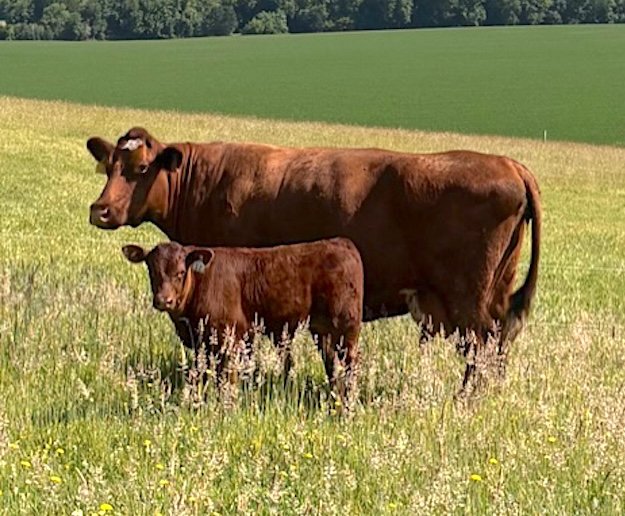
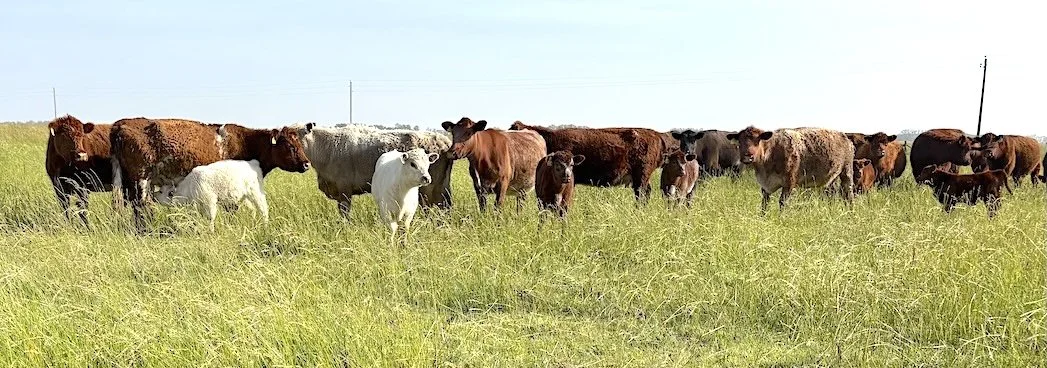
Cows & calves at Cabaña “El Campito”. (See also the picture just below the title at the top of this article).

They are currently experimenting with Australian Murray Greys through crossbreeding to produce higher quality, faster growing steers. Because of our lack of information on Murray Grey’s we did some research on Australian Murray Greys when we got home. Several things stand out on the Australian Murray Grey website. Murray Greys have many positive traits that could be useful through crossing with Shorthorns. One interesting fact about the Murray Grey breed association in Australian is they have utter distain for the whole EPD/EBV marketing gimick. Instead they use an on-farm evaluation system specific to each individual farm. That allows a buyer to compare management systems and find breeders that are similar to their own management, increasing their chance of success. There is no question Dr. Montero understands that the individual herd approach is far superior to the marketing ploy of many breed associations that “compare apples to oranges”.


5. Joaquin & Fermin Echazarreta (Brothers)

Ranch: Cabaña La Balbina de Echazarreta Tandil, Argentina
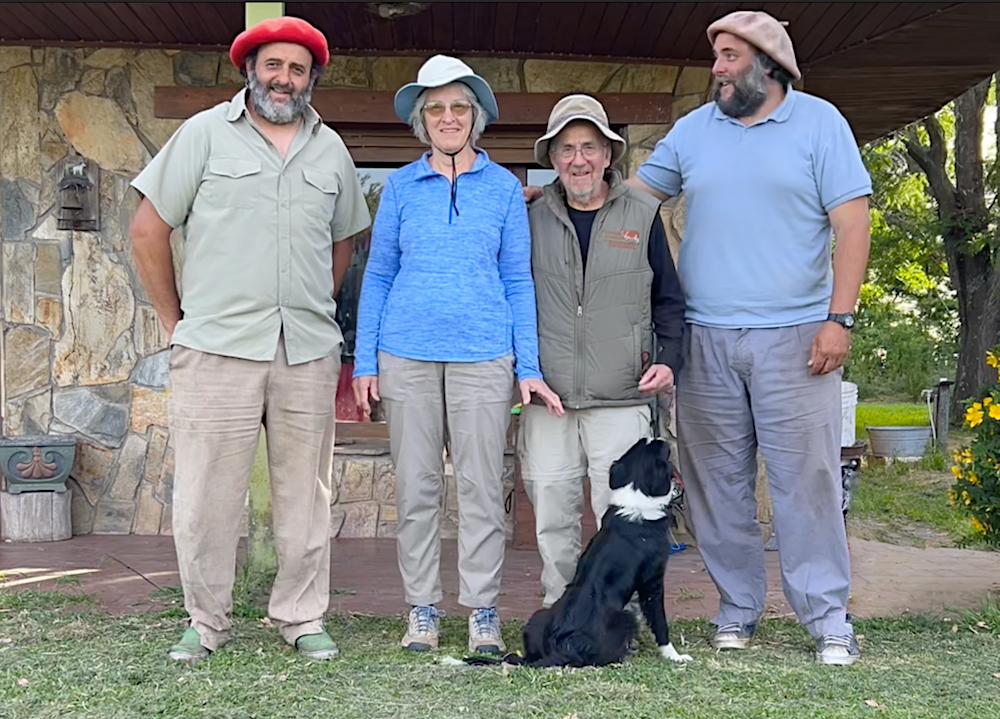
L. to Rt.: Fermin Echazaretta, Sue & Joe Schallberger, Joaquin Echazaretta

The Echazarreta family have raised Shorthorns for over 130 years and have been a mostly closed herd using their own home grown bulls to maintain both the purity and the phenotype that they desire for their commercial meat business which includes the making of several different types of sausage as well as various cuts of meat. They strongly believe in the grass fed model and believe their Shorthorn herd maximizes the potential when it comes to producing quality beef. They operate a fully integrated Shorthorn business that incorporates the production of grass fed Shorthorn beef with their own processing plant and their own meat shops. They also engage in several other farming endeavors which balance their cash flow.
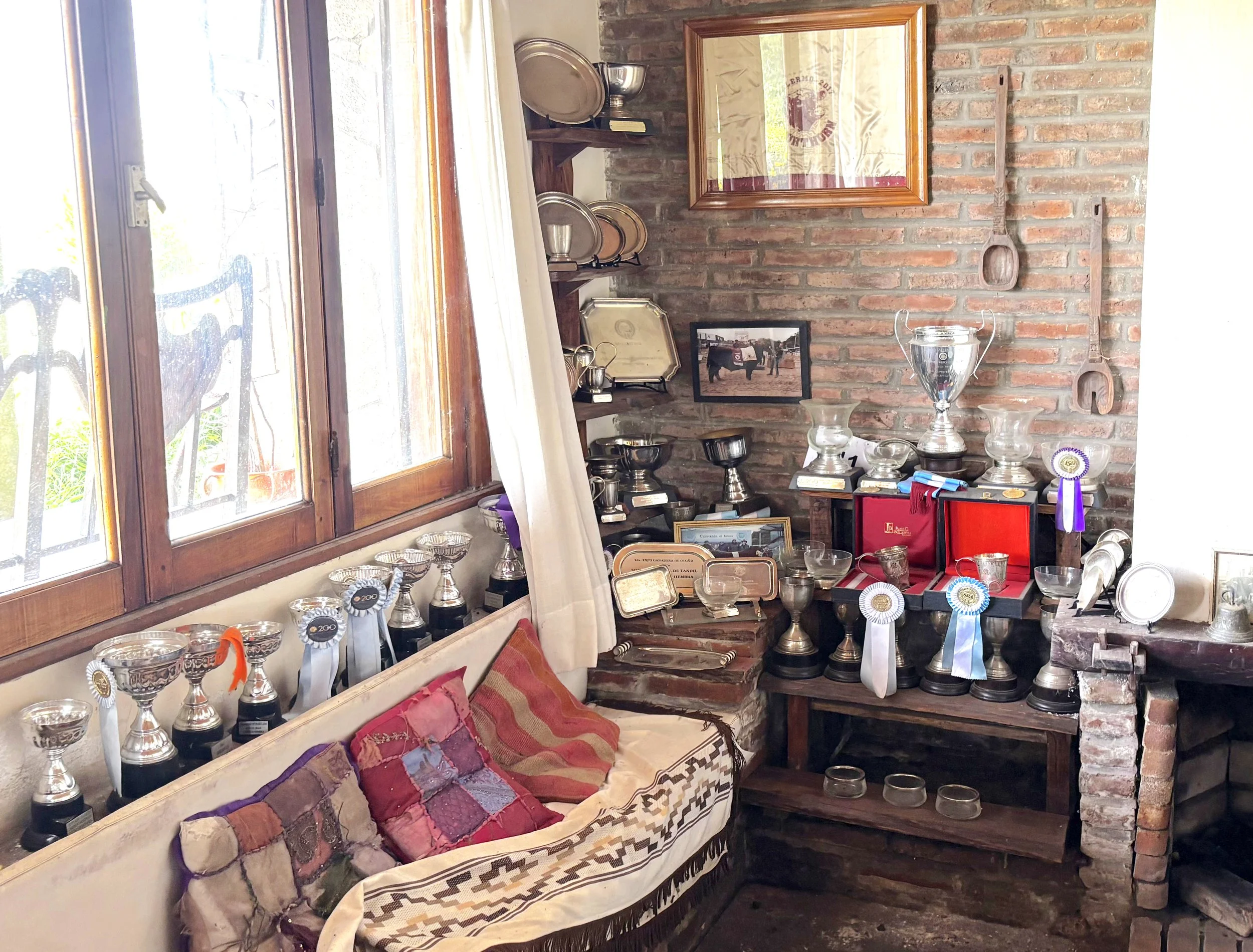
Some of the family’s Shorthorn trophies

Their cow herd numbers 400 and they are pastured on 500 hectares. The Echazarreta family only raises Shorthorns. They have often shown their Shorthorns at Palermo (with much success over the years). The Palermo livestock show has taken place in the greater Buenos Aries area every year since July, 1875. Joaquin said the Shorthorn show placings have started to move in the direction of Traditional Shorthorns as the interest in that type of Shorthorn mushrooms worldwide. Joaquin made it perfectly clear that his family has absolutely no interest in the Modern Shorthorn genetics that are promoted in the USA.
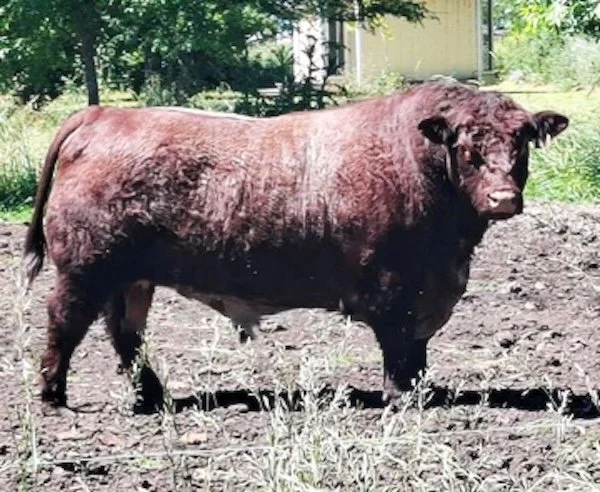
Echeza x105 CHÑ 52 “Gorrion”, 3rd Place Champion bull at Palermo National show in July 2025
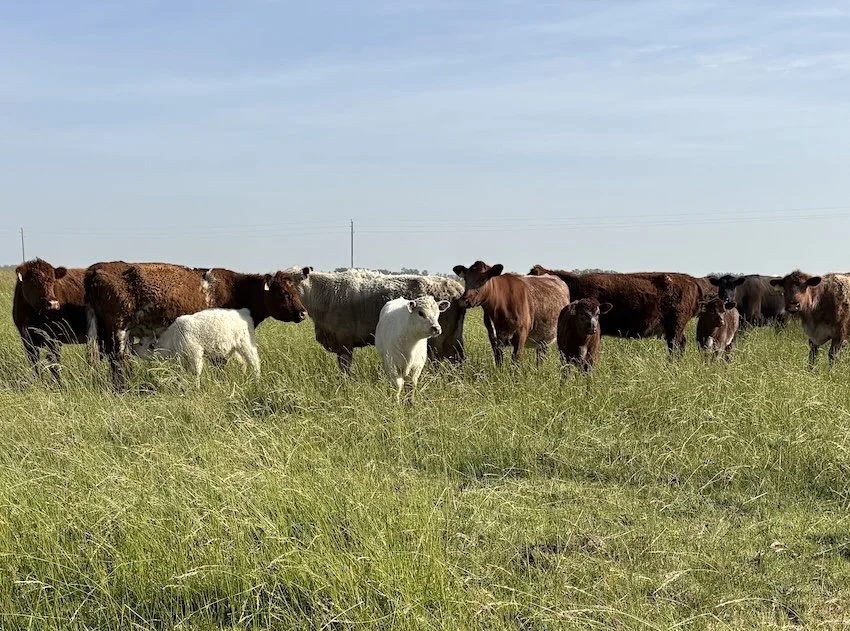
Like many long established livestock families in Argentina the Echazarreta cattle business is a family operation. For instance their diversified meat market in Tandil, which we were privileged to visit, has a family member running it and other family members are involved with advertising and marketing. It is a terrific outlet for their grass-fed beef. We were impressed by the marbling we saw in the different cuts of Shorthorn beef that were on display. Also the store displays were very professional along with an attractive exterior neon sign. The fact the meat market is located on a corner in one of the upscale neighborhoods in Tandil (population of 150.000) also helps with their sales.
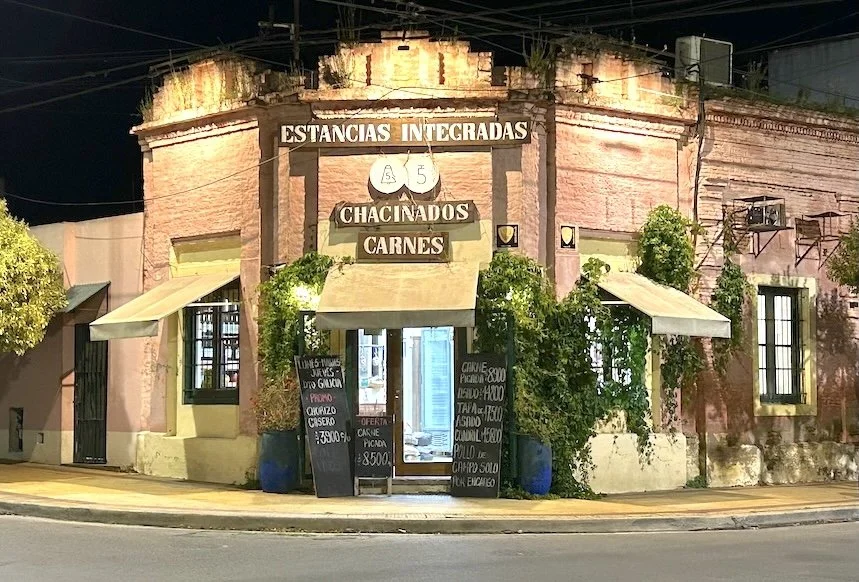
Echezaretta Family Meat Market in Tandil, Argentina
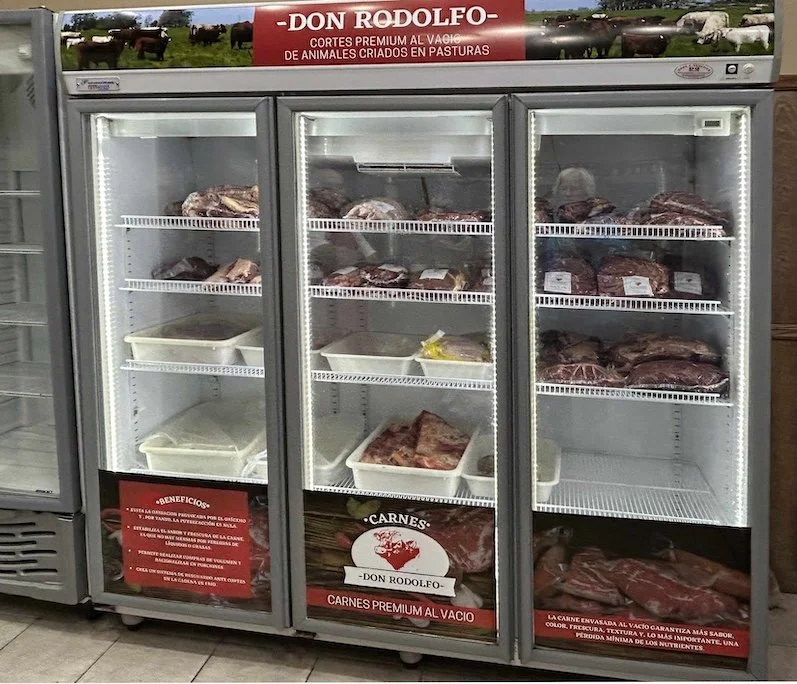
There is no question that the business model of the Echazarreta family has been very successful. Their totally integrated business model gives them better opportunities to control costs and adjust prices instead of being at the mercy of wholesale livestock buyers. The fact they are achieving this in Argentina makes it that much more impressive.


6. Ignacio Landivar

Ranch: Cabaña San Miguel Ayacucho, Argentina
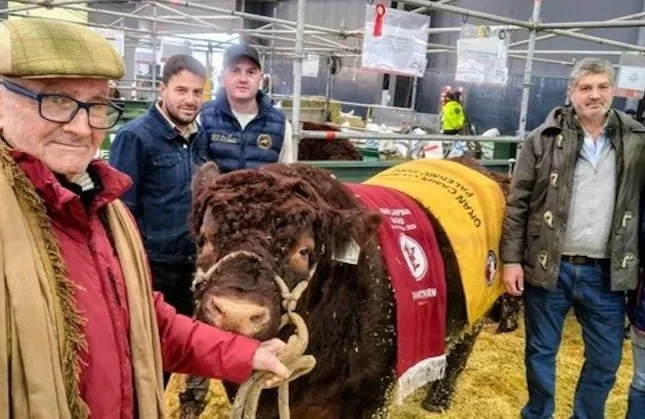
‍ ‍ 3 generations of the Landivars (Ignacio on Rt.) with their family’s Grand Champion bull at National Show in Palermo, Argentina

The Landivars are long-time breeders of Shorthorns and are well-established in the Argentine cattle industry. Ignacio has managed the herd for a number of years. They have had a mostly closed herd by utilizing their own bulls; however Ignacio is dedicated to gradually improving his Shorthorns by utilizing traditional Shorthorns via artificial insemination and embryos. He works closely with Dr. Narbaitz in trying to improve his herd. He is not as dedicated to the red color as many Argentine Shorthorn breeders, which further indicated his desire to improve the genetics of his herd without the constraints of just solid red. He mentioned some of the problems associated with the introduction of Lincoln Reds into the Argentine herd book that have cropped up in his herd that he is diligently working to eliminate. He listened attentively and asked many questions as different aspects of older Shorthorn genetics were discussed. He is meeting the challenge all Shorthorn breeders face: retaining and enhancing the positive traits of the breed while confronting the environmental challenges which can disrupt any cattle operation.
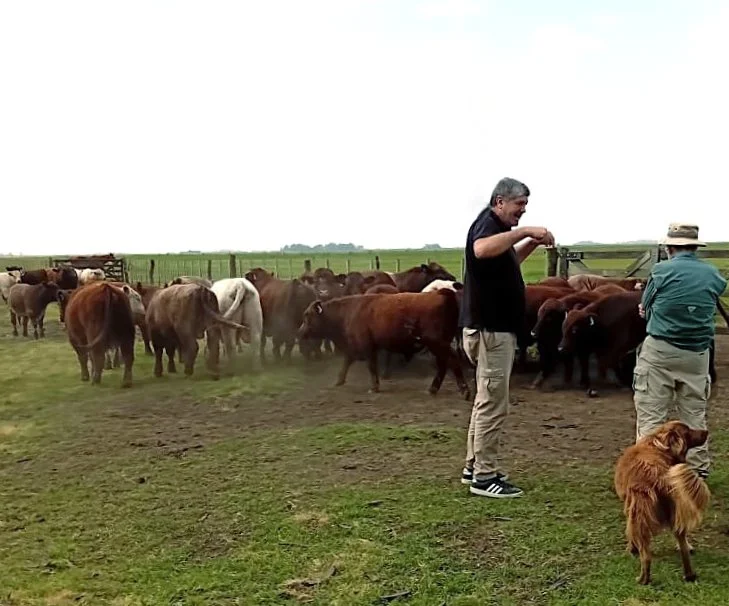
Ignacio with yearling bulls
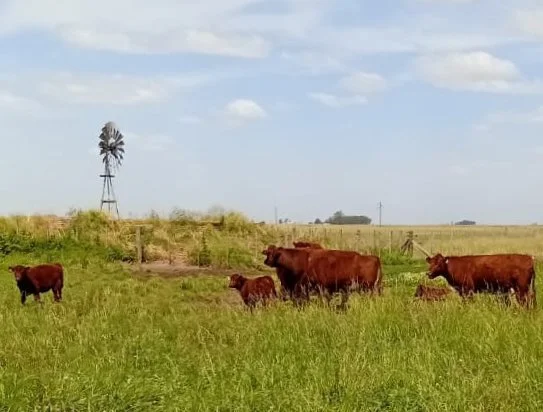
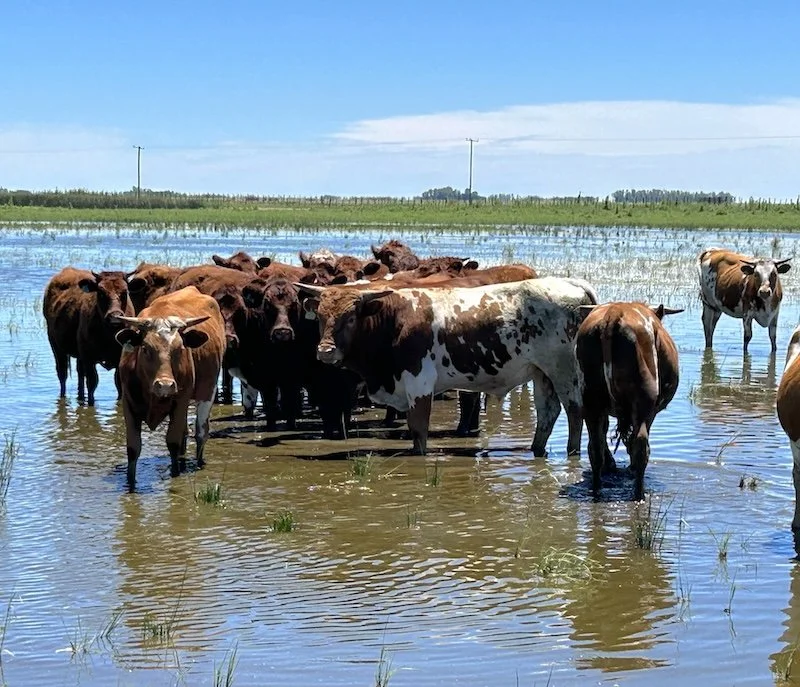
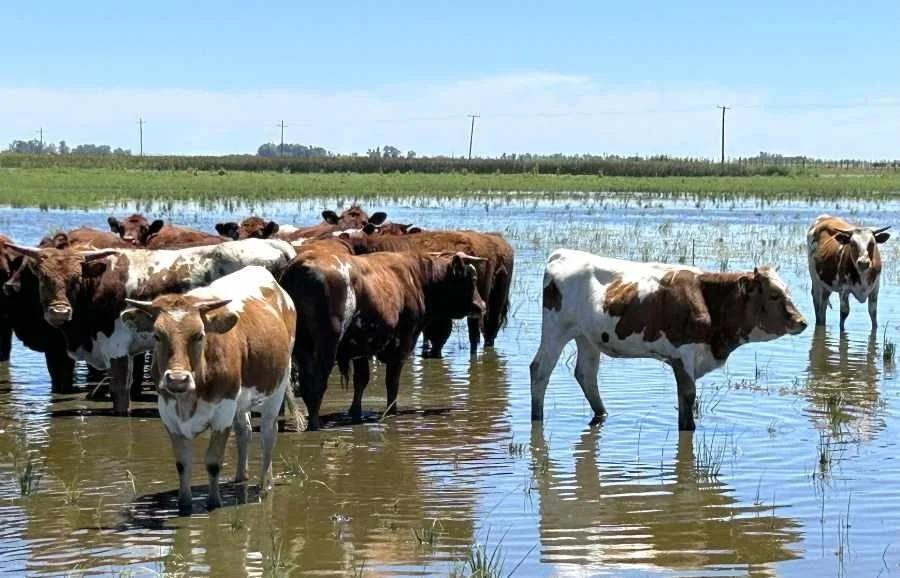
He has approximately 380 cows on 400 hectares of pasture, and also grows corn and winter greens. Unfortunately because of the marshy conditions from this year’s heavy spring rains & flooding, it was difficult to see all of his herd up close even though we were in a 4-wheel drive vehicle. He indicated that calving had been tough this spring, which was understandable. It speaks well to his breeding program that his Shorthorns looked so good despite the difficulties they had faced due to the weather.

There were many outstanding individuals in his cow herd that anyone would be proud to own. Like most of the Shorthorn calves we saw in Argentina, Ignacio’s calves had the thickness and muscling that everyone is looking for. He sells both finished steers and bulls through different marketing outlets.

He values cows that are fertile and do well just on pasture. He also values longevity and told a story about a bull that had been bred and used by his father for several years, sold to additional Shorthorn breeders, and then was again up at auction at 17 years of age. His father recognized the name of the bull and of a prior owner, and was astounded that the bull was still alive. The bull continued to breed cows until he died at 23 years of age.

7. Claudia Cagnoli, DVM PhD
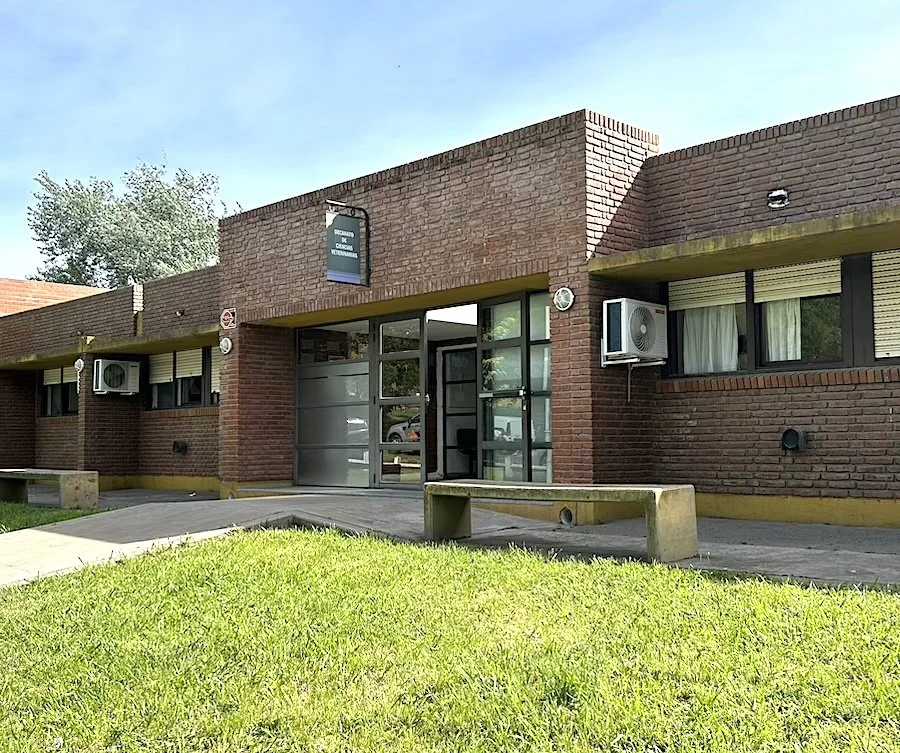
Admin. Building for the Veterinary Department at UNICEN, Tandil

Veterinarian at Facultad de Ciencias Veterinarias Tandil, Argentina
National University for the Central Province of Buenos Aries (UNICEN)

There are 8 Veterinary Schools scattered across Argentina. Dr. Juan Martín Narbaitz made arrangements for us to visit the Veterinary School in Tandil, Argentina. Dr. Claudia Cagnoli was kind enough to give us a personal tour of the many Departments within the Veterinary School.

The Tandil Veterinary School has approximately 1000 students with the full program to become a Veterinarian taking 6 1/2 years. Most Tandil students are involved in Large Animal medicine although there is a booming pet animal practice throughout Argentina. (One of the more common dog breeds seen in Argentine towns were Greyhounds which was very surprising.) A major difficulty for the Veterinary education program in Argentina is tight funding so that the number of faculty at the Veterinary Schools is limited, which also reduces the number of patients being seen at the university hospitals. The diminished staffing for clinical rounds results in limited hands-on experience by the students; however, as always, the dedication of the students and faculty for animal health and welfare prevails over the shortcomings.
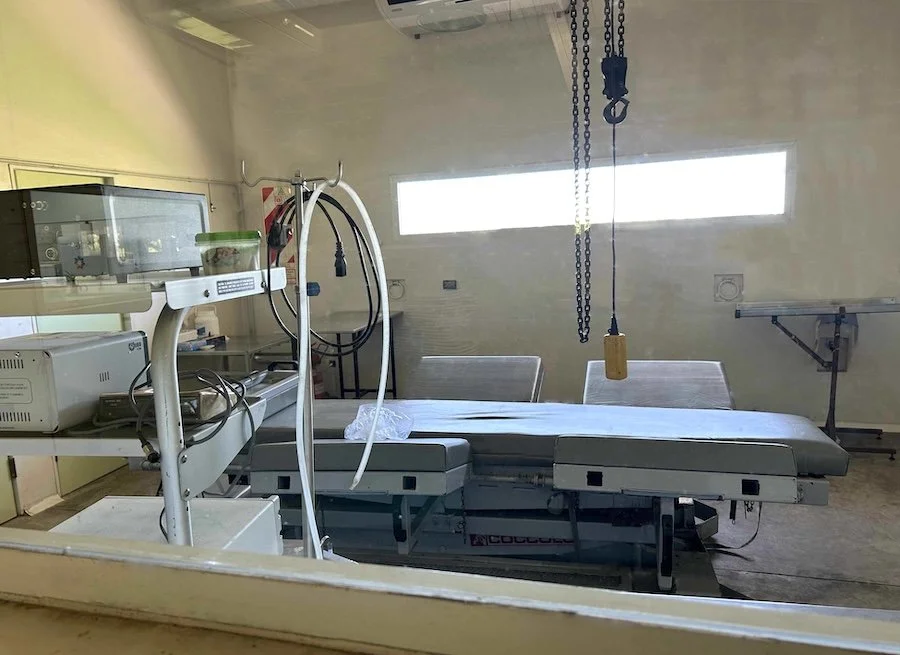
Veterinary School Large Animal Surgery
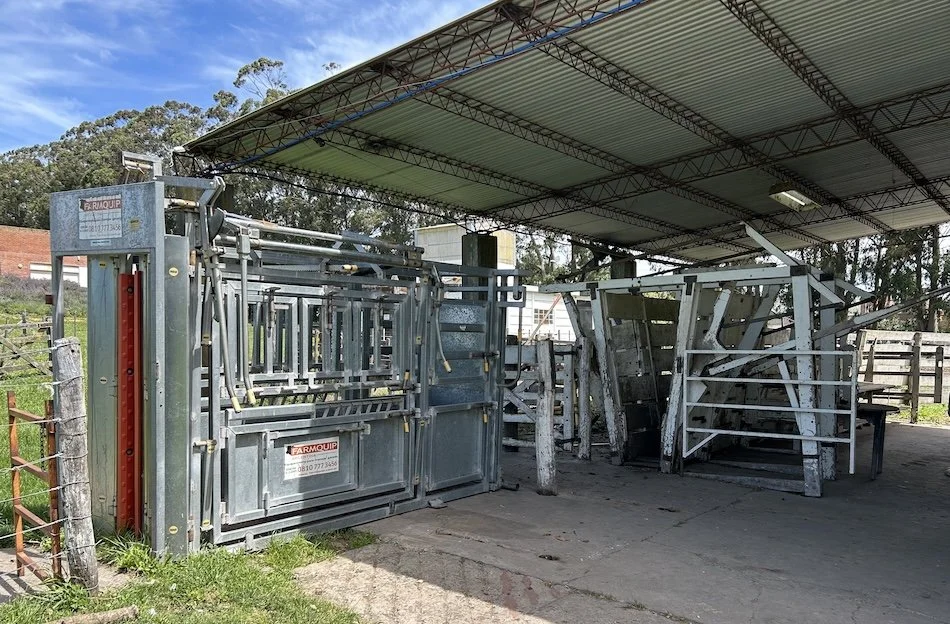
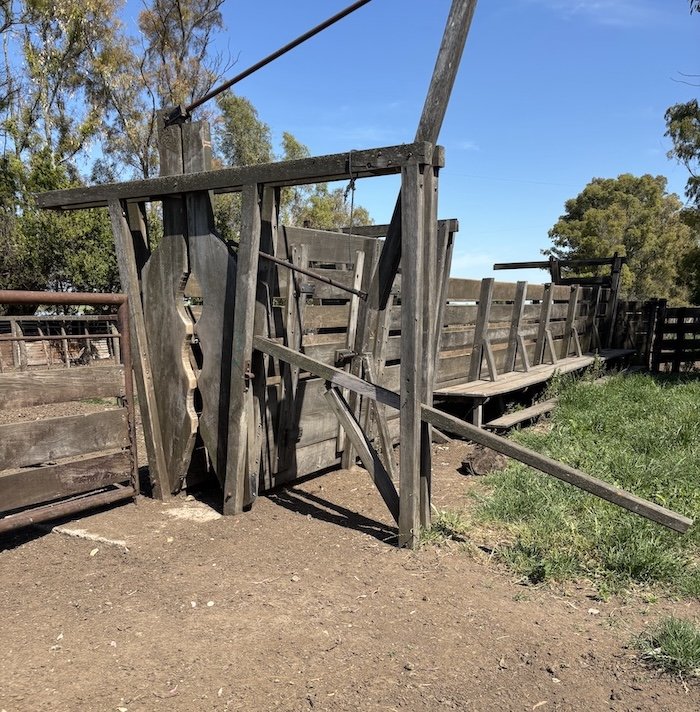
Traditional wooden chute in back, and recently acquired new metal chute in foreground.
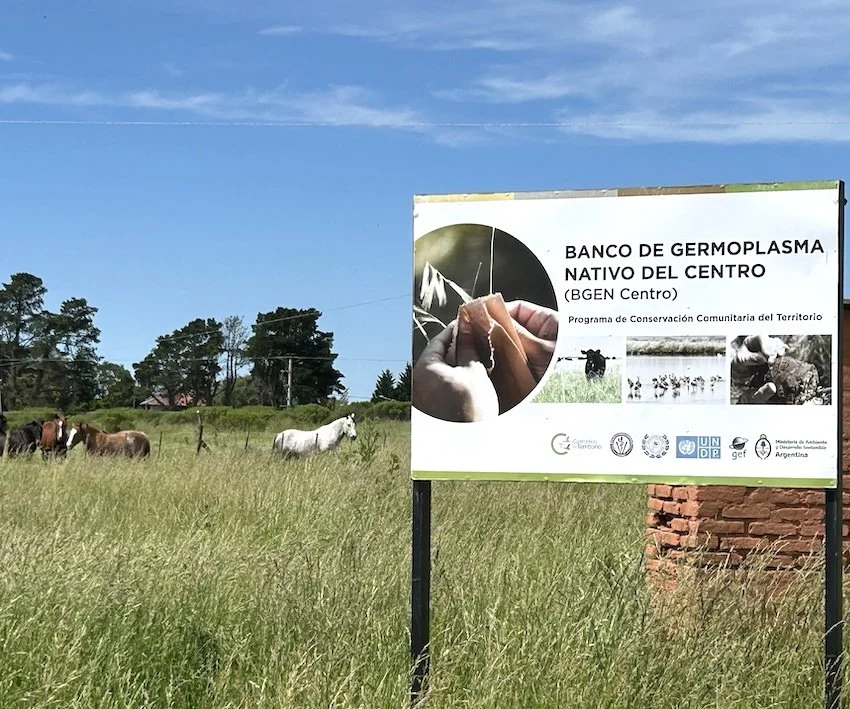
Besides the usual Veterinary Medicine related departments, they also have research programs—one of which is looking at various native Argentine plants which might provide good animal forage with more draught resistance and less need for chemical applications. They maintain a germplasm bank for various Argentine plants.


Post Script:

We were impressed by the quality of Shorthorns we saw throughout Argentina and the dedication of the different Shorthorn breeders we interacted with. They are progressive in their approach to the Shorthorn breed utilizing contemporary technology to produce a better beef animal. When we consider the many different governmental issues they have had to deal with over the years, and must continue to navigate, one has to be in awe of their dedication to cattle raising and to the Shorthorn breed. Hopefully as the latest Argentine government attempts to open up trade opportunities for marketing Argentine beef there will be a new era in the Argentine Shorthorn Industry.

Lastly we want to thank all the Argentine Shorthorn breeders that hosted us over our “Shorthorn Travels In Argentina”. Their kindness will not be forgotten. Overall our trip included a wide variety of “adventures” that all contributed to a very memorable journey.
2026

Photos: Nov. 2025 trip to visit Argentine Shorthorn Breeders

Presented are a random assortment of additional photos from Argentina which were not incorporated into the Argentine article in order to limit the length of the article.

(Click on a photo to enlarge it and to see the full caption)

2025

** Cattle Viewpoints—List of Topics **

Index for “Cattle Viewpoints”

Articles of Interest to Cattle Breeders

36. Shorthorn Travels in Argentina, November 2025, Drs. Joseph & Susan Schallberger

35. Photos: Nov. 2025 trip to visit Argentina, Drs. Joseph & Susan Schallberger

34. World Shorthorn Conference Presentation: Heritage Shorthorns in a Modern World, Dr. Joseph Schallberger

33. The Coming of Shorthorns to America (late 1700’s), Dr. Benjamin Hudson

32. Rose the Cow: A Ton of Calves, Dr. Joseph Schallberger

31. A Shorthorn Heritage (Part 8): Hodgepodge, Lonny Flack

30. Longevity—The Forgotten Trait, Dr. Joseph Schallberger

29. A Shorthorn Heritage (Part 7): “Glory Days” (and some not so much), Lonny Flack

28. A Shorthorn Heritage (Part 6): Show Tails, Lonny Flack

27. Artificial Insemination Guide to Using Old Bull Semen, Dr. Joseph Schallberger

26. A Shorthorn Heritage (Part 5): On the Road, Lonny Flack

25. A Shorthorn Heritage (Part 4): Growth and Development, Lonny Flack

24. A Shorthorn Heritage (Part 3): Change is Coming, Lonny Flack

23. A Shorthorn Heritage (Part 2): Early Days on the Farm, Lonny Flack

22. A Shorthorn Heritage (Part 1), Lonny Flack

21. George Washington and Shorthorns, Dr. Benjamin Hudson

20. “Shorthorns”—What’s in a Name?, Dr. Joseph Schallberger

19. Develop a Marketing Plan, Bill Englebrecht

18. Cow Eye Appeal and Functionality, R.E. Hodgson

17. Heritage Dairy Shorthorns or Heritage Milking Shorthorns, Dr. Joseph Schallberger

16. Coates Herdbook (A Lesson in Persistence—200 Yrs. and Counting, Dr. Bert Moore

15. Twinning in Cattle, Dr. Martin Lee

14. From One Inn to Another, Gary Caper

13. Do your Photos Sell Your Cattle?, Susan Schallberger

12. Raising Shorthorns for Working Oxen, a Growing Niche Market, Gregory Mitchell

11. Cow Efficiency: The Aspects of Maternal Cattle, Roy Beeby

10. What is a Heritage Breed?, Dr. Phillip Sponenberg

9. Quality Matters!, Dr. Phillip Sponenberg

8. What is the Cost of “Get Big or Get Out”?, Don Ashford

7. Future of Small Purebred Breeders, Jim Brown

6. Micro-Dairying with Heritage Milking Shorthorns, Dr. Joseph Schallberger

5. Black Noses on Shorthorn Cattle, Dr. Martin Lee

4. Heritage Shorthorn’s Impact on World Cattle Breeds, Dr. Bert Moore

3. Thoughts on Cattle in a Commercial Setting, Ralph Larson

2. Laying the Foundation for a Production-Focused Purebred Herd, Gary Kaper

1. The Importance of Heritage Shorthorns Today, Roy Lovaas

2025

World Shorthorn Conference Presentation: Heritage Shorthorns In A Modern World

Presented at the 18th World Shorthorn Conference on July 14th, 2025 in Brandon, Manitoba, Canada

by Joseph A. Schallberger, DVM PhD

Co-owner of Whispering Hills Farm and Co-founder of the Heritage Shorthorn Society

Dual Purpose Heritage Shorthorn Cow

(Additional visuals were used in the actual presentation besides the photos included below)

I want to thank the World Shorthorn Conference and the Canadian Shorthorn Association for giving me the opportunity to discuss Heritage Shorthorns and how they can play an important role in strengthening Modern Shorthorns. A special thank you to Grant Smith who has facilitated my appearance here today. I would be amiss in not giving credit to my wife, Dr. Susan Schallberger, who was instrumental in putting this talk together through suggestions and editing.

My Introduction to the Shorthorn Breed:
Before discussing the Heritage Shorthorn breed I think it is important to provide a little background as to how I became involved in Heritage Shorthorns. About 20 years ago my wife and I decided to expand our farming operation. We had already been raising and selling Registered Suffolk sheep across the USA and Canada for almost 25 years. After extensive research we came to the conclusion that the Shorthorn breed was for us. Even though we were both Veterinarians, and I had grown up on a large dairy farm in the 50’s and early 60’s, we had little knowledge of the Shorthorn breed when we started. Perhaps a better word to describe our initial involvement with the Shorthorn breed would be naive.
We purchased 3 bred heifers from a well known Shorthorn breeder in the Eastern USA that still sells Shorthorns today. They were selected from a group of about 50 yearling heifers. Despite the high price we paid for them, they exemplified a great many of the problems that permeate Modern Shorthorns today. Calving difficulties, bad udders, breeding issues, and poor maternal instinct were some of the problems we faced. We had absolutely no idea that what we had purchased were actually Shorthorn, Maine Anjou, and Red Angus crosses. We thought a purebred Shorthorn was all Shorthorn. Little did we know. As a result we were at a crossroad: do we sell out and forget our “Shorthorn Experiment” or do we go in a completely different direction with our herd trying to find a different route to success. Fortunately we contacted a Shorthorn breeder in Nevada, Jack Barnes, who had been around Shorthorns almost since he was born, and he was totally dedicated to the purity of the breed. More importantly he had avoided the whole show aspect of Shorthorns and he had distain for the crossbreeding scheme that was being promoted by breed associations and most Shorthorn show cattle enthusiasts under the guise of increasing Shorthorn profitability. Talking with Jack Barnes was a total enlightenment for us. He informed us about a small number of Shorthorn breeders in the USA, who had not been caught up in the promotional mantra that crossbreeding makes Shorthorns better. Armed with the knowledge which Jack had given us we decided to sell the Shorthorns we had and start over with Shorthorns that had not been crossed up. The American Milking Shorthorn Society had a program they called “Native” which was separate from their own crossbreeding program with Red and White Holsteins. The “Native Shorthorns”, were traditional Shorthorns that had their pedigrees researched and they traced only to the Coates Herd Book of 1822—no crossbreeding. This became the basis for our involvement in the identification and breeding of what are now known as Heritage Shorthorns. I will not go through all the difficulties that we experienced to find a group of heifers that became the basis of our Heritage Shorthorn herd but suffice it to say we were very judicious in our selection of breeding stock because we were on a new “mission”.

Shorthorn Terminology:
The name Heritage Shorthorn first appeared in 2015 as a way to encompass all Shorthorns (Dual Purpose, Beef, and Dairy) that completely trace their ancestry only to the 1822 Coates Herd Book. There are no other breeds of cattle intermingled with the Heritage pedigrees in contrast with Modern Shorthorns that may contain the blood of other breeds such as Maine Anjou, Red Angus, Holstein, and many others. The transition from the Heritage Shorthorns to Modern Shorthorns (crossbreds) primarily started in the 1970’s as breed associations around the world opened their herd books to allow registration of mixed breed cattle. This was done to rapidly remake the Shorthorn breed to compete with Holsteins on the milking side and Angus on the beef side. Breed associations and breeders were looking for a “quick fix” to the shortcomings at that time. They along with certain breeders, show judges, and animal scientists promoted a false premise that introducing other breeds into the Shorthorn breed would accelerate improvement in Shorthorns when in actuality a better answer was “right under their noses”—selectively using the diverse positive attributes that already existed in Shorthorns to improve them so they could compete for market share in the cattle industry while maintaining their breed purity.

Heritage Bull: “Canadian Image”

Heritage Bull: “Hub’s Director”


All Native Shorthorns are Heritage Shorthorns but the term Native has fallen out of favor because of its linkage with many negative connotations in today’s society. As the heritage livestock movement has ballooned, associating Heritage Shorthorns with it has created tremendous new marketing opportunities for Heritage Shorthorn breeders, and has eliminated the negativity surrounding the usage of the word “native”. In truth Heritage Shorthorns today are really a separate breed of cattle that are distinguished from Modern Shorthorns which have varying degrees of other cattle breeds incorporated into their gene pool.

Modern Shorthorns, in most countries around the world today, have little resemblance to the Shorthorns of the past because Modern Shorthorn breeders, especially in the USA, have embraced a different type of animal and wedded their progress and competitiveness in the cattle industry today to EPDs or EBVs and to show cattle. Unfortunately this approach is fraught with problems and is rapidly losing out to other breeds of cattle, especially Angus. Shorthorns in the USA are no longer even ranked in the top 10 beef cattle breeds by numbers registered. Where as Shorthorns were once the most popular cattle breed in the world they have become eclipsed by other breeds because Shorthorns have lost their way. Debate is finally emerging about the value of EPDs and EBVs in cattle selection because of the low inheritance of many traits, lack of accurate input data (most breeders do not submit information about their Shorthorns), and the fact phenotype is totally left out of the equation. Without empirical information a Shorthorn can have great EPDs/EBVs and yet be a disaster structurally--a reality conveniently left out by the proponents of EPDs/EBVs. One only has to look at the Holstein breed around the world for proof. I can speak with authority on this subject because I grew up on a large dairy farm in the 1950s and early 60s that consisted mainly of Holsteins that resembled the Beef Friesians of today except they milked extremely well even back then. They often were productive, milk wise, until they were 10-12 years of age. Today the Holstein breed in the USA, traces almost entirely to only two Holstein bulls because the emphasis has been only milk volume and butterfat (milk solids) production. The result has been high producing cows that rarely last past 3 lactations, have severe structural problems, decreased fertility, increased calving difficulties, increased genetic defects, have special dietary needs, and have increased susceptibility to many diseases because of depressed immune systems. I make this statement as a Veterinarian who has watched this happen. Modern Shorthorns in the USA are primarily a show breed now, and mostly trace to one particular show bull, which is a strong indication of both inbreeding and loss of valuable genetic diversity. The constant tweaking of algorithms to make EPDs and EBVs supposedly more accurate, according to the so called experts, demonstrates their inherent inaccuracies. EPDs/EBVs were originally designed only for “in herd” use where I believe they have value. Now with breed associations and individual breeders using them as marketing tools their usefulness has become mired in controversy.

Shorthorns are losing their relevance in the commercial cattle industry worldwide, especially with regard to size and growth rate. When breeds like Angus are now promoting bulls that produce offspring that can be 500kgs (1100 lbs) at 205 days of age the handwriting is and has been on the wall. Anyone who pays attention to evolving information realizes how and why Angus have taken over. As an example I have visited Australia over 10 times during the last 40 years. Forty years ago Angus were growing in popularity but were not as dominant as they are today. Driving through the countryside in West Australia in 2023 I was amazed by the number of Angus that were there compared to when I last visited back in the 1980s. Growth rate, marketing, and breed support by Nutrien ( a worldwide conglomerate of agricultural companies), have all played a role in the shift to Angus in Australia—a market once held by Shorthorns. The recent loss of the Thousand Guineas program in Australia, which paid a premium for well marbled Shorthorn Beef, has only hastened this transition to Angus. In one sense these trends are worldwide--even in South America the traditional pastoral approach in the grasslands of Argentina, Brazil, and Uruguay is being transitioned toward a feedlot model with Angus being a major part of this trend.

Shorthorns Over the Last 75 Years:
Prior to 1959, almost all Shorthorns were traditional (Heritage by pedigree). When I look at the recent 75 years of the Shorthorn breed it can really be broken down into four periods: 1950-1965 Belt Buckle era, 1965-1975 Heritage Shorthorn era, 1975-2000 Exotics And Irish era, and the 2000-today show dominant/double muscle era. There was overlap in each of these eras but they each represent major shifts in the type of cattle Shorthorn breeders were producing.

Belt Buckle Era: Champion Yearling Bull

The Belt Buckle era could also be called the “Baby Beef Era” because Shorthorns were down-sized to meet the demands of the “Show Market”. Semi-dwarf and dwarf genetics found their way into the breed. This trend was also seen in several other cattle breeds driven by show breeders, judges, and the lack of foresight. Definitely a “dark period” in the Shorthorn breed.

Heritage Bull: HHKA Buttercup’s Prince 20th

I would guess most audience members here today have never heard the 1965-1975 timeline referred to as the Heritage Shorthorn period. During this period there was a return to cattle breeding fundamentals with increased size and productivity through judicious selection of traits that made Shorthorns so popular, and it was done without crossbreeding. Canadian Shorthorns played a major role in this revival along with many classic Dual Purpose Shorthorns that brought much needed improvement in frame size.

Irish Bull

The Exotic and Irish era dominated from 1975-2000. In a further quest to compete with the large continental beef cattle (Maine Anjou, Simmental, Limousine, Charolais, and Chianina as examples), Shorthorn breeders, with the approval of breed associations, embarked on a misbegotten journey of crossbreeding with the aforementioned cattle breeds that has forever changed the Shorthorn breed. Another mania that further distorted the Shorthorn breed was the sudden importation and adoption of Irish Shorthorns as pure Shorthorns. The reality was that some of the imported Irish Shorthorns only had one generation pedigrees with almost all only having 2-3 generation pedigrees. Beyond that no one knew their real genetic makeup. There was tremendous controversy about the Irish Shorthorn pedigrees but they were eventually incorporated into herd books as full blood Shorthorns.

Modern “Shorthorn Plus” Heifer

Since 2000 “Show Shorthorns” and the double muscling gene (especially E226X) have reigned. Many Shorthorn breeders have put an emphasis on breeding show cattle because they have become convinced that is where the money is as Shorthorns have been replaced by many other breeds of cattle in the commercial cattle market. Double muscling became incorporated in many Shorthorns through crossbreeding in different parts of the world as another way to compete. Unfortunately the double muscling gene results in many problems that can have severe economic implications.

All of the above changes in Shorthorns have exacerbated what was an already decreasing relevancy for the Shorthorn breed. To say Shorthorns have “lost their way” is at best an understatement. The constant style changes, and the loss of many of the important genetic traits Shorthorns possessed, set the stage for their loss of popularity. The fact is that Show Shorthorns are not what the commercial cattleman is looking for today. Because of the dominance of certain breeders and the influence of judges the wrong traits have been emphasized.

I have presented all this historical information to validate the case for Heritage Shorthorns and characterize all the opportunities they present. When I look at the 1965-1975 Shorthorn time frame I see opportunity not futility. Hopefully I can validate that statement during the rest of my presentation. Fortunately there is a treasure chest of Heritage Shorthorn genetics sitting in semen tanks around the world still available today from that time period. With careful thought it can be utilized to correct some of missteps of the Shorthorn breed over the last 75 years.

Why Are Heritage Shorthorn Important Today?:
The simple answer is they are the last bastion of full blood, traditional Shorthorn genetics that can be utilized to preserve the genetic base that the Shorthorn breed was known for. This genetic purity is also diverse in the sense that there is not the concentration of pedigrees that is seen with Show Shorthorns that mostly trace to one or two bulls. It is important to note that even today Heritage Shorthorns are a foundational part of Modern Crossbred Shorthorns.

Rick Pisaturo (on left) with Mandalong Super Flag at 8 months old

As I was putting this talk together I tried to think of the one person that most changed the Shorthorn breed in a positive way over the last 75 years. In my opinion that individual was Rick Pisaturo who owned the Mandalong Stud in New South Wales, Australia. When Mandalong Super Flag (BD: 1971) was imported into Canada in 1972 by Dr. George Carter, who also was a Veterinarian, a new vision for Shorthorns became a reality because of his genetic influence in Shorthorns. Depending on which study is used, 12-15% of the blood coursing through the veins of Canadian Shorthorns today came from Mandalong Super Flag. Super Flag was actually flown to Canada, along with a large contingent of other Australian Shorthorns.
It is only fair to say that I do have some personal prejudice regarding this example as I was a friend of Rick’s and stayed at his home several times. I consider Rick to be the person that changed the paradigm that the Shorthorn breed was based on more than any other Shorthorn breeder in the last 75 years. I might add that Rick was truly a visionary who was successful in all aspects of life but especially business. He went from prisoner of war in WW II to receiving the “Order of Australia” in 1990.

Heritage Bull: Mandalong Super Flag

Super Flag was a breed changer bull who weighed 438 kgs (965 lbs) at 8 months of age and went on to weigh almost 1200 kgs (2600 lbs) at maturity. There have been many stories as to how Flag came to exist including that he was part Charolais. The truth is both Mandalong Super Flag and Mandalong Super Elephant were sired by classic dual purpose Milking Shorthorn bulls that Rick purchased at a dairy dispersal sale in New South Wales because he realized that something had to be done to resurrect the popularity of Shorthorns and compete in the commercial marketplace. The bulls he purchased were even larger than Flag and Super Elephant. Dual Purpose Shorthorns, which in one sense were the original Shorthorns, were often huge cattle that were utilized in many different ways. I will leave that discussion for another day. Flag was thought by many Shorthorn breeders to be the genesis for the E226X double muscling gene here in Canada. I think all the negative stories about Rick, Flag, and the Mandalong herd were a combination of jealousy and the lack of knowledge. Because I am a “trust but verify” person, I actually had all possible genetic tests done on Super Flag, including the breed assignment test, before anyone had even bothered to ferret out the truth. As expected Flag was negative on all genetic defect tests and came back 99.9% Shorthorn which is the highest purity number that can be achieved with breed assignment testing. Super Flag demonstrates the value of Heritage Shorthorns today because he effectively reversed the size reduction that had become a prominent feature of the Shorthorn breed—a trait that is raising its “ugly head” again in Modern Shorthorns.

Formation of the Heritage Shorthorn Society (HSS):

Before the Heritage Shorthorn Society was formed we made many attempts to work with the different Shorthorn breed associations in the USA to further document and promote the pure genetics of Heritage Shorthorns; however they ignored us. As a result the Heritage Shorthorn Society (HSS) came to fruition in 2017 to help HSS members preserve, promote, and produce Heritage Shorthorns. This mission encompasses many aspects of the Heritage Shorthorn breed. One of the main reasons HSS was initially formed was to fill the tremendous void in available historical information. Although plentiful, it was essentially inaccessible to people interested in Shorthorns.
Because Shorthorns had been so popular for so long around the world many historical books had been written about them but the information they contained had never been condensed and made into a short but comprehensive online format that told the story of the Shorthorn breed. The HSS website has more historical information about Shorthorns than any other Shorthorn website in the world. HSS also verifies that the pedigrees of Shorthorns trace to the 1822 Coates Herd Book so they can be listed as Heritage Shorthorns in the HSS database. Because of member demand a registry was created for Heritage Shorthorns that is both economical and comprehensive. HSS registration papers have several unique, innovative features including individual QR codes. The HSS pedigree database contains over 7 million Shorthorn pedigrees and is constantly being updated. This database goes back over 100 years for some Heritage Shorthorns. HSS also provides economical advertising options for members and provides free “Shorthorns wanted” ads for prospective Heritage Shorthorn breeders.

Locating Heritage Shorthorn Genetics:

It is important to realize that Heritage Shorthorns can be divided into three overlapping genetic groups: Dual Purpose, Dairy/Milking, and Beef. This genetic diversity facilitates incredible opportunities in the cattle industry today because of the vast number of important genetic traits available for improvement through Heritage Shorthorns. I would guess there is still semen available on upwards of 300 Heritage Shorthorn bulls today. In our quest to produce the ideal Shorthorn cow we have used between 50 and 60 different Heritage Shorthorn bulls over the last 20 years. In the process we have gained a lot of knowledge about what works and what doesn’t when utilizing old Heritage Shorthorn genetics. There is no question that just because a bull was collected, promoted, won shows, and gained fame in the 60’s/70’s time frame does not mean he can make a significant contribution to the improvement of the Shorthorn breed today. Heritage Shorthorns are not a simple panacea. They are a genetic tool that can increase the presence of many important traits that have been or are being lost in Modern Shorthorns such as longevity, fertility, maternal instincts, structural soundness, and general hardiness. Utilizing modern IVF technology the ability to produce multiple embryos from multiple cows from one ampule or straw of semen is amazing. An example of this in our herd is Canadian Image semen. From 2/3 of an ampule of Canadian Image semen we were able to produce over 30 IVF embryos from 9 different cows and I still have enough to breed a cow if we wanted to or undertake another IVF session. Now that is adding genetic diversity and positive genetic traits back into the Heritage Shorthorn genetic base. I would add two caveats. One is the semen has to be of good quality, which from my experience most of it is, and the bull has to produce freezable embryos. Not all bulls do.

Dual Purpose mother and daughter Heritage Shorthorns

Dairy/Milking Heritage Shorthorns

Beef type Heritage Shorthorn


Firefox of Upsall

One question I often receive is where to find semen on Heritage Shorthorns. For some Shorthorn breeders it may actually be in the bottom of their own semen tanks. Two examples I can think of involve Super Elephant and Super Flag. Those of you from England would be familiar with the Honorable Gerald Turton who owns the Upsall herd in England. His “Foxfire 0f Upsall” bull born in 2012, which I was privileged to see at his farm, is a Super Elephant son. When I visited him I was surprised to see the bull given his sire was born in 1970, so I queried Gerald as to where he got the semen. His answer was “I found one straw in the bottom of my semen tank and the Firefox bull was the result”. He had used Super Elephant in the 70’s and didn’t think he had any left but there it sat for 40 years.
Another friend of mine in Montana recently found a whole cane of Flag in the bottom of one of his semen tanks demonstrating the old adage that “it is better to be lucky than good”. For those who have not been in the Shorthorn business prior to 1980 there are four possibilities to find old Heritage Shorthorn semen: buy it at public auction when it comes up for sale, find out who might have a particular bull that you are interested in, buy semen produced by a son, or buy sons and daughters of the bull they are interested in from Heritage Shorthorn breeders. Even 15 years ago it was difficult to find semen from old Heritage Shorthorn bulls but currently much of it has been bought up, and what is available for sale periodically often sells for a lot of money.
What about Shorthorn breeders in other countries? Certainly in South America there is still some Heritage Shorthorn semen available because a large amount of Shorthorn semen was imported into Argentina, Brazil, and Uruguay back in the 60’s and 70’s. I know one Shorthorn breeder in Brazil that has quite a collection of old Heritage Shorthorn semen and is a stickler for breed purity. My guess is that several other countries around the world have small reservoirs of old Shorthorn semen but have never realized its usefulness in today’s Shorthorn industry. Utilizing modern reproductive technology opens up possibilities in most countries to step back in time and reintroduce Shorthorn genetics that were once preeminent in the world.

Opportunities with Heritage Shorthorns:

The opportunities to utilize Heritage Shorthorn genetics in Modern Shorthorn herds is boundless as seen in the increasing number of Heritage Shorthorn offspring available from many different bulls that offer a source for genetic traits that have been lost in Modern Shorthorns. There are Heritage Shorthorn breeders exploring the international export market for both semen and embryos. A whole list of potential business opportunities is listed on the HSS website (https://www.heritageshorthorn.org) including the opportunity to sell trademarked Heritage Shorthorn Certified Beef, which has its own website (www.heritageshorthornbeef.com).

The future of the Heritage Shorthorns is bright. The advent of the Heritage Shorthorn Society in 2017 opened up new venues for the breed. Membership is available to anyone in the USA and Canada. (Because of costs, HSS memberships cannot be extended to Shorthorn breeders in other countries.) The Heritage Shorthorn Society website is the most complete source in the world for information on traditional Shorthorns and historical pedigrees. The HSS registry is continuing to grow because it offers superior service, low fees, and certification of Heritage status. The ongoing expansion of the Heritage movement in all aspects of agriculture around the world, be it tomatoes, swine, or Shorthorns, is a stimulus for continuing growth as humans become more aware of both health concerns and the environmental impact of many modern agricultural products today. Thanks again for the opportunity to speak about Heritage Shorthorns.

Whisper Bernice: a Heritage Shorthorn Cow


2025

The Coming of Shorthorns to America (late 1700's)

Sign for Perry Hall, near Baltimore Maryland

There is a commemorative plaque about 13 miles north of Baltimore harbor on U.S. route 1 (formerly the Bel-Air Road) informing any curious passer-by that it stands at what was the entrance to Perry Hall, one the greatest houses in eighteenth-century Maryland, the home of Harry Dorsey Gough. Unmentioned that it was also the home of the first imported breed of improved cattle into America: Shorthorns.

By the eighteenth century, the expansion of agricultural production was a concern to every educated person. There were predictions of widespread famine as the world’s population increased, and laborers began to leave farms at the beginning of the Industrial Revolution. The challenge to improve agricultural production was taken up by many individuals, especially in Britain’s Anglo-Atlantic agricultural network that extended from the British Isles to the West Indies to the eastern shores of the North Atlantic. Among the better-known improvers was tenant farmer Robert Bakewell of Dishley Grange in Leicestershire with his Longhorn cattle and Dishley sheep (now known as Improved Leicester or Leicester Longwool). Bakewell had many admirers, among them was Harry Gough.

In North America prior to the American Revolution there was general indifference to either livestock production or the cultivation of crops beyond tobacco, the primary interest of many colonial proprietors. Horses, cattle, and swine foraged in the forests and only sheep, who suffered from the ravages of wolves, received close attention, but they were relatively few. Cattle in colonial America have called forth little comment. In New England they were Devons from southwest England, Dutch cattle were introduced into New York, and in the southern regions were Spanish influenced cattle. There were few efforts at management and the cattle pastured in the woodlands.

After 1783 and the colonists’ victory in the War of Independence, the population of the United States began to increase rapidly. To give an example, the demographic center of the United States in 1790 was 8 miles east of Baltimore Harbor, but ten years later that center had shifted 18 miles to the west of the harbor. The growing population needed food.

May 10, 1798 entry in Federal Gazette & Baltimore Daily Advertiser

One response was the importation of improved livestock. The first to do this in the United States was Baltimore businessman and plantation owner Harry Gough, who gave the date of his importation in a statement of his breeding philosophy to the Federal Gazette and Baltimore Daily Advertiser (May 10, 1798): “In the year 1785, I imported from England three cows and a bull . . . The cows were all in calf when exported and calved after they arrived in this country. . .”
Gough’s neighbor Richard Parkinson remarked: “Gough, at Perry Hall . . . has procured some imported cattle from near York, in England, something of the Teeswater kind”. “Teeswater” is one of several names given to what later became known as “Shorthorn” cattle. Parkinson did not approve of them and sniped that Gough was “distinguished for breeding short-horned and large cattle; although very improper for America, as no poor land ought to have large animals upon it.”


Gough expected to make money from his imported cattle, and he held the first auction of Shorthorns outside the British Isles in 1788 at Perry Hall as announced in the Maryland Journal and Baltimore Advertiser (October 18, 1788):

“To be sold, at Perry Hall, Baltimore County, on Tuesday the 28th instant, about twelve o’clock, several remarkable fine young bulls, from Mr. Gough’s imported English cattle, among which is one that weighed at six weeks, 253 lb.”

The sale was a failure, and the explanation was given in the same newspaper three days later:

“As the day appointed for the sale of Mr. Gough’s stock, at Perry Hall, proved rainy, there was none of it disposed of. – It will be offered for sale on Thursday the 6th day of November next at twelve o’clock. If that day should be unfavourable, on account of rain, the next fair day. – On yesterday two of Mr. Gough’s bull calves, from his imported English cattle, were weighed, one of which was 24 weeks and 4 days old, and weighed 420 lb. the other, about two weeks older, weighed 432 lb.”

Gough did not abandon auctions, but he sought other venues. He placed the following notice in Edwards’s Baltimore Daily Advertiser for March 31,1794:

“I have by Importations from England, Persia, etc., stocked my farm at Perry-Hall with a very superior breed of CATTLE and SHEEP, and propose raising Calves and Lambs for sale. I have now a number of both kinds, which I will deliver in Baltimore-town, to the order of such who may apply, which must be done in six weeks from this date, directing to whom they are to be delivered. The price of the Calves is from [$] 7.10 to 17.15, and the price of the Lambs from 8 to 20 Dollars.”

Those prices were steep. Parkinson claimed that fat calves, for example, sold between $4-8. For Gough there were two other enticements: temperament and transportation.

The temperament of animals was a concern in a country as large as America. Cattle left unattended and grazing over vast distances could become too wild to be handled. Gough’s hero Robert Bakewell had made the docility of his beasts famous, and Gough imitated him, as can be seen in the notice that appeared in the Federal Gazette for July 17, 1800:

“For Sale, Several valuable young BULLS & HEIFERS, of my noted English breed; the bulls fit for immediate use. They are perfectly docile and can with ease be taken from Baltimore by water or by land from Perry Hall, to any part of the United States.”

The final sentence is important, for water transportation implies substantial distances to be travelled. As will be shown, this was precisely what Gough intended.

Before animals could be sold, buyers had to be found. This was accomplished through the newspapers in brief “information” pieces probably written by Gough. Two pieces that appeared in newspapers along the Atlantic coast during the year 1796 are illuminating examples. The first appeared in Kline’s Carlisle [PA] Weekly Gazette on May 1, 1796, with the title “Encouragement for Farmers:”

“A calf was sold yesterday for two hundred dollars. The animal was raised by Harry D. Gough, Esq. and sold by him to Mr. Ashbel Welles, who means to send it to Boston. It is 14 months old, and weighs one thousand and twenty-two pounds.”

Ashbel Welles (1734-1806) of West Hartford, Connecticut, was a Revolutionary War hero who served with Ethan Allen and the Green Mountain Boys. This piece was reprinted in the Boston Gazette and Weekly Republican Journal on June 13; and in the Rutland (Vermont) Herald on June 20. The information could vary, and the Philadelphia Gazette and Universal Daily Advertiser (May 27) increased the weight of the bull to 2,022 pounds while the Augusta (Georgia) Chronicle (June 11) decreased the selling price to $100.

Gough was apparently satisfied because several months later the American Intelligence

Gazette of the United States and Philadelphia Daily Advertiser (September 22, 1796) announced that an “Importation Society” had been organized in Baltimore for the purpose of bringing into the country the best animals from England. Once again, the information was quickly reprinted by newspapers along the Atlantic coast. The Philadelphia Gazette printed the item the following day, the Newport (Rhode Island) Mercury published it on October 4, the American Telegraph and Fairfield Co. (of Bridgeport, CT) Gazette printed it on October 19, the Norwich (Connecticut) Packet published it on November 3, and the Medley or Newbedford (sic) Maine Journal printed it on November 4.

Gough boasted about the area over which his livestock sold. In addition to Welles there was Joseph Rice of Fauquier County, Virginia. On October 26, 1797, he sold a 3-year-old bull purchased from Gough for $100 when 5 months old that, supposedly, weighed 688 pounds. In the afore-mentioned news item/memoir from the Federal Gazette and Baltimore Daily Advertiser, Gough names several of his more important customers including former president George Washington and Captain (later Congressional Representative) Jeremiah Wadsworth (1743-1804 of Hartford, Connecticut) in addition to buyers from Maryland that included his brother-in-law Charles Ridgely of Hampton. He concluded by giving notice of a sale of 21 calves to be held on June 21 with the suggestion that some of the calves would weigh 100 pounds for each month of age.

A legacy of Gough’s Shorthorns are the so-called Gough and Miller cattle. Their history can be traced using, first, a memoir published a dozen years after Gough’s death by veteran stockman William Steenbergen of Virginia in The American Farmer for 27 July 1821 (page 140). Originally from Moorefield on the South Branch of the Potomac, Steenbergen relocated to ‘Dunmore Mt. Airy’ near Mount Jackson, Virginia, circa 1795. He claimed that cattle imported from England were introduced to his area of Virginia some 30 to 35 years earlier by a man named Matthew Patton who took them first to the South Branch of the Potomac (Augusta County in what is now West Virginia) and then to Kentucky; Gough is mentioned in an aside. The chronology given by Steenburgen encompasses the time of Gough’s first sale of livestock. Calculating from the longer of the two durations—35 years, from the year of the journal’s publication (1821)—yields the year 1786, while the shorter span gives a date of 1791. According to Steenburgen, Patton’s improved bull sired calves out of the native cows that so impressed his neighbors that a Mr. Miller purchased either the bull or some calves and then began his own importations. Steenburgen did not like the imported cattle and claimed that they had a detrimental effect on the native stock. The first cross produced good cattle, he wrote, but subsequent linebreeding resulted in a beast that was large, gained weight slowly, and whose beef was coarse and unsaleable.


Both Matthew Patton and Mr. Miller were important figures in livestock history. Matthew Patton was instrumental in introducing Gough’s breeding beyond Baltimore. His father, also named Matthew Patton, operated a mill in what is now West Virginia, close-by Fort Seybert near Franklin, in an area called Buffalo Meadows, where he had a large livestock operation. The younger Matthew moved to Baltimore a few years before the War of Independence. He was a saddler who traded in the partnership of Patton and Coulter, with a shop at the corner of Calvert and Water Streets. Politically, he was a fire-brand agitator for the colonists, joining the Baltimore Independent Cadets in December of 1774. In 1778 he signed oaths of allegiance and fidelity agreeing to manufacture knapsacks and haversacks for the Continental Army. Finally, he enrolled in the Baltimore County Troop of Horse, under the command of Captain Nicholas Ruxton Moore on June 21, 1781. Despite his active service, the post-war years were not kind to Patton. The partnership of Patton and Coulter suffered from the loss of military contracts following the signing of the Treaty of Paris and the firm’s dissolution on December 3, 1785 was noted in the Maryland Gazette of October 31, 1786. Matthew remained in Baltimore for a few more years and his departure can be marked by the birth of his children; in 1788 his twin boys were born in Baltimore, but the next child was born in Kentucky. So, a possible scenario is that Matthew Patton purchased a bull at Gough’s auction of 1788, took it with him when he returned to his family home in Buffalo Meadows, and again when he moved to Kentucky. This would explain why his beasts acquired such notoriety that they were known as “Patton Cattle.”

Turning to Mr. Miller, the other part of the ‘Gough and Miller’ cattle, he was Henry Miller (1732-1796), Patton’s neighbor in Augusta County and the owner of the Mossy Creek iron manufactory. He was also one of the great figures in the history of Shenandoah Valley agriculture and owned about 1100 acres of land. His home, now simply the “Henry Miller House” still stands and is listed on the national register of historic places.

Henry Miller House

In the penultimate decade of the century, he and Matthew Patton were buying cattle in partnership; possibly Miller was supplying the funds for Patton’s purchase of Gough’s cattle. He continued buying cattle after Patton’s departure for Kentucky. Miller employed Richard Sprigg of Upper Marlboro, Maryland, as his agent; Sprigg imported for Miller a Shorthorn cow and a bull, the latter costing one hundred guineas (roughly $30,000 in today’s money).

In addition to Steenbergen’s memoir, another account of the Gough cattle outside of Maryland was written in the mid-nineteenth century by Brutus Clay (a future congressman from Kentucky), who took his information from an elderly informant identified as B. Harrison of Woodford County. This account (“Brief History of Kentucky Cattle,” in Hunt’s Merchants Magazine and Commercial Review 33 (1855) 236) clearly is confused in places but basically agrees with Steenbergen’s information with additional details. According to Clay, Patton was one of the earliest purchasers of Gough’s imported cattle and took six calves by a bull he purchased from Gough with him to Kentucky in 1790. One animal is described as large and coarse, echoing Parkinson’s criticism, with large horns possibly from a cross on a native cow. Five years later he introduced two more animals—a bull and heifer—bred by Gough. The bull was described as deep red in color while the heifer was white. These might be the bull Mars and the heifer Venus that Matthew Patton took across the Alleghany Mountains. Mars (number 1850 in the American Herd Book) was a red bull with a white face and heavy horns. Venus was a white cow with red ears and small horns. After producing two bull calves with Mars, she died. Another, more famous, animal was the bull “Buzzard,” ancestor of the Shorthorns of Kentucky that is described in a laconic entry as “Red, descended from a Bull and Cow imported into the U.S.A. by Mr. Gough, Baltimore” (see Lewis F. Allen, Pedigrees of English Short-Horn Bulls to Which American Pedigrees Trace (Buffalo: Warren, Johnson & Co. 1874) 75, number 3253).

Even before his death, cattle descended from Gough’s importations were making the return journey from the western regions to the towns and cities of the east. History was made in 1805 with the first major cattle drive in the United States. George Renick took 96 head of cattle, descendants of the Gough and Miller breeding, from the Scioto River Valley to Baltimore (his home known as the Renick House or “Paint Hill” still stands in Chillicothe, Ohio). The American Farmer of June 29, 1821 (p. 112) claims “There is not a drove of fat Cattle brought to our market, which may not be recognized as the descendants of the Stock imported from time to time by Mr. Patterson, the late Mr. O’Donnell, Gough, Sprigg and a few others.”

The importation of Shorthorns and their initial distribution required the labor of breeders from all levels of society. Wealthy businessmen, failed shop keepers, and major stockmen were all a part of the story.


Author Profile: Dr. Benjamin Hudson

Benjamin Hudson is professor of history at the Pennsylvania State University, where he specializes in British history. He is a member of the Maryland Shorthorn Association as well as the Heritage Shorthorn Society. Coming from a family associated with Polled Shorthorns since the First World War, he showed Shorthorns in 4H and FFA. His grandfather B.C. “Brownie” Hudson’s Highland Polled Shorthorns showed throughout the Midwest while his father John Hudson judged Polled Shorthorns at the International Livestock Expo, the National Polled Shorthorn show, and the San Antonio Expo as well as numerous state fairs and regional shows.

2025

"Rose" the Cow: A Ton of Calves

“Rose” in 2015 with her 5 week old bull calf.

Her story begins on a farm in Kansas where she was born in April, 2007. Her dam was a 3 year old cow that was nondescript but produced a unique heifer calf that became Rose. I had purchased three yearling heifers from a Kansas Shorthorn breeder, who remains a well known Shorthorn breeder today, but when I arrived to pick them up in the spring of 2008 he informed me the best one “had suddenly died” never telling me before I left home. He said I could pick from a group of over a 100 red yearling heifers he had as a replacement for the one that I was supposed to receive. I was “boxed in” because I was already there and did not want to go home with just 2 heifers. He said he would run the group of heifers through a chute and I could decide which one I wanted as they moved through the chute setup. Probably about a third had gone through when a large framed heifer appeared that had a certain indescribable elegance about her and I said “I will take that one”. Her purchase price was $800 which in today’s (late spring 2025) dollars would be approximately $1200. Thus the saga of Rose began.

Once she arrived at our farm in Oregon it quickly became apparent she was quite apprehensive about her new home and was reticent to become a member of our small herd as she “did her own thing”. This often created difficulties when we were trying to work with our herd. Many times we contemplated selling her as she was heading in the opposite direction from the rest of the herd. After some thought we decided to give her a chance in hopes she would develop “a new attitude” that would facilitate her becoming a long term member of the herd. Little did we know how her value to us would evolve from a “cow project” to the “matron of the whole herd” 17 years later.

Her first calf was a 88# bull calf (all our calves are weighed on an electronic scale the day they are born—no guessing) that grew extremely well. She had him with no problems, was a good mother, and had a good udder. Her second calf was also a bull calf and weighed 96#. Her temperament was still a bit contrary but we were trying to build our herd and she certainly had produced good marketable offspring so we decided to keep her. Her third calf was a “shocker” because he weighed 131#. She delivered him with no help and no problems. By this time she had grown into a large cow at over 1900 pounds. Also she started to mellow and seemed to become an integral member of the herd assuming more of a “leadership role”.

I am a believer in the value of larger cows and recent research has indicated they are more feed efficient than smaller cows despite what has been preached for many years. Rose has always been last to the hay feeder and the first to leave in the winter which has caused me to tell visitors who have seen her that, despite her size, “she eats like a bird”. Rose is definitely the most feed efficient cow on the farm maintaining superior body condition throughout her life even though she is a totally grass fed cow. She doesn’t know what grain is. I always ask visitors now when they visit how old they think Rose is and the guess was usually 6-8 when in actuality she was well into her teens. They marvel at her body condition given her age and lack of supplemental nutrition.

As the years have gone by Rose has been bred to a wide variety of bulls both naturally and AI (11) so it is fair to say that the size of her calves is definitely attributable mostly to her genetic prepotence. She is the rare cow that imparts her good characteristics beyond expectations to all her offspring. She has never had what would be considered a 'bad calf”. I wish I could say that about all the cows we have owned over the last 20 years.

What has become apparent about Rose is that she is an extremely intelligent, calculating cow. She not only understands “what is coming” but develops a strategy in how to cope despite her distain for what may be happening. There is also no doubt she “understands English” as she responds to a wide variety of short phrases that we have utilized to move cows from location to location or convey what is about to take place. She consistently “moves” the herd in the right direction which has been an invaluable contribution to our management of the cow herd. Her value lies far beyond her ability to produce quality offspring.

Throughout her calving career she has been diligent about her maternal duties. She provides a tremendous amount of milk for her offspring while maintaining her body condition for breeding back on time to produce her next calf (calves). She epitomizes what Shorthorn cows are about and why they offer any cattle breeder the opportunity to make money. The picture of her at 18+ years with her latest calf, sired by Whisper Royal Chief II, validates all of the above. This calf weighed 112# at birth.
“Rose” in June 2025 at 18 years old with her most recent bull calf

The rationale behind Heritage Influenced Shorthorns has always been to encourage commercial cattle breeders to utilize Heritage Shorthorn bulls to produce superior offspring that can go to market rapidly, or in the case of heifers, add quality maternal capabilities to their cow herd. Many small breeders would like to register their cattle but do not want to pay the exorbitant fees, or do expensive, unnecessary testing on their own cattle. The Heritage Shorthorn Society’s Heritage Influenced Shorthorn program allows cattle breeders to do that. No better example, of the opportunities in the production of Heritage Influenced Shorthorn cattle, is available than Rose when I reflect on her career.

“Rose” and her twins in 2014

The remarkable numbers for Rose are her total number of calves raised to weaning is 20 (3 sets of twins), and with a grand total birth weight of 2037 pounds for an average of 102#/calf. She gave birth to and raised all the calves herself including the 3 sets of twins with the largest set having a combined birth weight of 182#. Rose and all of her calves have tested free of TH, PHA, DS, and myostatin.

Her bull calves have averaged 800# plus and her heifers 700# plus at 205 days of age (twins excluded). All this with only Rose, pasture, and hay to achieve these weights—no corn, no corn silage, no creep feed, no nurse cows, and no hormonal implants! I doubt there is a cow alive, let alone another Shorthorn, that can surpass those numbers. We have been lucky to own her. She is going into retirement later this year and will live out her life on our farm. She has developed mild arthritis in one hip, probably from carrying all those calves over our hills, and we do not believe it is fair to breed her again nor “put her on a truck”. Her last weight was 1930# this past winter so her salvage value in today’s market is well over $3000 but she has earned the right to enjoy a carefree life for as long as she lives.

Joseph Schallberger, DVM PhD
Whispering Hills Farm


The primary question in the HSS May 2025 Contest was to guess the total combined weight of Rose’s calves. If a tie-breaker was needed, the second question was about the total number of her calves. As expected, no one overestimated the numbers. The top 3 winning guesstimates were:

1st Place: Jake Bruton Total wt 1513 lbs, 17 calves

2nd Place: Alan Leap Total wt 1377 lbs, 14 calves

3rd Place: John Mullet Total wt 1200 lbs, 14 calves


Addendum, late May 2026: Rose continues to do great as she moves toward her 20th birthday.  Her weight fluctuates between 1825# and 1900# although this spring she is little heavier because pasture and weather conditions have been optimum, and we did not allow her to get bred this past season.  She still is the leader of the herd and is in with our main group of cows going up and down hills.  Because we are retiring at the end of this year she will be moving to a “Bovine Retirement Home” to live out the rest of her life on a farm here in western Oregon.  
Rose pictured on 5/20/2026 at 19 years of age.

2024

A Shorthorn Heritage (Part 8): Hodgepodge

Lonny and his sister Susan (Iowa Shorthorn Lassie Queen), hosting the Iowa Sh. Assoc. picnic & field day

The early 80s were certainly good to us as far as the Shorthorn herd was going. During a 5 year stretch, we had a champion and/or top-selling female at the Iowa Beef Expo each year. As usual, there was a constant search for that next great herd bull. It seemed as though the industry as a whole was determined to breed larger and larger cattle. The Continental breeds certainly played a major role in this movement and the long-established British breeds went along for the ride. At times it seemed as though cattle shows were simply placed from biggest to smallest. Since part of our cattle enterprise was showing cattle, we had to follow suit. In addition to 50-60 purebred Shorthorn cows on the farm, Dad started to use Simmental bulls on another 30 or so cows. We fed out the calves that were not kept or sold for breeding purposes, so this seemed to be logical at the time.

At the intersection of Hubbell and University in Des Moines is the AE dairy. At the edge of their property is a Guernsey-appearing cow/calf pair. The cow must be 15 feet tall and the calf is maybe 6 feet. I remember driving past the building once with Dale Studer and he remarked his goal was to someday produce a cow that big. I'm quite sure he was kidding, but in reality there was a headlong rush for extreme frame size. Our cattle were reasonably competitive in the Shorthorn shows, but when we got up against interbreed competition in the supreme championship drive, we, along with the other British breed champions, were dwarfed by the Continentals. The Simmentals were absolutely huge. They would be at least 2 frame scores larger.

Traditional Chianina Bull

Then there were the Chianinas. They were in a league of their own. It was not uncommon to see frame-score 10 cattle in some of the shows of that era. Breeders quite often cited hip heights and cannon bone measurements at birth in their ads emphasizing the increased frame size in their herd. A certain bull might be advertised as being 60 inches tall, the next one at 62, then one at 65, and maybe another up to six feet tall at the shoulder. It was very similar to the fisherman's story.

I certainly enjoyed touring the bull display aisles on my trips to Denver. The National Western always seemed to be the coming out party for the next generation of hot genetics. On one of my trips, Graham Land and Livestock of Minnesota brought out a bull named Ayatollah. He was a registered Milking Shorthorn but had some Australian genetics in his background and could not come into the ASA herdbook as a purebred and was labeled an Appendix Shorthorn. I remember leaning on the gate surrounding his display pen and absolutely having no idea what to think. He was big. Really big. But in my opinion, that's where it stopped. He didn't have much else that I liked. KaDel Urice, long-time Shorthorn breeder from Vinton, Iowa, stood next to me and we just stared and shook our heads. Speechless. Later on, we discussed what we saw and we were definitely on the same page. Ayatollah did work for many breeders, though, and sired numerous show winners. He was just not my cup of tea.

Rich and Dale Studer and I have been friends for many years. We talked for hours it seemed on the phone. This was long before cell phones and I know we ran up a huge phone bill every month. During one of my conversations with Rich, he mentioned that he had found a new bull I might be interested in. Bar-D Belle's Winner. Rich said he was one of the biggest Shorthorn bulls he had ever seen. Naturally, I had to take a quick trip to Wesley to see him. We worked out a deal and I purchased 1/2 interest. I took the trailer up in a week or so and brought him home. As we were loading, Mike Studer shook his head, looked at us, and said, "All you guys think about is size." Someone had done a poor job of dehorning the bull and he had small misshaped horn stubs on each side of his head. Neighbor Dan Sowers had ridden with me to pick him up and the first thing Winner did when we got home and turned him into the pasture was dig up an old tree stump. That should have been my first indication that he could not be trusted around humans. In fact, Winner was a walking safety hazard. You could not chase him. If you moved the cows, you chased the cows and Winner followed you. You didn't go out to the pasture without a big stick and you kept your eye on him all the time. Lloyd Jungman of Hawkeye Breeders did on-farm collections back then and I set a date for Lloyd to collect Winner later that fall. He was in a pen north of the barn and when Lloyd got there, I went out to move the bull into the barn. He didn't want to cooperate, so I tapped him on the rump with a stick. Fortunately, I was still thin and agile from all the basketball I played so I was able to put my hand on the top bar of the gate that was thankfully nearby and jumped as I felt his head grazing my heel. I looked around after clearing the gate to see Lloyd standing in the doorway of the barn and he said, "I think we'll wait for a better day to do this." I called Rich and told him that Winner was no longer to be at our place. We worked it out so Rich gave me 1/2 of his estimated market value and called it good. Rich later sold the bull to Carvin Guy, Hilltop Ranch, in South Dakota. Carvin introduced the bull to his cattle dogs and later said he had no problems.

Winner never really clicked with my cows. However, we did have a pretty good summer heifer calf out of a straight beef-bred cow that I took to the Polled Congress in Omaha the next spring. The heifer was maybe 8 or 9 months old and Dad decided there was no need for me to take the pickup and trailer. He had a topper for the pickup, not a stock rack, a camper-type topper, and said I should just use it. As you can imagine, I wasn't too excited about that idea. Everyone else was going to arrive in their new pickup and fancy trailer and I was supposed to show up to this national level show with my calf in a pickup topper. I guess it was fortunate I had a basketball league game that night so I didn't get to Omaha until maybe 2 a.m. when no one was there to see me. The heifer won her class in the show and sold to Popes in Illinois and later won her class at the Illinois State Fair. Despite the embarrassment of the topper, it had been a reasonably successful trip, and it was time to head home. My wife, Kathie, had gone with me to the event and Dale Studer was going to ride home with us, so we hopped in the half-ton Dodge 2-wheel drive pickup, with the topper, and took off on I-80. However, sometime during the sale, it had started to snow. This was one of those late March, early April Midwest snowstorms that soon turned into a full-blown blizzard. The flakes were the size of small snowballs and had to weigh a pound each. We made it to Des Moines, turned north on I-35, and headed to Ames. It had to be some kind of a miracle that we made it to Ames. We pulled into town and stopped at a Perkins. I called every motel in town, but they were all full. I finally remembered a small, somewhat run-down motel just across the street from the Perkins and behind a Holiday Inn. It was about 10:30 p.m. when I called, the manager said he did not have rooms at the time, but would after midnight. Somewhat bewildered, I relayed his message to Kathie and Dale. About halfway through it hit me. I hung up the phone. We were about 25 miles from home and decided we would try to make it. We took off on old highway 30. We had to dodge about 20 stranded vehicles but made it to Nevada. I still don't know how. I had called home earlier and Mom told me not to even try to get home. We got the last room at the motel on the west side of town and stayed there until morning. As is typical for April snowstorms in Iowa, as soon as it's over it climbs to 60 degrees. The snowplows went out and we were home by noon the next day. I don't know why, perhaps as a memento to an eventful trip, Dale left his worn-out pair of cowboy boots in the crotch of a tree at the motel. I haven't checked, but I don't think they're still there.

Oakview Irish Bess, daughter of Lazy D Ultimate Type. Top selling female at the Iowa Beef Expo.

I suppose it was the lack of success in my quest for increased frame size, but somewhere along the line I decided I needed to try something else. This is what drew my attention to the Irish Shorthorns and Lazy D Ultimate Type. I had some reservations because I knew there was no actual recorded ancestry on almost all of the Irish cattle. If you pull up Ultimate Type's registration paper, you will see there are no animals listed behind his sire, Deerpark Leader. It just says "foundation." I really didn't consider the lack of documented ancestry very much at the time. He was a tremendous bull, his relatives in this country were extremely successful, and he was in the herd book. His first heifer calf was the top seller at the Iowa Beef Expo and I remember ASA Executive Secretary Roger Hunsley was extremely complimentary of her. Ultimate Type was one of the best breeding bulls I ever used and have often thought of the fame he would have gained had he been in a more noted herd. He was recognized by the ASA as a Balanced Trait Leader for several years.

In spite of the relative success of the Shorthorn herd, the lingering effects of the 1977 total crop failure still lingered. Things just seemed to pile up. Sometimes it seemed as if the light at the end of the tunnel was a train. We had fed several loads of cattle for many years. The order buyer we used retired, and another took his place. We had never fed black cattle because at that time they just didn't grow. Well, the new order buyer got a hot deal on some black heifers for us. They were done when they got off the truck. They weighed maybe 450 pounds and were just finished. We typically successfully sold grade and yield to either Bookey Pack or IBP in Des Moines. Nobody would touch these heifers. We got them to about 800-850 pounds and that was it. We ended up selling them to a small packing plant in Mason City or Fort Dodge, I can't remember which.

Lonny’s granddaughter Katie Rouse “showing a high frame-score Hereford”.

The buyer also sent us a group of Polled Hereford heifers. These were big-framed, growthy heifers that weighed in the mid-600 range. About 2 months later, our well-trained eye determined that most of these heifers were bred. Definitely not the calves we were told they were. We calved them out and then later fed them as heiferettes. On the bright side, we truly learned to appreciate the milking ability of our Shorthorn cows. I had basically been working for Dad on the farm with a small herd of cows of my own. To help out I purchased the hog operation. It might have been a good thing had the hog market not tanked and the price of the corn I needed to purchase shot through the roof. I sold my steer calves as feeders and felt fortunate to get $.60/pound and hoped they weighed 500. Several of us sold bull calves at the Beef Expo for around $500 to a big Western outfit. After the sale, their agent told us we had to take the calves home, feed them for 2 months, bring them to Omaha on the first of April, and the big outfit would take them and send us the money when they got them sold. We were told we had to transfer ownership of the calves immediately. That didn't sit well with a couple of us and we refused to relinquish the little security we had. Lots of nasty phone calls, but that's exactly what we did. I think we got our $500 about May 1 and then transferred the papers.

I had two 3/4 brothers, both sired by Clark and out of Foxdale Favorite Robin cows, Admiral Halsey and Monaco Prince. I absolutely loved those bulls. However, I decided to sell Prince at the Polled Congress. I hated to sell one. The morning of the sale, Dale Studer came up to me and said that Admiral Halsey had jumped a gate at home for some reason, got hung up halfway over, and died. Kathie had called him and said Mom and Dad didn't want to tell me because they were afraid I'd pull Monaco Prince from the sale and they knew I needed the money. Both were true. I loaded Prince up and headed home, still broke. I'll never know what caused Admiral Halsey to jump that fence. There was nothing on the other side. Nothing. Of course, the gate had been hung correctly, not just wired to the post. If it had been just wired, it would have fallen and he would have been fine. I still have a few straws of his semen I'd love to use someday.

Of course, then interest rates spiked to 15% for farm operating money. All the money I had used to buy out the hog operation was borrowed. Try taking 15% off the top of everything you sell. I wasn't the only one. It was universal. If you didn't live through the 80s, it's hard to understand. It affected everyone in the rural communities, Farmers, ag businesses, local grocery and hardware stores, you name it. We were taught that if you worked hard, you would succeed. I think all of us were working as hard as we could. You relied on your faith, family, and friends to get through. I guess we were blessed to make it through to the other side. All the hogs were sold, so the only thing I had left was my cow herd. I made the decision to finish my last year of college and sell the cow herd. Duane Sicht of Missouri purchased the entire herd including Lazy D Ultimate Type.

Shorthorn-Simmental x being shown by Lonny’s daughter Betsy

I got my degree in Ag. Ed. at Iowa State and got a teaching job in eastern Iowa. My daughters, Betsy and Andrea, were old enough to start showing and Dad let us borrow a few steers and heifers. Most of Dad's calves were Shorthorn-Simmental crosses so we had a few of those along with a couple of Shorthorns. I eventually purchased a few Shorthorn heifers from him and we started slowly rebuilding the herd. I think we had 3 daughters of Lazy D Ultimate Type and a daughter of Prairie RR Babe Ruth my daughters purchased from Dean Fieser.

About this time the ASA herdbook was thrown wide open. About anything with size had been used in the Appendix program, now called Shorthorn Plus. The ASA board determined that once an animal reached the 15/16 level it was considered 'purebred'.  Black hided cattle were not to be considered purebred regardless of the percentage they reached.  The previously discussed bull Ayatollah was considered a purebred Milking Shorthorn, but not a purebred in the ASA herdbook because he had some genetics in his background that the ASA did not recognize.  Eventually the ASA declared him a 7/8 Shorthorn, eligible to sire purebred Shorthorn calves when mated to a purebred Shorthorn cow.

Mike Studer had a 7/8 grandson of Ayatollah, out of a 3/4 Shorthorn cow that went back to the noted Chianina bull Black Power Play, that we purchased. His name was MR Red Man and we had great success with him. His sire was Lefty 83rd, recognized as a purebred Shorthorn (15/16) since his sire was the 7/8 Ayatollah and Lefty’s dam was a purebred Shorthorn.  Red Man's dam was considered a 3/4 Shorthorn since she went back to Black Power Play and was out of a purebred Shorthorn.  Confused?  There's a reason why I entitled this article Hodgepodge.

Oakview Powerplant, “7/8” Shorthorn

Later the ASA determined that Maine Anjou had enough Shorthorn genetics in their development that they allowed full blood Maine Anjous into the herd book at the 3/4 Shorthorn level, and I took full advantage of that. I raised a bull, Oakview Powerplant, sired by the full-blood Maine Anjou bull Etula, and out of a granddaughter of another full-blood Maine Anjou bull, Dollar II. Here's where it gets even more confusing unless you lived through it.  He was considered to be 5/8 Maine, 7/8 Shorthorn, and he sired purebred Shorthorn calves.  Here’s how ASA came up with those numbers:  From the Maine Anjou standpoint, Oakview Powerplant  was a direct son of the fullblood Maine Anjou bull Etula, so he was 50% or 4/8 Maine Anjou on the sire's side.  On the dam's side, his mother was sired by a bull I raised named Oakview Sultan.  He was a direct son of the fullblood Maine Anjou bull Dollar II and out of a purebred Shorthorn cow.  Since Dollar II was fullblood Maine Anjou, Sultan was 4/8 or 50% Maine Anjou.  Sultan was bred to a purebred Shorthorn cow, so the resulting calf, the dam of Oakview Powerplant, was 2/8 or 25% Maine Anjou.  Add the offspring percentages together and you get 5/8 Maine Anjou.  From the Shorthorn view, Etula was considered 3/4 Shorthorn since he was a fullblood Maine Anjou.  Powerplant's dam came in as a purebred Shorthorn.  Her grandsire, Dollar II was considered 3/4 Shorthorn as a fullblood Maine Anjou.  His son, Oakview Sultan, sire of Powerplant's dam, was recognized as a 7/8 Shorthorn since his dam was a purebred Shorthorn. Powerplant's dam was considered a purebred Shorthorn (15/16) since she was sired by a 7/8 Shorthorn bull, Oakview Sultan, and out of a purebred cow.  So, Oakview Powerplant came in as a 7/8 Shorthorn. (3/4 bull X purebred cow.  Remember a 15/16 is considered purebred). Aren’t percentages amazing!

Son of Oakview Powerplant, Res. Champ. Steer. At left is Iowa Lassie Queen (Lonny’s daughter Andrea).

One of Powerplant’s calves was reserve champion steer at both the Iowa Beef Expo and Iowa State Fair. A daughter won her class in the tough feeder calf show at Des Moines. For small timers, we raised quite a few good show steers back then. I absolutely loved working on genetic combinations to see what I could come up with. Some of the results were quite unique to say the least. We had come a long way in 25 years. The first Shorthorns we had were probably 4.5-5 frame scores and in the early 90s they were perhaps 8+.

The genetics were not remotely connected with what we started with. In a span of less than 10 years, we had incorporated the Irish Shorthorns with little or no documented ancestry, and whatever genetics the cattle world offered through the Appendix Shorthorn program. By then Scotch-type Shorthorns had all but disappeared. The dual purpose type had been all but absorbed into whatever other genetics were in the breed. During that time period it was the same for every breed of cattle in the U.S. The Milking Shorthorns accepted Australian and New Zealand genetics and even Red & White Holsteins. The Angus basically accepted whatever blood produced 'typical Angus'. I knew a young man that claimed his class winning 'Angus' heifer at the Iowa State Fair had blood typed purebred Angus, but she was sired by a fullblood Maine Anjou bull.  He had registration papers from both the Angus and Maine Anjou Associations.  I was there as he loaded her on a trailer as he had sold her after the show in Des Moines and heard him ask the buyer if they wanted Angus or Maine Anjou papers or both.

The rat tails of the Herefords led to speculation of perhaps some Simmental blood? There are very, very few Continental breeds that resemble at all what their ancestors looked like when they were first imported into the U.S.: i.e. Black Simmentals, Maines, Limousins, Chianinas, Salers—now with black coats? Right. It happened. People used whatever they thought they needed to improve what they had. We might long for the good old days, but I guess the folks that 'invented' the first of every breed used whatever tool they had at their disposal to mold what they wanted. Things are no different today. I guess we're lucky there are some old-time, heritage genetics around, though, of nearly every kind.

Red Bull calf sired by Oakview Powerplant and out of a daughter of M R Red Man

2024

Longevity--The Forgotten Genetic Trait

This article was initially posted on the “The Shorthorn Bulletin” website and has been reprinted here with permission by it’s author: Joseph A. Schallberger, DVM, PhD


History:

Most readers will agree we have become a throw away society with little concern about the impact. Advertisers constantly promote the newest, improved, and beneficial product with the hope we will toss what we have and buy the new product. Many of us who grew up in the 50’s and 60’s can remember businesses, such as small appliance repair shops, that were predicated on fixing and maintaining the viability of a product rather than replacing it. Economics were the driving force but most consumers did not buy into the hype we are all confronted with today through the internet and cable television. Cows have become the throw away commodity of the cattle business. Today both dairy and beef producers don’t even give “lip service” to the fact that the productive life of a cow is an important consideration in the profitability of their operations. The average dairy cow barely gets through her second lactation and the average beef cow, depending on who’s statistics you trust, does not stay in a beef herd past her 6th birthday. Unfortunately most cattle breeders today, both dairy and beef, buy into the constant promotion by Artificial Insemination companies and Seedstock producers that there is an urgency to “upgrade” their cow herd through the latest greatest bull. The continual promotion of show ring cattle also has a negative impact because longevity is never a consideration in judging.

Profitable Longevity:

Guckian’s Betsy Pet Dawn (dam of “Columbus”), born 1964, pictured at 14 years of age.

The Guinness Book of World Records lists an Irish Friesian cow, Big Bertha, as the oldest cow to have ever lived. She lived to be 48 producing 39 calves during her lifetime. I would not call this profitable longevity. Profitable longevity can be defined as when the cost of maintaining a cow in the herd is less than the cost of replacing her. This metric includes her ability to wean a calf every year and breed back within herd parameters, while maintaining her health and feed efficiency. The lifetime value of a cow actually increases as she gets older if she continues to exceed herd culling criteria. A productive cow at 10 years of age has put more dollars in a farmers pocket than any “fancy” 4 year old because she has a proven track record. In addition, the 10 year old’s daughters have more value because their dam met the “show me” standard. Prolonging the date a cow needs to be replaced allows a breeder to sell more heifers and increases net profit. A healthy, mature cow that calves every year is a known quantity. while a first calf heifer carries risks that are uncommon in mature cows which have successfully and consistently produced good calves.

What Has Caused Longevity To Decrease?:

Cattle longevity can be attributed to many factors but the overriding factor is they have the right genes. Certainly environment, health status (proper vaccinations), nutrition, structural soundness, disease resistance, and owner management all play an important role in a cow’s ability to have a long productive life. Shorthorns have always had a reputation for being long lived cattle but that has been reduced by neglecting to actively select for this trait, and by the introduction of certain other cattle breeds into the Shorthorn gene pool.

There are innumerable reasons as why a beef or dairy cow may be culled. The most common issues would include reproductive problems, udder breakdown, disease (particularly Johne’s and Bovine Leukemia Virus), lameness, unthriftiness from dental disease, poor milk production, and bad temperament. Each of these reasons have their own permutations but a cow who is in a herd at 10 years of age has undoubtedly surmounted them all. Her genetics have great value because she has met the challenge of her environment, be it the winters of North Dakota or endotoxic affected fescue fields in Missouri. A breeder can spend all day looking at EPDs but no statistical analysis can match the real world productivity of that 10 year old cow. I would take her daughter for a replacement heifer over any spiffed up EPD selected heifer put forth by “breed fashionistas”. Many would call this approach old fashioned but just ask anyone who has seen the disastrous results from selecting offspring based only on EPDs whether they are having second thoughts about selection methodology.

Longevity has been “left at the barn door” because most breeders do not have a real breeding program that takes it into account. They are more concerned with the latest trends in cattle production and are wedded to the constant churning of EPD data from Enhance EPDs to the new Bolt technology. Certainly there has been some awakening to the longevity issue but I do not believe proper consideration is being given to how important profitable longevity really is. When culling is based on the belief that the heifer being born today is automatically better than the 10 year old cow in the field, average herd lifespan is being shortened and genetic selection for longevity disappears. It is more likely that the 10 year old in the field will have an enhanced genetic influence on the herd than a purchased 2 year old heifer who has no track record.

How To Improve Profitable Longevity:

TLC Erica X002 (dam of KAMILAROI MEAT PACKER), shown at 17 years of age in the Australian Outback.

Selection. Selection. Selection. Using bulls that have longevity in their pedigree when producing replacement heifers is the quickest way to instill longevity in the herd. Utilizing replacement heifers from cows that have been long-lived productive members of the herd enhances the rapidity with which a breeder can increase herd profitable longevity. I am not saying to ignore other selection criteria, but if everything is fairly equal, the older cow’s heifer calf has more value for replacement. There is no short term fix for the longevity problem but with sensible selection criteria and patience it’s a realistic economically rewarding trait to have in a breeder’s cattle herd.

The “Other Shoe”— Animal Rights:

I have always thought that the Animal Rights Movement in the European Union is the trendsetter for Animal Rights in the United States. Cattle breeders in general, dairyman specifically, should take heed from the warning that is being projected from the EU regarding the short lifespans of cattle raised in EU countries. The belief is that high intensity production methods, i.e. confinement operations, are the prime reason for the reduced lifespans in cattle. The goal of the Animal Rights Movement goes well beyond concern for cattle lifespans but it is being used to further drive a wedge between cattle producers and consumers. Being cognizant of the future implications should cause producers to re-think their de-emphasis of longevity and return to placing more importance on it in their selection process.


Realistic Goals For Longevity:

Personally my goal has always been for my cows to have average productive lives of 12 years. I realize that, given the harsh environments of many producers, it is probably not realistic for them though I still believe that selective steps can be taken to lengthen the productive longevity of their herds. For many beef herds a goal of 8-10 years and for dairy herds 6-8 years would be a drastic improvement. By ignoring this issue breeders are short changing themselves economically, doing a disservice to their cows, and opening up the burgeoning Animal Rights issue of shortened lifespans in cattle. Being proactive today will help mute criticism and produce happier cows and wealthier owners.

Whisper Rose, pictured at 17 years old, has produced & raised 18 calves and is expecting another calf in Spring 2025.


Joseph Schallberger, DVM, PhD
Whispering Hills Farm
Member Academy of Veterinary Consultants

2024

A Shorthorn Heritage (Part 7): "Glory Days" (and some not so much)

Everyone that breeds or shows purebred cattle has had a few that they remember for a long, long time.  Maybe it's the first calf you ever had, the first cow you ever bought with your own money, or for many Shorthorn breeders it's a white heifer.  I wish I had a dollar for every time someone told me they fell in love with Shorthorns because of a white heifer.  I've been at this for a long time, maybe that's why there are so many that have held a special place in the heart.  The first one, though, was that white Leader 21st heifer that I won the Iowa State Fair junior show with.  Then there was Justamere Todd.  Winning the Iowa State Fair open show was a thrill I'll never forget.  Maybe it was luck, maybe it was just being in the right place at the right time, it doesn't matter.  To find a bull like that and accomplish what he did was an unforgettable experience.  I bought Todd in late spring of 1975 and wanted to show him later that year so we bred only a very few cows to him.  We used him more heavily the next year and went into winter of 1977 with great anticipation.

Justamere Todd as Grand Champion at the Iowa State Fair, being held by Lonny

The fall of 1976 was extremely dry in our area.  There was no fall rain to speak of and absolutely no snow.  We had feedlots full of market cattle, about 50 purebred cows, 25 Suffolk ewes, and an 80-sow farrow to finish hog operation.  Our hog facilities were much different than those of today.  We had ten 24 X 48 buildings with a 24 X 48 concrete pad in front of each.  Two buildings stood side by side, maybe 50 feet apart, then another pair maybe another 50 feet away.  One building was used for an 18-stall farrowing house, another for a nursery and over run farrowing needs, 6 were used for finishing hogs, maybe 125-150 per pen, and 2 others for storage.  Each building had a water hydrant and the pens for market hogs had 4-way cup waterers.  It was so dry that by January of 1977 the underground water lines began freezing.  The cup waterers were warm, but the pipes that fed them were frozen.  Then the lines to the hydrants froze.  Soon I was down to three working hydrants.  To provide water to the hogs, I bought several metal hog troughs and pieced together up to 200' of garden hoses.  Every morning I would put the trough in the hog pens, one by one, and stand there with a hose trying to hit the constantly moving target of the water trough with 100+ hogs battling for what they thought was the last drop of water on the face of the earth.  After finishing the west half of the lots, I moved the hoses to the next working hydrant and finished the remainder of the pens.  I then pulled the hoses back into the warm farrowing house and rolled them up.  The process was repeated every evening, every day, until the last water line finally thawed in April.  Imagine, if you will, holding a garden hose in below zero temperatures for maybe 15-20 minutes, water splashing on you, every piece of clothing frozen stiff, then moving on to the next pen to repeat the process.  I suppose it took 2 hours, day and night, to finish the process every day for 3 months.  

I was so happy when that last water line thawed, but the problems were not over.  There was no snow, so there was nothing to melt in the fields.  There was virtually no spring rain.  We planted our crops into essentially dry dirt.  It was next to impossible to follow the row markers when planting.  Some crops germinated, most did not.  The corn that did germinate didn't last long.  The pasture was nonexistent.  A neighbor had quit feeding cattle then and he sold us his bunker silo full of silage from the year before.  That got us through for a while.  We finally got some rain just as the state fair started in mid-August, but it was way too late for the crops.  The pastures greened up, so we did have some fall pasture.  The only soybeans we harvested were on a rented farm 3 miles south of us and they yielded almost 6 bushels/acre.  We had no silage to chop and no corn or beans to combine at home.  Crop insurance was nearly unheard of at that time so there was no help.  Imagine investing all the money to put in your crop and getting no income.  It's hard enough to go without income from losing a job or for other reasons, but to have all the cash invested on top of it is something that is almost impossible to recover from.  Added to that is the fact that we had to buy all the grain to feed our livestock.  I wouldn't wish that experience on anyone. A very small area around us was the most affected.  I had several friends within 5 or 10 miles that got a few small showers that allowed them to get 1/3 to 1/2 a crop.

Justamere Todd daughter which was the dam of a Minnesota St. Fair reserve champion bull

We got our first real sampling of Justamere Todd calves in 1977 and they were everything I had hoped for.  We didn't start calving back then until about April 1st, so there were obviously no problems with spring mud that year.  There was an early spring yearling heifer that was always in the top 2 or 3 of her class, but could never get around Greenley's Millvale Prairie Pearl heifer that won the National Junior Show.  Oakview Swamp Fox (a son of Justamere Todd) won his class every time shown including at Denver and was later named an All American.  Others included a reserve champion bull at the Minnesota State Fair, the top selling female at the Iowa Beef Expo, and many others that represented our herd well.  Later on, I was able to purchase several cows from the Jones Family of Washington, Iowa, the breeders of Todd.  They included four half-sisters to him, Roan Beauty, Justamere Staci, Justamere Clarabelle, and Justamere Monica 3rd.  The other two were Justamere Hildegard and Justamere Missy.

All were tremendous producers and the real dual-purpose kind.  I bought Staci and Clarabelle at the Iowa State Fair following the Milking Shorthorn show and stalled them with my beef string when I brought them to Des Moines.  There was a young man there that had sold the Des Moines paper in the barns for as long as I could remember.  He came by my stalls twice a day saying, "Lonny.  When you gonna milk those cows?"  I did take them to the milking parlor twice a day and we had a good time.  Everyone in the barn knew the story, but a few asked me if I was going to show them in the beef show.  I told some them, "Of course."  I knew full well all the time I couldn't for a variety of reasons including they had not been transferred to my name and were not yet double registered with the ASA.  Virgil Wegener of Hub's Shorthorns finally came over and asked how I was going to show those cows.  I smiled and told him of course I couldn't and we had a good laugh.

Now I had to figure out the next step in our genetics.  Dad had purchased Weston Garrison, a son of Weston Goliath, plus a son of Mandalong Super Flag, but I was not too interested in using them because I felt they didn't have enough growth for the time period.  I had always admired the Graham cattle, so the logical choice for me included Clark, Columbus, and Great White Hope.  Clark and Great White Hope seemed to work best on my cows.  I didn't seem to have a very good conception rate with Columbus, so I had very few calves by him to compare.  Several of the best cattle I had raised up to that time were sired by Clark and out of the Foxdale Favorite Robin cows I had purchased.  Admiral Halsey, out of Justamere Clarabelle, was Iowa Champion and reserve overall at the Iowa State Fair, reserve Senior Champion at the Illinois State Fair, and a two time All American.  Monaco Prince, out of Justamere Monica 3rd, won his class at both the Iowa and Illinois State Fairs and teamed with Admiral Halsey to win the pair of bulls class at Des Moines and Minneapolis.  Justamere Staci produced the champion and top selling female at the Iowa Beef Expo.  We used Great White Hope on several Todd daughters with great success, too, producing a member of the champion pair at the Iowa Beef Expo and other good show cattle.

Beef Expo Champion pair. Bull (Great White Hope son) won his class, and heifer (Clark daughter out of Justamere Staci) was grand champion. People L to R: Steve & Linda Haywood, Lonny Flack, Flack’s daughter Andrea (Lassie Princess), Susan Flack is the Lassie Queen, and nephew Derek (prince).

Artificial insemination allowed us to use several bulls that we otherwise couldn't afford at that time. Soon, though, I began searching for a bull that I liked to turn out in the pasture.  Bob Miller in North Dakota had several Hilltop Lancer 457 sons that I wanted to see, so one evening Dale Studer and I took off for Fordville.  We drove all night and finally stopped for a brief nap at a rest area somewhere around Fargo.  We pulled into Bob's driveway around 10:00 a.m. and he showed us his bulls.  The two I liked best were named Mr. Majestic and Jubilation.  Bob was especially proud of Majestic and just went on and on about how he looked down his top.  I could see that, but he insisted that I climb into the hay mow to get a bird's eye view.  I finally relented and up the ladder I went.  I was interested in the bull, but didn't think I could afford the price tag. On our way home we drove to Waverly, Minnesota, to see what the Grahams had.  It was maybe 11:00 p.m. when we got there, but they had lights on the round barn and we were told to make ourselves at home and look around.  I had driven the entire trip, but when we got just south of Mankato I had had enough.  Dale took over the driving.  I don't think we'd driven a mile when we met a semi coming towards us with a deer standing on the dividing line of the highway.  Fortunately, it didn't move and both vehicles just missed it.  Needless to say, I was awake then and drove the rest of the way.  

Soon after that trip, Rich Studer and I set off for Plains, Kansas, to visit Dean Fieser.  Nelco McLeod was one of my favorite Lancer line bulls plus he was polled.  I didn't buy a bull there, either, though there were several I liked.  That, too, was an interesting trip.  Rich had spent time in Vietnam and wasn't as nervous about spending the night at some stops I wasn't too sure about.  I decided to use Admiral Halsey on my cows and it turned out to be a good decision.  The Admiral Halsey calves, in my opinion, were just right for the times.  Good growth, excellent conformation, correct, stylish cattle with adequate depth and thickness.

Admiral Halsey (Justamere Todd son) was Iowa Champion and reserve overall at the Iowa State Fair, reserve Senior Champion at the Illinois State Fair, and a two time All American.

I couldn't help but notice the rising popularity of the Irish Shorthorn cattle (which are not Heritage Shorthorns).  Since they had become accepted into the ASA herdbook, their use became widespread.  The Alden family from Missouri made a huge splash in the breed with their offspring of Deerpark Leader 13th (Dividend) and Deerpark Improver, the very bulls I had seen on display in Denver several years earlier and passed by because their calves could not get fully into the herdbook.  Dividend became the most popular in the United States perhaps because he was the larger framed, more extended bull of the two.  I had not used any Irish breeding up to that time, but thought perhaps they could improve the rump structure and feet and legs of some of the other popular cattle of the day.  Richard Dolginow had founded a new herd near Excelsior Springs, Missouri, and had imported several full Irish cows.  I called Richard and he said he had some bull calves I might be interested in.  Kathie and I drove down to take a look and I immediately picked out two calves that stood out from the rest.  Lazy D Ultimate Type and Lazy D HL Quane.  Richard and his manager, Larry Moorehead, told me earlier that Ultimate Type was so named because of his impeccable structure and appearance.  They weren't kidding.  Quane was almost as impressive to me due to his substance, growth, and bone.  I ended up selecting Ultimate Type because, in additional to his tremendous eye appeal, his sire was the original Deerpark Leader, his dam, Highfield Una 3rd, was a faultless cow, and his full sister, Lazy D Deerpark Una, was one of the top heifers I had ever seen.  Quane's dam, Ballyart Snowflake, was a legendary show cow overseas, but I just couldn't resist Ultimate Type after I had seen him.  With Admiral Halsey and Lazy D Ultimate Type roaming the pastures, I thought I was set for years.

Oakview Ad from 1983 highlighting some of Lonny’s cattle which he talks about in this article.

2024

A Shorthorn Heritage (Part 6): Show Tails

Story County Fair outdoor arena in 1960’s

Our family started showing cattle almost 60 years ago. Along the way, we have also shown sheep and even a few hogs. We started at the Story County Fair in Nevada, Iowa, and have shown at many junior and open shows across Iowa, several state fairs, and at Kansas City, Louisville, Chicago, Denver, and Fort Worth. Someone in our family exhibited at the Iowa State Fair for 52 consecutive years until 2020 when Covid put a stop to the streak. It was something we always looked forward to. From the early days when we spent much of our time sitting on the tractors in the machinery displays, sliding down the newfangled gravity flow wagons, learning how to play penny poker on the show box, or slobbering snow cones, there were always new things to explore and new people to meet. It may come as a surprise, but going to a show is not all business. It’s also no surprise that things don’t always go smoothly at the fair. There’s always something that comes up which changes your plans or makes you shake your head. The one thing you can always count on though, is that no matter how much cash you take with you, it’s always gone by the time you go home. For the following, please remember the statute of limitations has expired for these occurrences and names may have been changed to protect the “innocent”.

We always tried to have our cattle well broke and tame before going to the county fair. There are always some ill-tempered animals that you have to deal with. I can remember several instances where a calf got loose and ran through the grounds, even leaving town on some occasions. Calves might get loose in the show ring and the ring men would be there to help grab the halter. This seemed to escalate when Chianinas became popular in the 80’s. The championship drive was often held at night in an outdoor horse arena. There were no tie outs at that time, so the calves were confined to a hot, humid barn and got little exercise for several days. Naturally, when they entered the outdoor arena, it was like being turned out to pasture. More than one kicked up its heals and went skipping across the arena. One particular steer got spooked and was finally captured at a farm over a mile way. On the other hand, a neighbor had a Hereford steer that had been treated with tranquilizers and laid down in the show ring and would not get up. He had been the breed champion and they had to continue the show around him for awhile until he finally stood up. Of course, we never had an animal act up at the fair. Wrong! My sister, Susan, took a pretty good Simmental cross steer one year. He was always calm at home and never caused any problems. We took the cattle in one evening, bedded them down, and went home for the night. The next morning, when I walked into the barn, his halter had been pulled so tight that I could not get it untied. He was blowing smoke, as they say. I brushed him for a while and he seemed to calm down. As a precaution, I decided I better lead him to the scales for weigh in. He seemed a little more alert than normal and we got to the scales with no issues, but then ran into trouble. After you leave the scales, there’s a somewhat narrow alleyway between two building to go through before you go across the grounds and back to the barn. When we got to the end of the alleyway, there was a loud noise, and he was gone! We followed him as he left the grounds and headed towards the northwest bridge. We thought we had him. Terry Robinson climbed up the west side of the bridge and I got on the east side. He charged at Terry and he had to jump off the bridge. The steer then streaked north on the blacktop. About a quarter of a mile north, he turned onto a gravel road and ran into the first farm yard he saw. When he ran into a corn crib, we shut the doors behind him. I got the trailer, backed it up to the door, and we carefully loaded him. I hauled him home and turned him into the feedlot. The next morning, I walked up to him at the feed bunk and casually removed his halter. I found out later that after we had left for the evening, two young girls would hide behind the stall divider, jump up, and throw water balloons in his face. I guess I’d have been a little excited too.

We started consigning cattle to the Iowa Royal Shorthorn Sale in the early 70’s. Our first consignment included two bred heifers and two heifer calves. None had ever been shown, but I had them broke pretty well and they were reasonably quiet. I had been washing, brushing, and clipping in the farrowing house and had them all ready to go. There were no livestock trailers then, so we had Charlie Henson haul them to Des Moines for us and had used a loading chute to unload the cattle. Someone was clipping cattle right at the bottom of the chute and one of the bred heifers lunged a little as she came off the end, like they always seem to do. I slipped on some ice and dropped the halter. The heifer wasn’t spooked, I just dropped the halter when I fell. She walked from the west end of the main cattle barn into what is now the tie out area. Of course, the snow was two feet deep. There were a few security guards there doing a wonderful imitation of Keystone Kops. I asked them to just stay away, trudged through the snow, and led her back to the barn without incident.

Lonny with his family enjoying the Olde Mill ride at Iowa State Fair.

I almost never went to the midway at the Iowa State Fair. The furthest north I usually made it was Ye Olde Mill. It was relaxing, cool, and a highlight of the fair for me. I later took our kids and grandkids on a ride every year. After the show, we would go to the Iowa Cattleman’s booth for prime rib and head straight to the Mill. In the old days, most everyone washed their cattle with Orvus. It came in a gallon jug and was a white, somewhat solid substance when cold and a clear jelly like material when it was warm. I heard once of a group of young people that decided it might be a good idea to take some plastic bags full of Orvus to the Mill, empty them in the water, and see what happened when it hit the giant paddle wheel. I can’t say if it ever really happened or what effect it might have had, but I’m pretty sure there is an anti-sudsing agent in the water now!

There was a small grocery store on the grounds just east of Ye Olde Mill. One year, to save money, I decided to buy a loaf of bread, sliced cheese, and a package of bologna. I had a sandwich or two and put the rest in my suitcase in the FFA dorm. It never got below 110 in the FFA dorm in those days. I was ready to go to lunch the next day and told our neighbor lady, Wanda Carlson, what I was doing. She informed me it might not be such a great idea for reasons obvious to her, but not to me at the time. I opened the suitcase and noticed a somewhat foul odor and discovered the bologna was about twice the size as it had been when I bought it. Lesson learned.

I also heard a story about three guys, let’s call them Moe, Larry and Curly. They ventured into the midway one evening and Curly started to play a game of chance. The object was to toss a ping pong ball into a mug or something. If successful, you won a prize. Somehow, Curly won a prize which turned out to be a gold fish in a plastic bag of water. As they headed back towards the livestock barns, the discussion centered on what in the world Curly was going to do with the stupid goldfish which, by the way, was impossible to determine if it was even still alive. Larry accidentally knocked the bag out of Curly’s hand and it fell to the concrete, splitting the bag and leaving the poor goldfish on the side walk. Quick thinking Moe grabbed the gold fish, lifted up the flap on a concession tent, and put the fish into a jug of lemonade, perhaps saving its life!

One particular year at the Iowa State Fair it was absolutely scorching and for some reasons the flies in the barn had to number in the billions.  Gallons and gallons of fly spray didn't seem to do any good.  It was almost unbearable for humans and cattle.  Kevin Lamparek decided he wanted to take a nap on a reclining lawn chair, but spent so much time fighting flies he finally gave up and completely enclosed himself in a sleeping bag.  Tom Adams and I decided we should take the opportunity to loosely wrap twine strings around him and the chair, slowly pull them tight, and then loudly yell that the cows were out.  Kind of a mean trick, but everyone except Kevin thought it was funny.

I started going to the Minnesota State Fair in 1975. It soon became one of my favorite places to go. It was a couple of weeks after the Iowa State Fair, always seemed a little cooler, had great cheese curds, and the Olde Mill ride was longer. In the early 80’s, I travelled to Minnesota in a caravan with Dale and Craig Studer from Wesley, Iowa, and Duane Harms from Crystal Lake, Iowa. I had a much overloaded 16-foot bumper hitch trailer with six head of my own. Dale had purchased Dayspring Buttercup 2nd from David Castle from Eldora, and wanted me to pick her up. So, I stuffed her in and off I went to Wesley. I probably drove in excess of 100 miles out of my way, but it was fun to travel together. We were rolling into St Paul, maybe two miles from the fairgrounds, when I heard a squeaking noise. I thought it couldn’t be me, but as I slowed down for the next stop light, the squeaking slowed down right with me. I turned into an abandoned gas station lot and sure enough, the right rear wheel fell off the trailer—the whole wheel. I sent Duane and Dale on to unload at the fairgrounds so they could come back for my cattle and tack. I tied three cattle on each side of the trailer. It wasn’t more than two minutes later until I was completely surrounded by community residents from 2 to 40 years of age and from probably all over the globe. It was a blast! Everyone wanted to touch the animals and could not believe how soft they were. I seriously doubt if any of them had ever seen a live animal other than a cat, dog, or a rat before. It was a once in a lifetime opportunity. Dad brought up a new bearing when he came up for show day.

The Minnesota State Fair is absolutely relentless regarding ring worm and warts. The state vets constantly monitor the cattle and any animal showing signs are immediately placed in a quarantine barn, making them ineligible to show. I don’t know if any cattle have ever died from ringworm or warts, but they shouldn’t be at the fair. One year, a particular breeder, let’s call him Stanley, had a very light pigmented heifer that broke with a very slight ringworm the day he left for the show. He had six head entered and needed all six for the prestigious six head class. Oliver was there when Stanley started to unload and suggested that he leave the heifer in the trailer in the parking lot and bring her over the night before the show. The entire Shorthorn show contingent was very aware of what was going on and decided to help pull it off. The fair vets came around and were always given the excuse the that heifer was at the wash rack, someone was clipping her, or whatever excuse someone could think of. Same with the tattoo inspection crew. Show day finally arrived and Oliver brought the heifer over in the trailer about 3am. Stanley led her into the show ring and fair personnel immediately walked up to Stanley and informed him they never got a chance to check her tattoo. They read the tattoo and that was it. I think the heifer was 2nd or 3rd in the class, but Stanley did win the best six head class.

Students in the livestock judging team taking notes during a practice session.

I was always thankful that I attended a small school where I had the opportunity, and responsibility, to be in everything.  My days in 4-H and FFA provided so many chances to be involved in public speaking, group activities, and individual and team contests.  Among my favorite events were livestock judging contests.  We participated in local, state, and national events.  It was only natural, then, that I tried out for the Iowa State livestock judging team in college.  The first course was basically an introduction to livestock evaluation and at the end of the term, Doc Warner, the coach, encouraged me to continue on with the team since I had done quite well in the introductory class.  We spent countless hours judging cattle, hogs, sheep, and horses.  We not only placed the animals, we had to give an oral set of reasons explaining and defending our placings.  I will readily admit my biggest challenge was horses.  Dad had a few Arabians, but all the horses at ISU and in the contests were Quarter Horses.  Kind of like the difference between an Angus and old style Limousin.  Our first official trip was to Denver.  We left well in advance of the Denver contest and made numerous stops along the way to hone our skills.  I was the only one on the trip that did not chew tobacco.  We drove a 15-passenger van and a pop bottle was passed around to collect the tobacco juice. Not my favorite part of the trip.  We stopped at Gene Doran's near Beaver, Iowa.  Gene had been on the ISU judging team previously and Doc Warner told us he was the only member he had ever had that did not take notes during contests.  That was no small accomplishment considering you had to give oral reasons from memory on most of the classes you judged.  We then stopped at Wiese Herefords in Southwest Iowa and traveled on to Eastern Nebraska to several horse ranches.  It seems like all I saw for three days were horses.  I think I was more mixed up when we finally moved on than before we got there.  I certainly had seen enough Quarter Horses.  We had an all species practice contest at Lincoln, Nebraska, visited a few more horse ranches, and then moved on to Colorado.  There was another practice contest at Colorado State in Fort Collins and it went well.  Then it was on to Denver.

We stayed at the Albany Hotel in downtown Denver and our rooms were on the top floor.  There was a rickety old fire escape right outside the door to my room and I made the mistake of mentioning my absolute fear of heights.  One night the fire alarm went off.  I was almost in a panic.  I immediately ran to the elevator.  Once I got there, I remembered that the last place you wanted to be during a fire was on the elevator.  Then I thought of the rest of the guys.  I ran back to the rooms and pounded on each door telling them there was a fire and we had to get out.  Several of them were sitting in their room playing cards.  When they didn't move and kind of smiled, I realized I'd been had.    One of the highlights of the stay was when a member of the Harlem Globetrotters, I think it was Theodis Lee, gave me change for a quarter at the pop machine.  The stockyards in Denver were almost still in their glory days in the mid 70's.  I spent hours walking on the catwalk just looking at the pens full of Hereford bulls, one after another.  Part of our group participated in a carload judging contest which required them to place groups of bulls.  The next day, Joel Brinkmeyer, Ken Rossman, Roger Boatman, Jim Venner, and myself competed in the livestock judging contest.  It was a long day.  I can't remember how many classes of cattle, hogs, sheep, and horses we evaluated.  We then congregated in a room to prepare our oral reasons.  A list was drawn and you gave your reasons, in that order, on one class, then came back into the room to prepare your next set of reasons.  Our team did not win the contest, but did quite well and it was good preparation for the upcoming contest season.

Deerpark Improver

I spent a lot of time wandering around the National Western grounds and loved seeing all the display bulls.  There were young club calf sires and breeding bulls of all shapes, sizes, and breeds.  I came across two new Shorthorn bulls, Deerpark Improver and Deerpark Leader 13th, later known as Dividend.  These bulls had recently been imported from Ireland and I thought they had something to offer the breed.  We had been using a lot of Dual-Purpose blood in the US and Improver and Leader 13th appeared to have a little more substance, muscling, and rear quarter structure than a lot of the bulls in use.  I took several photos of each.  I was probably more impressed with Improver at the time.  He seemed to be a thicker kind of bull, though some of it may be due to the fact he was a little older and I don't think they had been out of quarantine for too long.  I ordered two canes of Improver and one of Leader 13th.  Shortly after I got home I found out that even though the ASA had started an Appendix registry, Improver and Leader 13th were not considered purebred and their descendants would never be allowed into the herd book as purebreds.  I cancelled my semen order.  They were later accepted into the herd book as purebreds, even though they had no real recorded ancestry—more on that in a later article.
The day after the contest, we left for home.  It's about a 10-12 hour drive from Denver to Ames, Iowa, remembering the nationwide 55 mph speed limit at the time.  We arrived in Ames fairly late at night and after Doc dropped off several folks at their apartments we arrived back at Kildee Hall.  We were gone for maybe 10-12 days.  It was a memorable trip, lots of fun, opportunities to meet people, see a lot of cattle, and very enjoyable to attend the National Western.  As I exited the van, there was a Toyota parked halfway across the parking lot.  My wife, Kathie, and young daughter, Betsy, were in that Toyota—in the snow, waiting for me to get home from the trip to Denver.  Somewhere along that walk across the parking lot, I figured out that there were probably other places I should be rather than on a judging team trip to Denver.  I retired.