2025

2025

** Cattle Viewpoints—List of Topics **

Index for “Cattle Viewpoints”

Articles of Interest to Cattle Breeders

36. Shorthorn Travels in Argentina, November 2025, Drs. Joseph & Susan Schallberger

35. Photos: Nov. 2025 trip to visit Argentina, Drs. Joseph & Susan Schallberger

34. World Shorthorn Conference Presentation: Heritage Shorthorns in a Modern World, Dr. Joseph Schallberger

33. The Coming of Shorthorns to America (late 1700’s), Dr. Benjamin Hudson

32. Rose the Cow: A Ton of Calves, Dr. Joseph Schallberger

31. A Shorthorn Heritage (Part 8): Hodgepodge, Lonny Flack

30. Longevity—The Forgotten Trait, Dr. Joseph Schallberger

29. A Shorthorn Heritage (Part 7): “Glory Days” (and some not so much), Lonny Flack

28. A Shorthorn Heritage (Part 6): Show Tails, Lonny Flack

27. Artificial Insemination Guide to Using Old Bull Semen, Dr. Joseph Schallberger

26. A Shorthorn Heritage (Part 5): On the Road, Lonny Flack

25. A Shorthorn Heritage (Part 4): Growth and Development, Lonny Flack

24. A Shorthorn Heritage (Part 3): Change is Coming, Lonny Flack

23. A Shorthorn Heritage (Part 2): Early Days on the Farm, Lonny Flack

22. A Shorthorn Heritage (Part 1), Lonny Flack

21. George Washington and Shorthorns, Dr. Benjamin Hudson

20. “Shorthorns”—What’s in a Name?, Dr. Joseph Schallberger

19. Develop a Marketing Plan, Bill Englebrecht

18. Cow Eye Appeal and Functionality, R.E. Hodgson

17. Heritage Dairy Shorthorns or Heritage Milking Shorthorns, Dr. Joseph Schallberger

16. Coates Herdbook (A Lesson in Persistence—200 Yrs. and Counting, Dr. Bert Moore

15. Twinning in Cattle, Dr. Martin Lee

14. From One Inn to Another, Gary Caper

13. Do your Photos Sell Your Cattle?, Susan Schallberger

12. Raising Shorthorns for Working Oxen, a Growing Niche Market, Gregory Mitchell

11. Cow Efficiency: The Aspects of Maternal Cattle, Roy Beeby

10. What is a Heritage Breed?, Dr. Phillip Sponenberg

9. Quality Matters!, Dr. Phillip Sponenberg

8. What is the Cost of “Get Big or Get Out”?, Don Ashford

7. Future of Small Purebred Breeders, Jim Brown

6. Micro-Dairying with Heritage Milking Shorthorns, Dr. Joseph Schallberger

5. Black Noses on Shorthorn Cattle, Dr. Martin Lee

4. Heritage Shorthorn’s Impact on World Cattle Breeds, Dr. Bert Moore

3. Thoughts on Cattle in a Commercial Setting, Ralph Larson

2. Laying the Foundation for a Production-Focused Purebred Herd, Gary Kaper

1. The Importance of Heritage Shorthorns Today, Roy Lovaas

2025

World Shorthorn Conference Presentation: Heritage Shorthorns In A Modern World

Presented at the 18th World Shorthorn Conference on July 14th, 2025 in Brandon, Manitoba, Canada

by Joseph A. Schallberger, DVM PhD

Co-owner of Whispering Hills Farm and Co-founder of the Heritage Shorthorn Society

Dual Purpose Heritage Shorthorn Cow

(Additional visuals were used in the actual presentation besides the photos included below)

I want to thank the World Shorthorn Conference and the Canadian Shorthorn Association for giving me the opportunity to discuss Heritage Shorthorns and how they can play an important role in strengthening Modern Shorthorns. A special thank you to Grant Smith who has facilitated my appearance here today. I would be amiss in not giving credit to my wife, Dr. Susan Schallberger, who was instrumental in putting this talk together through suggestions and editing.

My Introduction to the Shorthorn Breed:
Before discussing the Heritage Shorthorn breed I think it is important to provide a little background as to how I became involved in Heritage Shorthorns. About 20 years ago my wife and I decided to expand our farming operation. We had already been raising and selling Registered Suffolk sheep across the USA and Canada for almost 25 years. After extensive research we came to the conclusion that the Shorthorn breed was for us. Even though we were both Veterinarians, and I had grown up on a large dairy farm in the 50’s and early 60’s, we had little knowledge of the Shorthorn breed when we started. Perhaps a better word to describe our initial involvement with the Shorthorn breed would be naive.
We purchased 3 bred heifers from a well known Shorthorn breeder in the Eastern USA that still sells Shorthorns today. They were selected from a group of about 50 yearling heifers. Despite the high price we paid for them, they exemplified a great many of the problems that permeate Modern Shorthorns today. Calving difficulties, bad udders, breeding issues, and poor maternal instinct were some of the problems we faced. We had absolutely no idea that what we had purchased were actually Shorthorn, Maine Anjou, and Red Angus crosses. We thought a purebred Shorthorn was all Shorthorn. Little did we know. As a result we were at a crossroad: do we sell out and forget our “Shorthorn Experiment” or do we go in a completely different direction with our herd trying to find a different route to success. Fortunately we contacted a Shorthorn breeder in Nevada, Jack Barnes, who had been around Shorthorns almost since he was born, and he was totally dedicated to the purity of the breed. More importantly he had avoided the whole show aspect of Shorthorns and he had distain for the crossbreeding scheme that was being promoted by breed associations and most Shorthorn show cattle enthusiasts under the guise of increasing Shorthorn profitability. Talking with Jack Barnes was a total enlightenment for us. He informed us about a small number of Shorthorn breeders in the USA, who had not been caught up in the promotional mantra that crossbreeding makes Shorthorns better. Armed with the knowledge which Jack had given us we decided to sell the Shorthorns we had and start over with Shorthorns that had not been crossed up. The American Milking Shorthorn Society had a program they called “Native” which was separate from their own crossbreeding program with Red and White Holsteins. The “Native Shorthorns”, were traditional Shorthorns that had their pedigrees researched and they traced only to the Coates Herd Book of 1822—no crossbreeding. This became the basis for our involvement in the identification and breeding of what are now known as Heritage Shorthorns. I will not go through all the difficulties that we experienced to find a group of heifers that became the basis of our Heritage Shorthorn herd but suffice it to say we were very judicious in our selection of breeding stock because we were on a new “mission”.

Shorthorn Terminology:
The name Heritage Shorthorn first appeared in 2015 as a way to encompass all Shorthorns (Dual Purpose, Beef, and Dairy) that completely trace their ancestry only to the 1822 Coates Herd Book. There are no other breeds of cattle intermingled with the Heritage pedigrees in contrast with Modern Shorthorns that may contain the blood of other breeds such as Maine Anjou, Red Angus, Holstein, and many others. The transition from the Heritage Shorthorns to Modern Shorthorns (crossbreds) primarily started in the 1970’s as breed associations around the world opened their herd books to allow registration of mixed breed cattle. This was done to rapidly remake the Shorthorn breed to compete with Holsteins on the milking side and Angus on the beef side. Breed associations and breeders were looking for a “quick fix” to the shortcomings at that time. They along with certain breeders, show judges, and animal scientists promoted a false premise that introducing other breeds into the Shorthorn breed would accelerate improvement in Shorthorns when in actuality a better answer was “right under their noses”—selectively using the diverse positive attributes that already existed in Shorthorns to improve them so they could compete for market share in the cattle industry while maintaining their breed purity.

Heritage Bull: “Canadian Image”

Heritage Bull: “Hub’s Director”


All Native Shorthorns are Heritage Shorthorns but the term Native has fallen out of favor because of its linkage with many negative connotations in today’s society. As the heritage livestock movement has ballooned, associating Heritage Shorthorns with it has created tremendous new marketing opportunities for Heritage Shorthorn breeders, and has eliminated the negativity surrounding the usage of the word “native”. In truth Heritage Shorthorns today are really a separate breed of cattle that are distinguished from Modern Shorthorns which have varying degrees of other cattle breeds incorporated into their gene pool.

Modern Shorthorns, in most countries around the world today, have little resemblance to the Shorthorns of the past because Modern Shorthorn breeders, especially in the USA, have embraced a different type of animal and wedded their progress and competitiveness in the cattle industry today to EPDs or EBVs and to show cattle. Unfortunately this approach is fraught with problems and is rapidly losing out to other breeds of cattle, especially Angus. Shorthorns in the USA are no longer even ranked in the top 10 beef cattle breeds by numbers registered. Where as Shorthorns were once the most popular cattle breed in the world they have become eclipsed by other breeds because Shorthorns have lost their way. Debate is finally emerging about the value of EPDs and EBVs in cattle selection because of the low inheritance of many traits, lack of accurate input data (most breeders do not submit information about their Shorthorns), and the fact phenotype is totally left out of the equation. Without empirical information a Shorthorn can have great EPDs/EBVs and yet be a disaster structurally--a reality conveniently left out by the proponents of EPDs/EBVs. One only has to look at the Holstein breed around the world for proof. I can speak with authority on this subject because I grew up on a large dairy farm in the 1950s and early 60s that consisted mainly of Holsteins that resembled the Beef Friesians of today except they milked extremely well even back then. They often were productive, milk wise, until they were 10-12 years of age. Today the Holstein breed in the USA, traces almost entirely to only two Holstein bulls because the emphasis has been only milk volume and butterfat (milk solids) production. The result has been high producing cows that rarely last past 3 lactations, have severe structural problems, decreased fertility, increased calving difficulties, increased genetic defects, have special dietary needs, and have increased susceptibility to many diseases because of depressed immune systems. I make this statement as a Veterinarian who has watched this happen. Modern Shorthorns in the USA are primarily a show breed now, and mostly trace to one particular show bull, which is a strong indication of both inbreeding and loss of valuable genetic diversity. The constant tweaking of algorithms to make EPDs and EBVs supposedly more accurate, according to the so called experts, demonstrates their inherent inaccuracies. EPDs/EBVs were originally designed only for “in herd” use where I believe they have value. Now with breed associations and individual breeders using them as marketing tools their usefulness has become mired in controversy.

Shorthorns are losing their relevance in the commercial cattle industry worldwide, especially with regard to size and growth rate. When breeds like Angus are now promoting bulls that produce offspring that can be 500kgs (1100 lbs) at 205 days of age the handwriting is and has been on the wall. Anyone who pays attention to evolving information realizes how and why Angus have taken over. As an example I have visited Australia over 10 times during the last 40 years. Forty years ago Angus were growing in popularity but were not as dominant as they are today. Driving through the countryside in West Australia in 2023 I was amazed by the number of Angus that were there compared to when I last visited back in the 1980s. Growth rate, marketing, and breed support by Nutrien ( a worldwide conglomerate of agricultural companies), have all played a role in the shift to Angus in Australia—a market once held by Shorthorns. The recent loss of the Thousand Guineas program in Australia, which paid a premium for well marbled Shorthorn Beef, has only hastened this transition to Angus. In one sense these trends are worldwide--even in South America the traditional pastoral approach in the grasslands of Argentina, Brazil, and Uruguay is being transitioned toward a feedlot model with Angus being a major part of this trend.

Shorthorns Over the Last 75 Years:
Prior to 1959, almost all Shorthorns were traditional (Heritage by pedigree). When I look at the recent 75 years of the Shorthorn breed it can really be broken down into four periods: 1950-1965 Belt Buckle era, 1965-1975 Heritage Shorthorn era, 1975-2000 Exotics And Irish era, and the 2000-today show dominant/double muscle era. There was overlap in each of these eras but they each represent major shifts in the type of cattle Shorthorn breeders were producing.

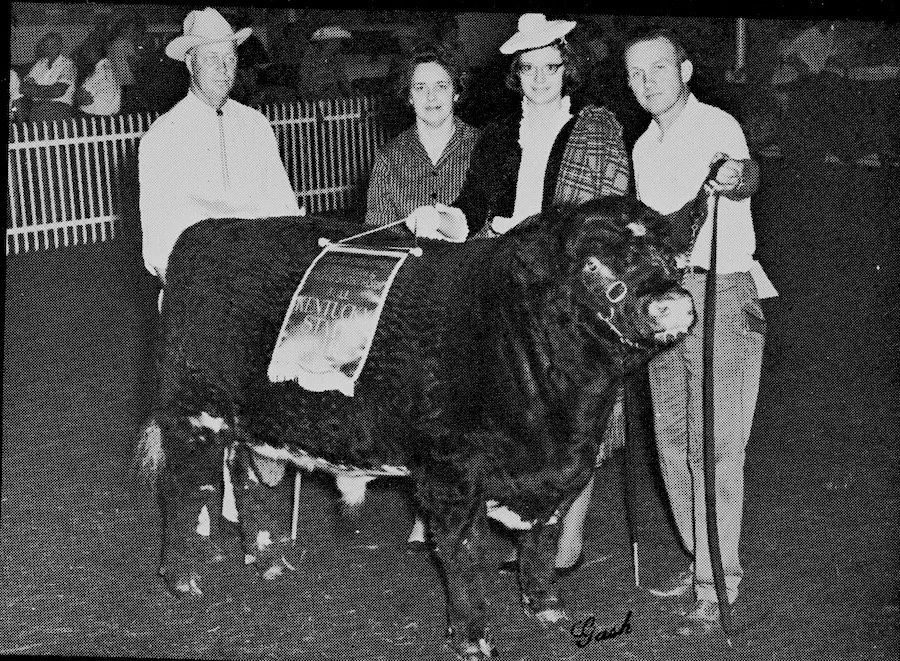
Belt Buckle Era: Champion Yearling Bull

The Belt Buckle era could also be called the “Baby Beef Era” because Shorthorns were down-sized to meet the demands of the “Show Market”. Semi-dwarf and dwarf genetics found their way into the breed. This trend was also seen in several other cattle breeds driven by show breeders, judges, and the lack of foresight. Definitely a “dark period” in the Shorthorn breed.

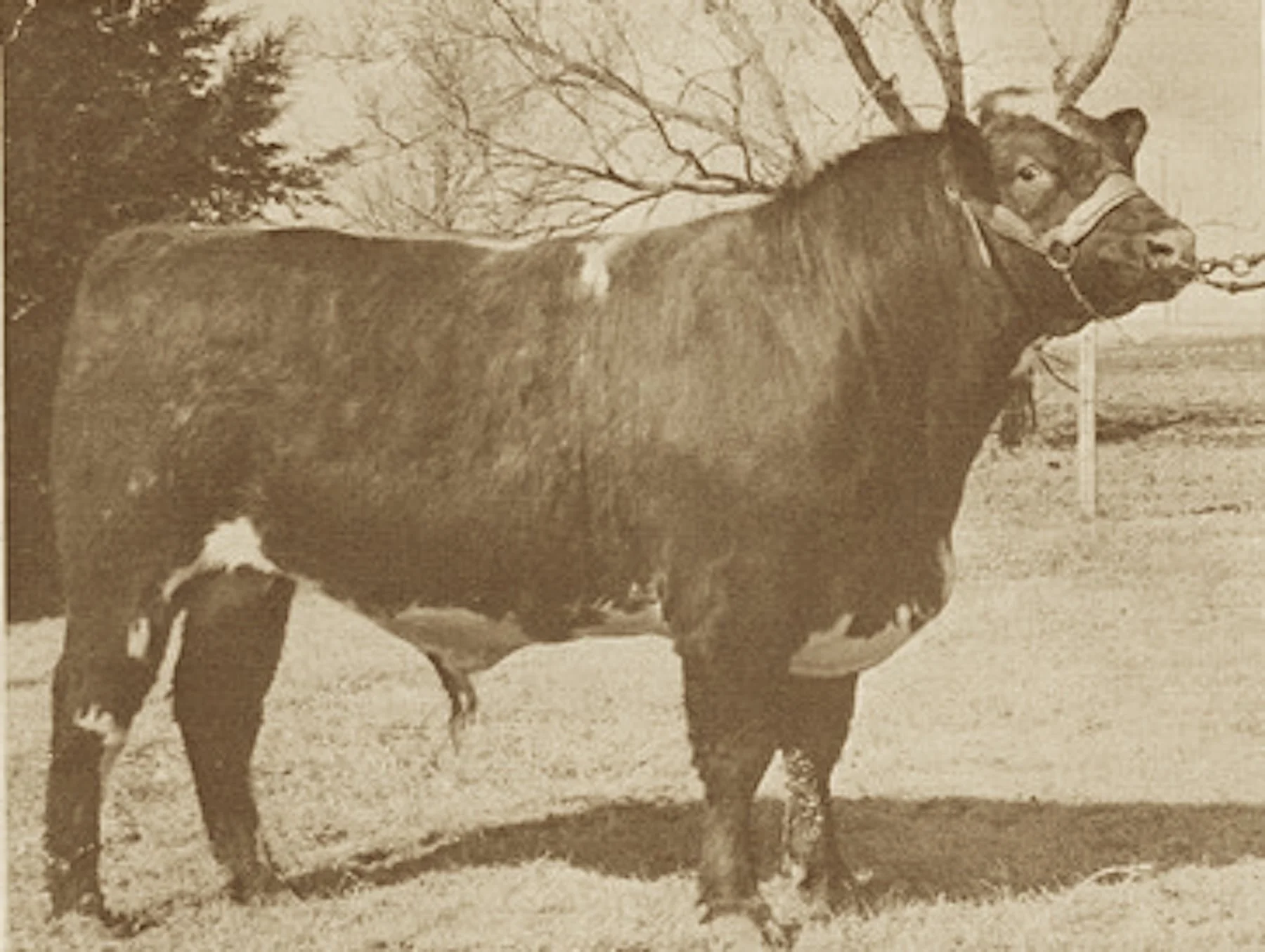
Heritage Bull: HHKA Buttercup’s Prince 20th

I would guess most audience members here today have never heard the 1965-1975 timeline referred to as the Heritage Shorthorn period. During this period there was a return to cattle breeding fundamentals with increased size and productivity through judicious selection of traits that made Shorthorns so popular, and it was done without crossbreeding. Canadian Shorthorns played a major role in this revival along with many classic Dual Purpose Shorthorns that brought much needed improvement in frame size.

Irish Bull

The Exotic and Irish era dominated from 1975-2000. In a further quest to compete with the large continental beef cattle (Maine Anjou, Simmental, Limousine, Charolais, and Chianina as examples), Shorthorn breeders, with the approval of breed associations, embarked on a misbegotten journey of crossbreeding with the aforementioned cattle breeds that has forever changed the Shorthorn breed. Another mania that further distorted the Shorthorn breed was the sudden importation and adoption of Irish Shorthorns as pure Shorthorns. The reality was that some of the imported Irish Shorthorns only had one generation pedigrees with almost all only having 2-3 generation pedigrees. Beyond that no one knew their real genetic makeup. There was tremendous controversy about the Irish Shorthorn pedigrees but they were eventually incorporated into herd books as full blood Shorthorns.

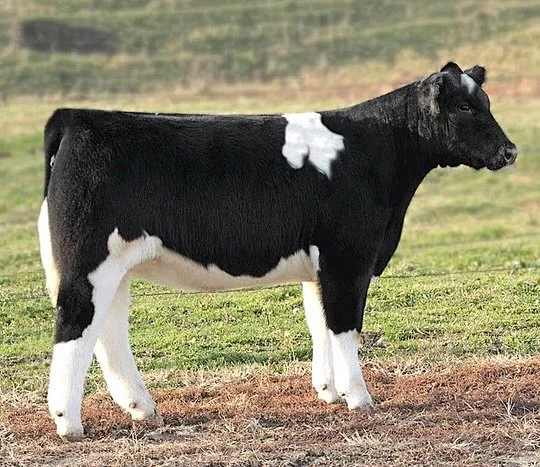
Modern “Shorthorn Plus” Heifer

Since 2000 “Show Shorthorns” and the double muscling gene (especially E226X) have reigned. Many Shorthorn breeders have put an emphasis on breeding show cattle because they have become convinced that is where the money is as Shorthorns have been replaced by many other breeds of cattle in the commercial cattle market. Double muscling became incorporated in many Shorthorns through crossbreeding in different parts of the world as another way to compete. Unfortunately the double muscling gene results in many problems that can have severe economic implications.

All of the above changes in Shorthorns have exacerbated what was an already decreasing relevancy for the Shorthorn breed. To say Shorthorns have “lost their way” is at best an understatement. The constant style changes, and the loss of many of the important genetic traits Shorthorns possessed, set the stage for their loss of popularity. The fact is that Show Shorthorns are not what the commercial cattleman is looking for today. Because of the dominance of certain breeders and the influence of judges the wrong traits have been emphasized.

I have presented all this historical information to validate the case for Heritage Shorthorns and characterize all the opportunities they present. When I look at the 1965-1975 Shorthorn time frame I see opportunity not futility. Hopefully I can validate that statement during the rest of my presentation. Fortunately there is a treasure chest of Heritage Shorthorn genetics sitting in semen tanks around the world still available today from that time period. With careful thought it can be utilized to correct some of missteps of the Shorthorn breed over the last 75 years.

Why Are Heritage Shorthorn Important Today?:
The simple answer is they are the last bastion of full blood, traditional Shorthorn genetics that can be utilized to preserve the genetic base that the Shorthorn breed was known for. This genetic purity is also diverse in the sense that there is not the concentration of pedigrees that is seen with Show Shorthorns that mostly trace to one or two bulls. It is important to note that even today Heritage Shorthorns are a foundational part of Modern Crossbred Shorthorns.

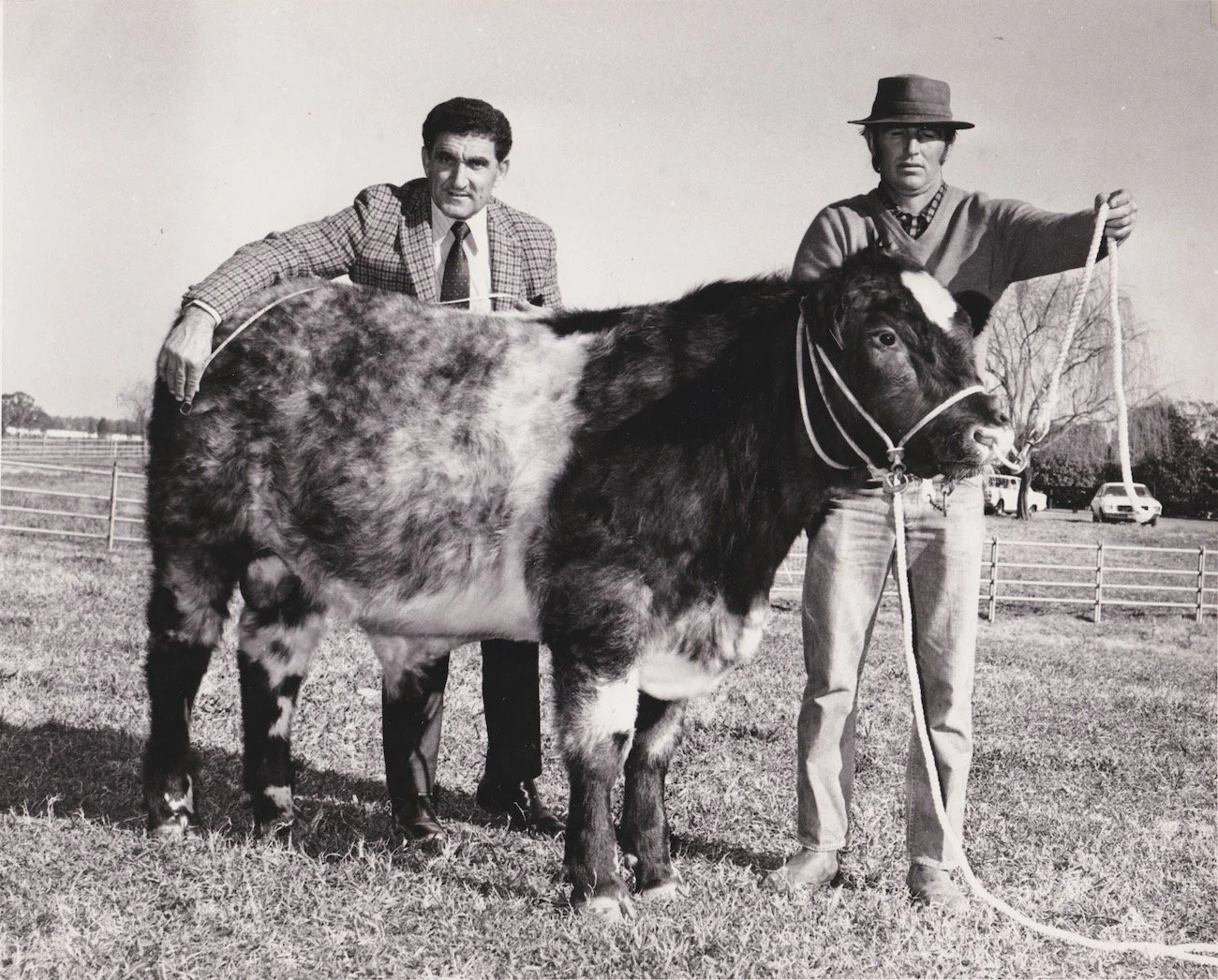
Rick Pisaturo (on left) with Mandalong Super Flag at 8 months old

As I was putting this talk together I tried to think of the one person that most changed the Shorthorn breed in a positive way over the last 75 years. In my opinion that individual was Rick Pisaturo who owned the Mandalong Stud in New South Wales, Australia. When Mandalong Super Flag (BD: 1971) was imported into Canada in 1972 by Dr. George Carter, who also was a Veterinarian, a new vision for Shorthorns became a reality because of his genetic influence in Shorthorns. Depending on which study is used, 12-15% of the blood coursing through the veins of Canadian Shorthorns today came from Mandalong Super Flag. Super Flag was actually flown to Canada, along with a large contingent of other Australian Shorthorns.
It is only fair to say that I do have some personal prejudice regarding this example as I was a friend of Rick’s and stayed at his home several times. I consider Rick to be the person that changed the paradigm that the Shorthorn breed was based on more than any other Shorthorn breeder in the last 75 years. I might add that Rick was truly a visionary who was successful in all aspects of life but especially business. He went from prisoner of war in WW II to receiving the “Order of Australia” in 1990.

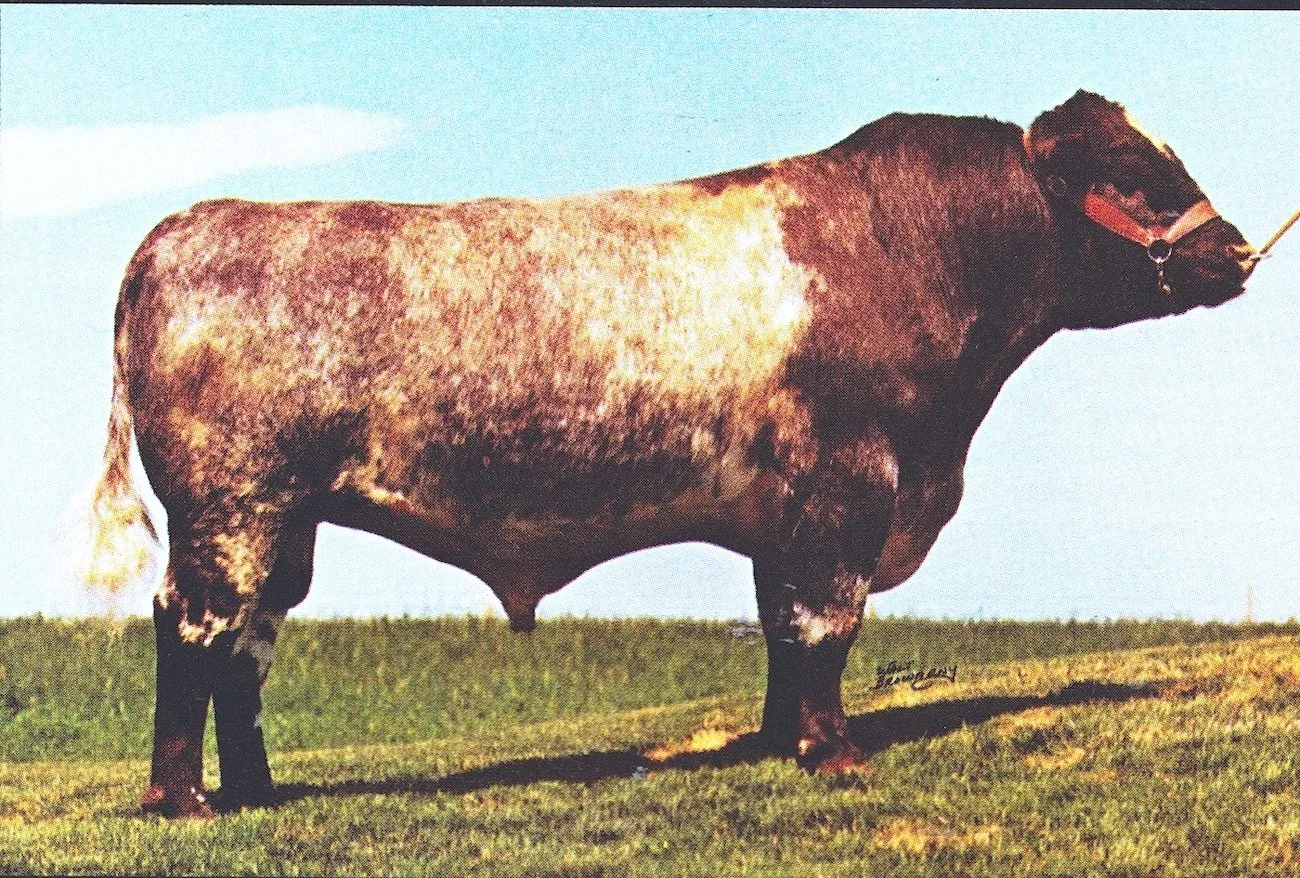
Heritage Bull: Mandalong Super Flag

Super Flag was a breed changer bull who weighed 438 kgs (965 lbs) at 8 months of age and went on to weigh almost 1200 kgs (2600 lbs) at maturity. There have been many stories as to how Flag came to exist including that he was part Charolais. The truth is both Mandalong Super Flag and Mandalong Super Elephant were sired by classic dual purpose Milking Shorthorn bulls that Rick purchased at a dairy dispersal sale in New South Wales because he realized that something had to be done to resurrect the popularity of Shorthorns and compete in the commercial marketplace. The bulls he purchased were even larger than Flag and Super Elephant. Dual Purpose Shorthorns, which in one sense were the original Shorthorns, were often huge cattle that were utilized in many different ways. I will leave that discussion for another day. Flag was thought by many Shorthorn breeders to be the genesis for the E226X double muscling gene here in Canada. I think all the negative stories about Rick, Flag, and the Mandalong herd were a combination of jealousy and the lack of knowledge. Because I am a “trust but verify” person, I actually had all possible genetic tests done on Super Flag, including the breed assignment test, before anyone had even bothered to ferret out the truth. As expected Flag was negative on all genetic defect tests and came back 99.9% Shorthorn which is the highest purity number that can be achieved with breed assignment testing. Super Flag demonstrates the value of Heritage Shorthorns today because he effectively reversed the size reduction that had become a prominent feature of the Shorthorn breed—a trait that is raising its “ugly head” again in Modern Shorthorns.

Formation of the Heritage Shorthorn Society (HSS):

Before the Heritage Shorthorn Society was formed we made many attempts to work with the different Shorthorn breed associations in the USA to further document and promote the pure genetics of Heritage Shorthorns; however they ignored us. As a result the Heritage Shorthorn Society (HSS) came to fruition in 2017 to help HSS members preserve, promote, and produce Heritage Shorthorns. This mission encompasses many aspects of the Heritage Shorthorn breed. One of the main reasons HSS was initially formed was to fill the tremendous void in available historical information. Although plentiful, it was essentially inaccessible to people interested in Shorthorns.
Because Shorthorns had been so popular for so long around the world many historical books had been written about them but the information they contained had never been condensed and made into a short but comprehensive online format that told the story of the Shorthorn breed. The HSS website has more historical information about Shorthorns than any other Shorthorn website in the world. HSS also verifies that the pedigrees of Shorthorns trace to the 1822 Coates Herd Book so they can be listed as Heritage Shorthorns in the HSS database. Because of member demand a registry was created for Heritage Shorthorns that is both economical and comprehensive. HSS registration papers have several unique, innovative features including individual QR codes. The HSS pedigree database contains over 7 million Shorthorn pedigrees and is constantly being updated. This database goes back over 100 years for some Heritage Shorthorns. HSS also provides economical advertising options for members and provides free “Shorthorns wanted” ads for prospective Heritage Shorthorn breeders.

Locating Heritage Shorthorn Genetics:

It is important to realize that Heritage Shorthorns can be divided into three overlapping genetic groups: Dual Purpose, Dairy/Milking, and Beef. This genetic diversity facilitates incredible opportunities in the cattle industry today because of the vast number of important genetic traits available for improvement through Heritage Shorthorns. I would guess there is still semen available on upwards of 300 Heritage Shorthorn bulls today. In our quest to produce the ideal Shorthorn cow we have used between 50 and 60 different Heritage Shorthorn bulls over the last 20 years. In the process we have gained a lot of knowledge about what works and what doesn’t when utilizing old Heritage Shorthorn genetics. There is no question that just because a bull was collected, promoted, won shows, and gained fame in the 60’s/70’s time frame does not mean he can make a significant contribution to the improvement of the Shorthorn breed today. Heritage Shorthorns are not a simple panacea. They are a genetic tool that can increase the presence of many important traits that have been or are being lost in Modern Shorthorns such as longevity, fertility, maternal instincts, structural soundness, and general hardiness. Utilizing modern IVF technology the ability to produce multiple embryos from multiple cows from one ampule or straw of semen is amazing. An example of this in our herd is Canadian Image semen. From 2/3 of an ampule of Canadian Image semen we were able to produce over 30 IVF embryos from 9 different cows and I still have enough to breed a cow if we wanted to or undertake another IVF session. Now that is adding genetic diversity and positive genetic traits back into the Heritage Shorthorn genetic base. I would add two caveats. One is the semen has to be of good quality, which from my experience most of it is, and the bull has to produce freezable embryos. Not all bulls do.

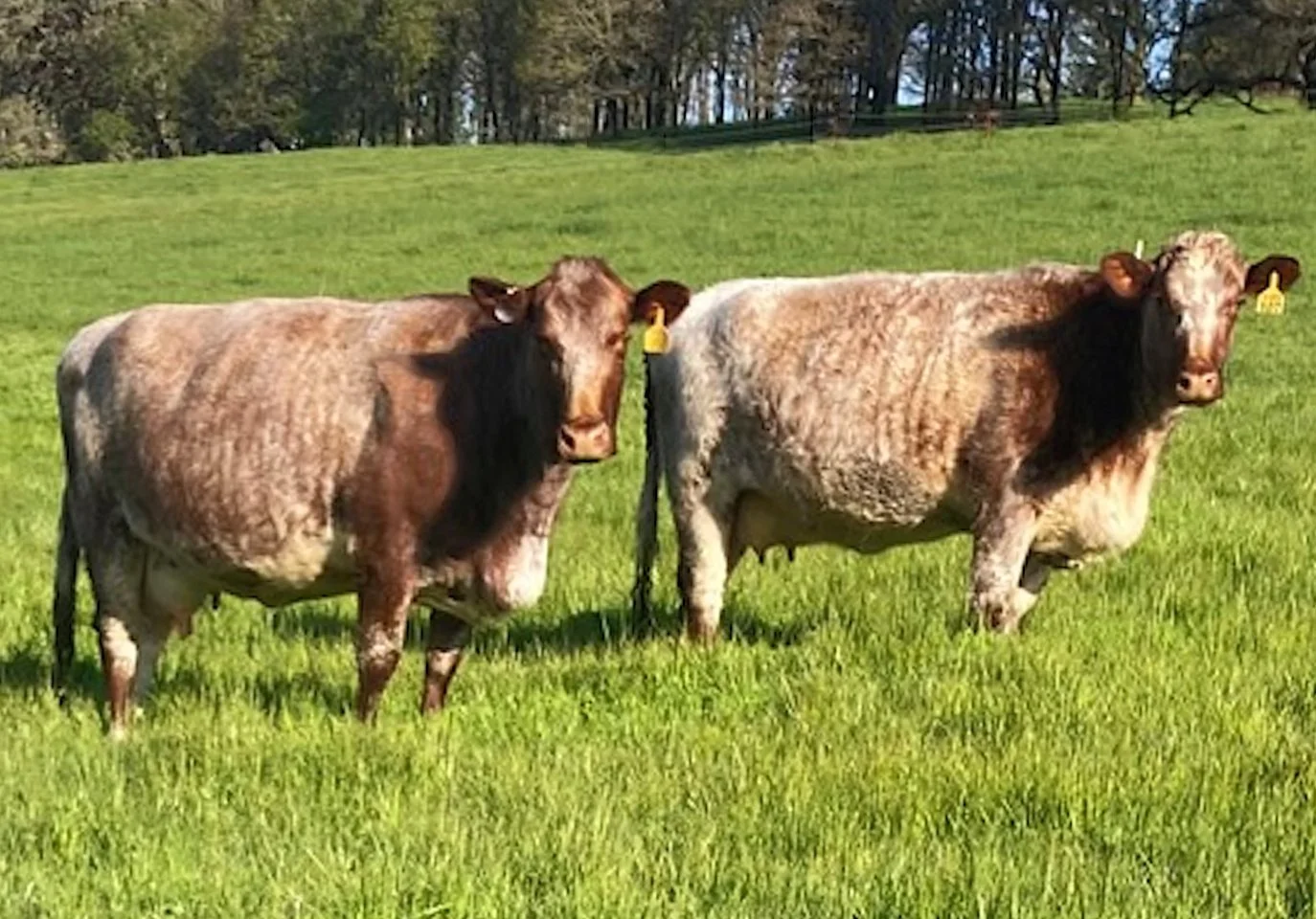
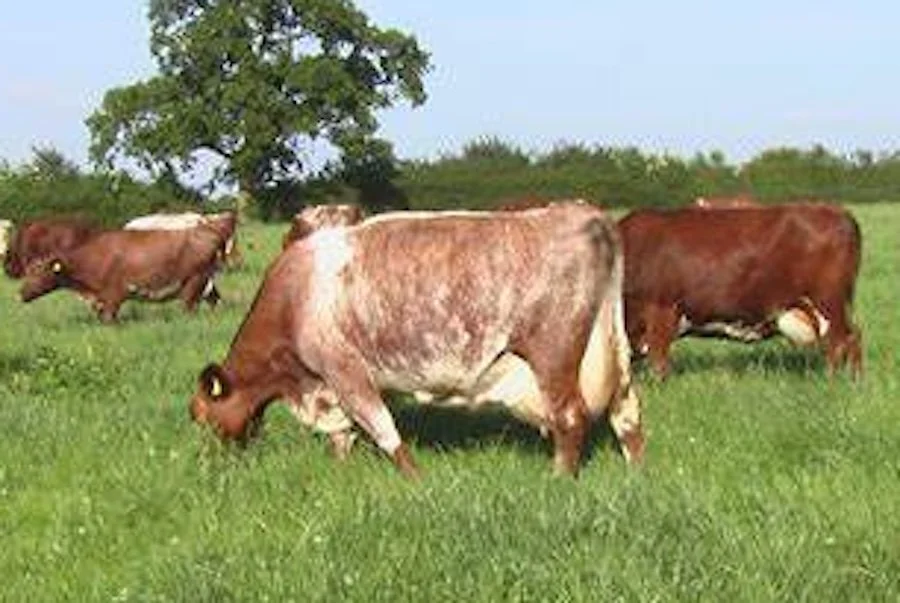
Dual Purpose mother and daughter Heritage Shorthorns

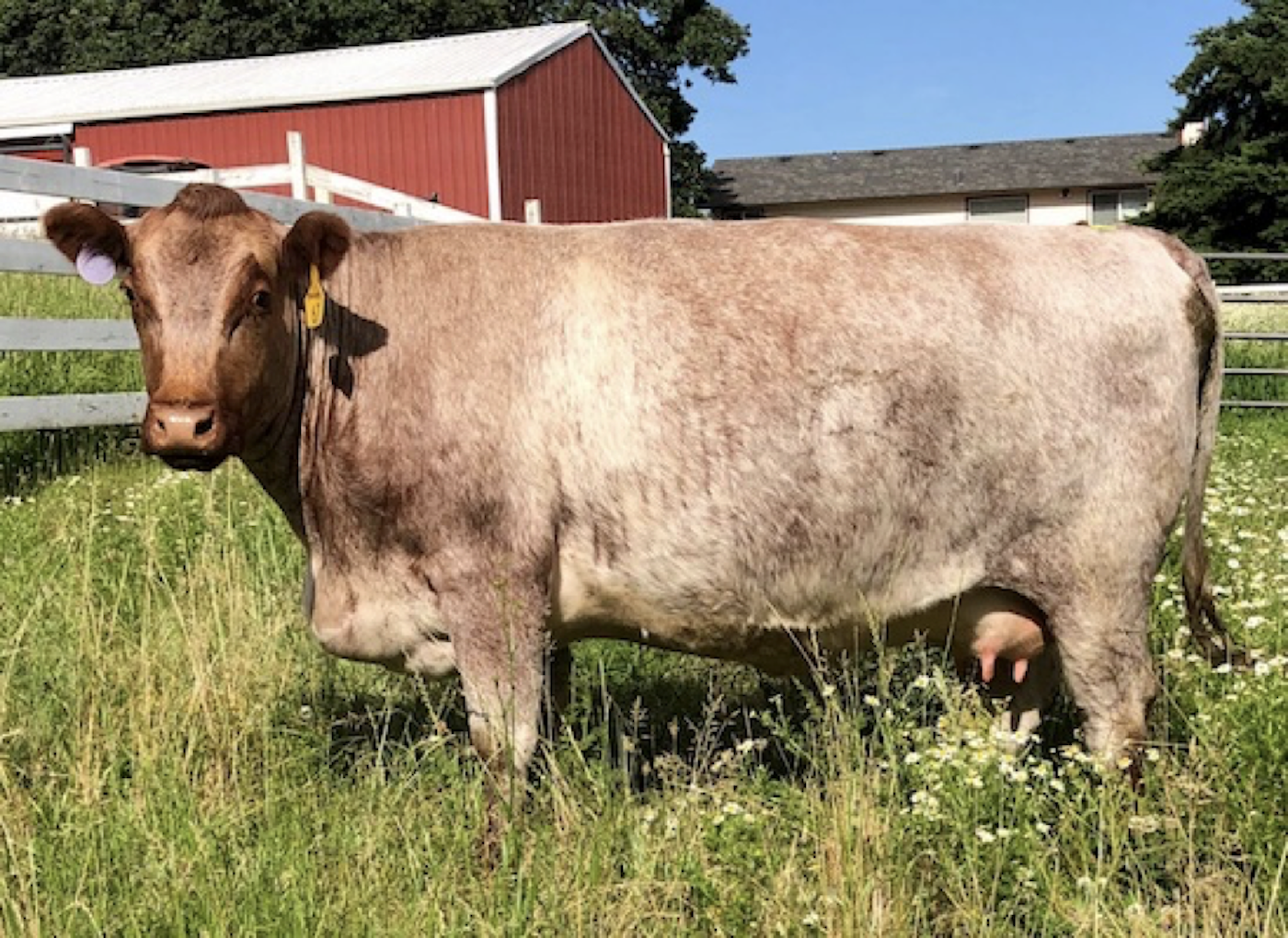
Dairy/Milking Heritage Shorthorns

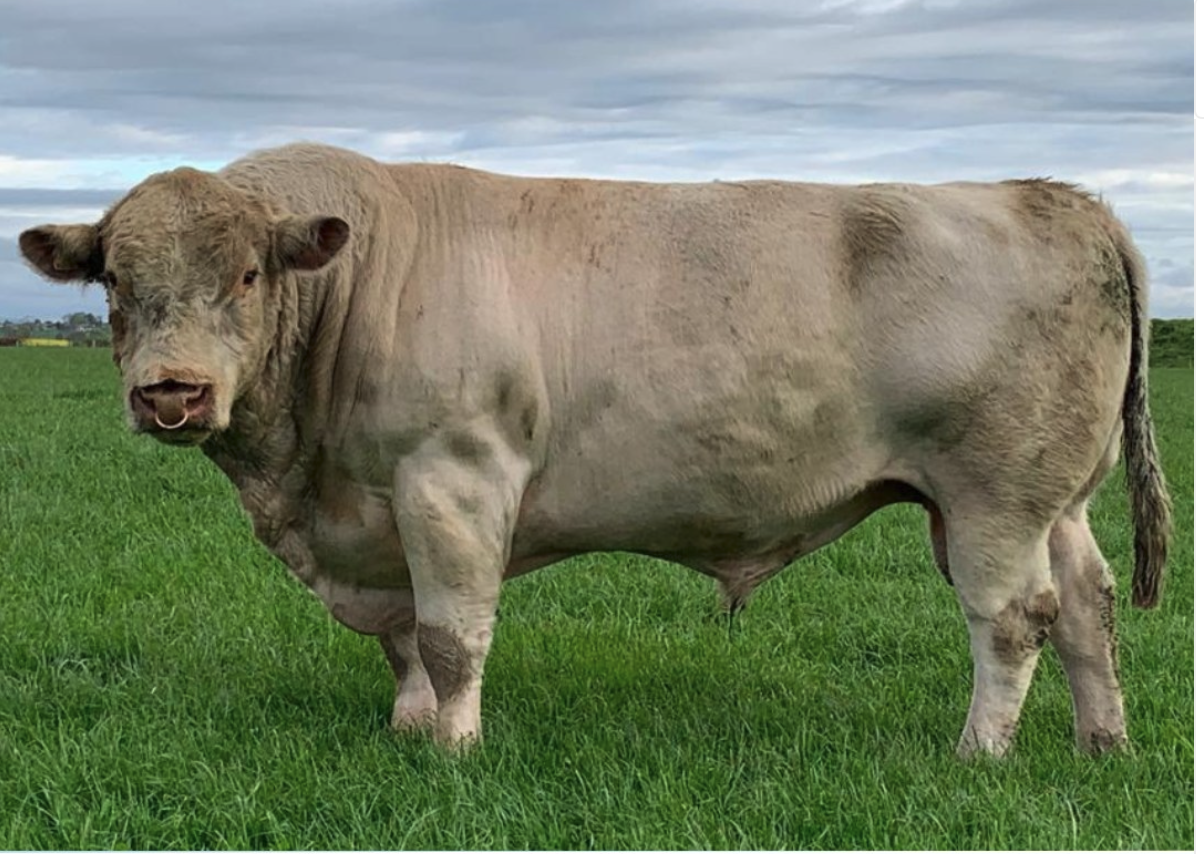
Beef type Heritage Shorthorn


Firefox of Upsall

One question I often receive is where to find semen on Heritage Shorthorns. For some Shorthorn breeders it may actually be in the bottom of their own semen tanks. Two examples I can think of involve Super Elephant and Super Flag. Those of you from England would be familiar with the Honorable Gerald Turton who owns the Upsall herd in England. His “Foxfire 0f Upsall” bull born in 2012, which I was privileged to see at his farm, is a Super Elephant son. When I visited him I was surprised to see the bull given his sire was born in 1970, so I queried Gerald as to where he got the semen. His answer was “I found one straw in the bottom of my semen tank and the Firefox bull was the result”. He had used Super Elephant in the 70’s and didn’t think he had any left but there it sat for 40 years.
Another friend of mine in Montana recently found a whole cane of Flag in the bottom of one of his semen tanks demonstrating the old adage that “it is better to be lucky than good”. For those who have not been in the Shorthorn business prior to 1980 there are four possibilities to find old Heritage Shorthorn semen: buy it at public auction when it comes up for sale, find out who might have a particular bull that you are interested in, buy semen produced by a son, or buy sons and daughters of the bull they are interested in from Heritage Shorthorn breeders. Even 15 years ago it was difficult to find semen from old Heritage Shorthorn bulls but currently much of it has been bought up, and what is available for sale periodically often sells for a lot of money.
What about Shorthorn breeders in other countries? Certainly in South America there is still some Heritage Shorthorn semen available because a large amount of Shorthorn semen was imported into Argentina, Brazil, and Uruguay back in the 60’s and 70’s. I know one Shorthorn breeder in Brazil that has quite a collection of old Heritage Shorthorn semen and is a stickler for breed purity. My guess is that several other countries around the world have small reservoirs of old Shorthorn semen but have never realized its usefulness in today’s Shorthorn industry. Utilizing modern reproductive technology opens up possibilities in most countries to step back in time and reintroduce Shorthorn genetics that were once preeminent in the world.

Opportunities with Heritage Shorthorns:

The opportunities to utilize Heritage Shorthorn genetics in Modern Shorthorn herds is boundless as seen in the increasing number of Heritage Shorthorn offspring available from many different bulls that offer a source for genetic traits that have been lost in Modern Shorthorns. There are Heritage Shorthorn breeders exploring the international export market for both semen and embryos. A whole list of potential business opportunities is listed on the HSS website (https://www.heritageshorthorn.org) including the opportunity to sell trademarked Heritage Shorthorn Certified Beef, which has its own website (www.heritageshorthornbeef.com).

The future of the Heritage Shorthorns is bright. The advent of the Heritage Shorthorn Society in 2017 opened up new venues for the breed. Membership is available to anyone in the USA and Canada. (Because of costs, HSS memberships cannot be extended to Shorthorn breeders in other countries.) The Heritage Shorthorn Society website is the most complete source in the world for information on traditional Shorthorns and historical pedigrees. The HSS registry is continuing to grow because it offers superior service, low fees, and certification of Heritage status. The ongoing expansion of the Heritage movement in all aspects of agriculture around the world, be it tomatoes, swine, or Shorthorns, is a stimulus for continuing growth as humans become more aware of both health concerns and the environmental impact of many modern agricultural products today. Thanks again for the opportunity to speak about Heritage Shorthorns.

Whisper Bernice: a Heritage Shorthorn Cow


2025

The Coming of Shorthorns to America (late 1700's)

Sign for Perry Hall, near Baltimore Maryland

There is a commemorative plaque about 13 miles north of Baltimore harbor on U.S. route 1 (formerly the Bel-Air Road) informing any curious passer-by that it stands at what was the entrance to Perry Hall, one the greatest houses in eighteenth-century Maryland, the home of Harry Dorsey Gough. Unmentioned that it was also the home of the first imported breed of improved cattle into America: Shorthorns.

By the eighteenth century, the expansion of agricultural production was a concern to every educated person. There were predictions of widespread famine as the world’s population increased, and laborers began to leave farms at the beginning of the Industrial Revolution. The challenge to improve agricultural production was taken up by many individuals, especially in Britain’s Anglo-Atlantic agricultural network that extended from the British Isles to the West Indies to the eastern shores of the North Atlantic. Among the better-known improvers was tenant farmer Robert Bakewell of Dishley Grange in Leicestershire with his Longhorn cattle and Dishley sheep (now known as Improved Leicester or Leicester Longwool). Bakewell had many admirers, among them was Harry Gough.

In North America prior to the American Revolution there was general indifference to either livestock production or the cultivation of crops beyond tobacco, the primary interest of many colonial proprietors. Horses, cattle, and swine foraged in the forests and only sheep, who suffered from the ravages of wolves, received close attention, but they were relatively few. Cattle in colonial America have called forth little comment. In New England they were Devons from southwest England, Dutch cattle were introduced into New York, and in the southern regions were Spanish influenced cattle. There were few efforts at management and the cattle pastured in the woodlands.

After 1783 and the colonists’ victory in the War of Independence, the population of the United States began to increase rapidly. To give an example, the demographic center of the United States in 1790 was 8 miles east of Baltimore Harbor, but ten years later that center had shifted 18 miles to the west of the harbor. The growing population needed food.

May 10, 1798 entry in Federal Gazette & Baltimore Daily Advertiser

One response was the importation of improved livestock. The first to do this in the United States was Baltimore businessman and plantation owner Harry Gough, who gave the date of his importation in a statement of his breeding philosophy to the Federal Gazette and Baltimore Daily Advertiser (May 10, 1798): “In the year 1785, I imported from England three cows and a bull . . . The cows were all in calf when exported and calved after they arrived in this country. . .”
Gough’s neighbor Richard Parkinson remarked: “Gough, at Perry Hall . . . has procured some imported cattle from near York, in England, something of the Teeswater kind”. “Teeswater” is one of several names given to what later became known as “Shorthorn” cattle. Parkinson did not approve of them and sniped that Gough was “distinguished for breeding short-horned and large cattle; although very improper for America, as no poor land ought to have large animals upon it.”


Gough expected to make money from his imported cattle, and he held the first auction of Shorthorns outside the British Isles in 1788 at Perry Hall as announced in the Maryland Journal and Baltimore Advertiser (October 18, 1788):

“To be sold, at Perry Hall, Baltimore County, on Tuesday the 28th instant, about twelve o’clock, several remarkable fine young bulls, from Mr. Gough’s imported English cattle, among which is one that weighed at six weeks, 253 lb.”

The sale was a failure, and the explanation was given in the same newspaper three days later:

“As the day appointed for the sale of Mr. Gough’s stock, at Perry Hall, proved rainy, there was none of it disposed of. – It will be offered for sale on Thursday the 6th day of November next at twelve o’clock. If that day should be unfavourable, on account of rain, the next fair day. – On yesterday two of Mr. Gough’s bull calves, from his imported English cattle, were weighed, one of which was 24 weeks and 4 days old, and weighed 420 lb. the other, about two weeks older, weighed 432 lb.”

Gough did not abandon auctions, but he sought other venues. He placed the following notice in Edwards’s Baltimore Daily Advertiser for March 31,1794:

“I have by Importations from England, Persia, etc., stocked my farm at Perry-Hall with a very superior breed of CATTLE and SHEEP, and propose raising Calves and Lambs for sale. I have now a number of both kinds, which I will deliver in Baltimore-town, to the order of such who may apply, which must be done in six weeks from this date, directing to whom they are to be delivered. The price of the Calves is from [$] 7.10 to 17.15, and the price of the Lambs from 8 to 20 Dollars.”

Those prices were steep. Parkinson claimed that fat calves, for example, sold between $4-8. For Gough there were two other enticements: temperament and transportation.

The temperament of animals was a concern in a country as large as America. Cattle left unattended and grazing over vast distances could become too wild to be handled. Gough’s hero Robert Bakewell had made the docility of his beasts famous, and Gough imitated him, as can be seen in the notice that appeared in the Federal Gazette for July 17, 1800:

“For Sale, Several valuable young BULLS & HEIFERS, of my noted English breed; the bulls fit for immediate use. They are perfectly docile and can with ease be taken from Baltimore by water or by land from Perry Hall, to any part of the United States.”

The final sentence is important, for water transportation implies substantial distances to be travelled. As will be shown, this was precisely what Gough intended.

Before animals could be sold, buyers had to be found. This was accomplished through the newspapers in brief “information” pieces probably written by Gough. Two pieces that appeared in newspapers along the Atlantic coast during the year 1796 are illuminating examples. The first appeared in Kline’s Carlisle [PA] Weekly Gazette on May 1, 1796, with the title “Encouragement for Farmers:”

“A calf was sold yesterday for two hundred dollars. The animal was raised by Harry D. Gough, Esq. and sold by him to Mr. Ashbel Welles, who means to send it to Boston. It is 14 months old, and weighs one thousand and twenty-two pounds.”

Ashbel Welles (1734-1806) of West Hartford, Connecticut, was a Revolutionary War hero who served with Ethan Allen and the Green Mountain Boys. This piece was reprinted in the Boston Gazette and Weekly Republican Journal on June 13; and in the Rutland (Vermont) Herald on June 20. The information could vary, and the Philadelphia Gazette and Universal Daily Advertiser (May 27) increased the weight of the bull to 2,022 pounds while the Augusta (Georgia) Chronicle (June 11) decreased the selling price to $100.

Gough was apparently satisfied because several months later the American Intelligence

Gazette of the United States and Philadelphia Daily Advertiser (September 22, 1796) announced that an “Importation Society” had been organized in Baltimore for the purpose of bringing into the country the best animals from England. Once again, the information was quickly reprinted by newspapers along the Atlantic coast. The Philadelphia Gazette printed the item the following day, the Newport (Rhode Island) Mercury published it on October 4, the American Telegraph and Fairfield Co. (of Bridgeport, CT) Gazette printed it on October 19, the Norwich (Connecticut) Packet published it on November 3, and the Medley or Newbedford (sic) Maine Journal printed it on November 4.

Gough boasted about the area over which his livestock sold. In addition to Welles there was Joseph Rice of Fauquier County, Virginia. On October 26, 1797, he sold a 3-year-old bull purchased from Gough for $100 when 5 months old that, supposedly, weighed 688 pounds. In the afore-mentioned news item/memoir from the Federal Gazette and Baltimore Daily Advertiser, Gough names several of his more important customers including former president George Washington and Captain (later Congressional Representative) Jeremiah Wadsworth (1743-1804 of Hartford, Connecticut) in addition to buyers from Maryland that included his brother-in-law Charles Ridgely of Hampton. He concluded by giving notice of a sale of 21 calves to be held on June 21 with the suggestion that some of the calves would weigh 100 pounds for each month of age.

A legacy of Gough’s Shorthorns are the so-called Gough and Miller cattle. Their history can be traced using, first, a memoir published a dozen years after Gough’s death by veteran stockman William Steenbergen of Virginia in The American Farmer for 27 July 1821 (page 140). Originally from Moorefield on the South Branch of the Potomac, Steenbergen relocated to ‘Dunmore Mt. Airy’ near Mount Jackson, Virginia, circa 1795. He claimed that cattle imported from England were introduced to his area of Virginia some 30 to 35 years earlier by a man named Matthew Patton who took them first to the South Branch of the Potomac (Augusta County in what is now West Virginia) and then to Kentucky; Gough is mentioned in an aside. The chronology given by Steenburgen encompasses the time of Gough’s first sale of livestock. Calculating from the longer of the two durations—35 years, from the year of the journal’s publication (1821)—yields the year 1786, while the shorter span gives a date of 1791. According to Steenburgen, Patton’s improved bull sired calves out of the native cows that so impressed his neighbors that a Mr. Miller purchased either the bull or some calves and then began his own importations. Steenburgen did not like the imported cattle and claimed that they had a detrimental effect on the native stock. The first cross produced good cattle, he wrote, but subsequent linebreeding resulted in a beast that was large, gained weight slowly, and whose beef was coarse and unsaleable.


Both Matthew Patton and Mr. Miller were important figures in livestock history. Matthew Patton was instrumental in introducing Gough’s breeding beyond Baltimore. His father, also named Matthew Patton, operated a mill in what is now West Virginia, close-by Fort Seybert near Franklin, in an area called Buffalo Meadows, where he had a large livestock operation. The younger Matthew moved to Baltimore a few years before the War of Independence. He was a saddler who traded in the partnership of Patton and Coulter, with a shop at the corner of Calvert and Water Streets. Politically, he was a fire-brand agitator for the colonists, joining the Baltimore Independent Cadets in December of 1774. In 1778 he signed oaths of allegiance and fidelity agreeing to manufacture knapsacks and haversacks for the Continental Army. Finally, he enrolled in the Baltimore County Troop of Horse, under the command of Captain Nicholas Ruxton Moore on June 21, 1781. Despite his active service, the post-war years were not kind to Patton. The partnership of Patton and Coulter suffered from the loss of military contracts following the signing of the Treaty of Paris and the firm’s dissolution on December 3, 1785 was noted in the Maryland Gazette of October 31, 1786. Matthew remained in Baltimore for a few more years and his departure can be marked by the birth of his children; in 1788 his twin boys were born in Baltimore, but the next child was born in Kentucky. So, a possible scenario is that Matthew Patton purchased a bull at Gough’s auction of 1788, took it with him when he returned to his family home in Buffalo Meadows, and again when he moved to Kentucky. This would explain why his beasts acquired such notoriety that they were known as “Patton Cattle.”

Turning to Mr. Miller, the other part of the ‘Gough and Miller’ cattle, he was Henry Miller (1732-1796), Patton’s neighbor in Augusta County and the owner of the Mossy Creek iron manufactory. He was also one of the great figures in the history of Shenandoah Valley agriculture and owned about 1100 acres of land. His home, now simply the “Henry Miller House” still stands and is listed on the national register of historic places.

Henry Miller House

In the penultimate decade of the century, he and Matthew Patton were buying cattle in partnership; possibly Miller was supplying the funds for Patton’s purchase of Gough’s cattle. He continued buying cattle after Patton’s departure for Kentucky. Miller employed Richard Sprigg of Upper Marlboro, Maryland, as his agent; Sprigg imported for Miller a Shorthorn cow and a bull, the latter costing one hundred guineas (roughly $30,000 in today’s money).

In addition to Steenbergen’s memoir, another account of the Gough cattle outside of Maryland was written in the mid-nineteenth century by Brutus Clay (a future congressman from Kentucky), who took his information from an elderly informant identified as B. Harrison of Woodford County. This account (“Brief History of Kentucky Cattle,” in Hunt’s Merchants Magazine and Commercial Review 33 (1855) 236) clearly is confused in places but basically agrees with Steenbergen’s information with additional details. According to Clay, Patton was one of the earliest purchasers of Gough’s imported cattle and took six calves by a bull he purchased from Gough with him to Kentucky in 1790. One animal is described as large and coarse, echoing Parkinson’s criticism, with large horns possibly from a cross on a native cow. Five years later he introduced two more animals—a bull and heifer—bred by Gough. The bull was described as deep red in color while the heifer was white. These might be the bull Mars and the heifer Venus that Matthew Patton took across the Alleghany Mountains. Mars (number 1850 in the American Herd Book) was a red bull with a white face and heavy horns. Venus was a white cow with red ears and small horns. After producing two bull calves with Mars, she died. Another, more famous, animal was the bull “Buzzard,” ancestor of the Shorthorns of Kentucky that is described in a laconic entry as “Red, descended from a Bull and Cow imported into the U.S.A. by Mr. Gough, Baltimore” (see Lewis F. Allen, Pedigrees of English Short-Horn Bulls to Which American Pedigrees Trace (Buffalo: Warren, Johnson & Co. 1874) 75, number 3253).

Even before his death, cattle descended from Gough’s importations were making the return journey from the western regions to the towns and cities of the east. History was made in 1805 with the first major cattle drive in the United States. George Renick took 96 head of cattle, descendants of the Gough and Miller breeding, from the Scioto River Valley to Baltimore (his home known as the Renick House or “Paint Hill” still stands in Chillicothe, Ohio). The American Farmer of June 29, 1821 (p. 112) claims “There is not a drove of fat Cattle brought to our market, which may not be recognized as the descendants of the Stock imported from time to time by Mr. Patterson, the late Mr. O’Donnell, Gough, Sprigg and a few others.”

The importation of Shorthorns and their initial distribution required the labor of breeders from all levels of society. Wealthy businessmen, failed shop keepers, and major stockmen were all a part of the story.


Author Profile: Dr. Benjamin Hudson

Benjamin Hudson is professor of history at the Pennsylvania State University, where he specializes in British history. He is a member of the Maryland Shorthorn Association as well as the Heritage Shorthorn Society. Coming from a family associated with Polled Shorthorns since the First World War, he showed Shorthorns in 4H and FFA. His grandfather B.C. “Brownie” Hudson’s Highland Polled Shorthorns showed throughout the Midwest while his father John Hudson judged Polled Shorthorns at the International Livestock Expo, the National Polled Shorthorn show, and the San Antonio Expo as well as numerous state fairs and regional shows.

2025

"Rose" the Cow: A Ton of Calves

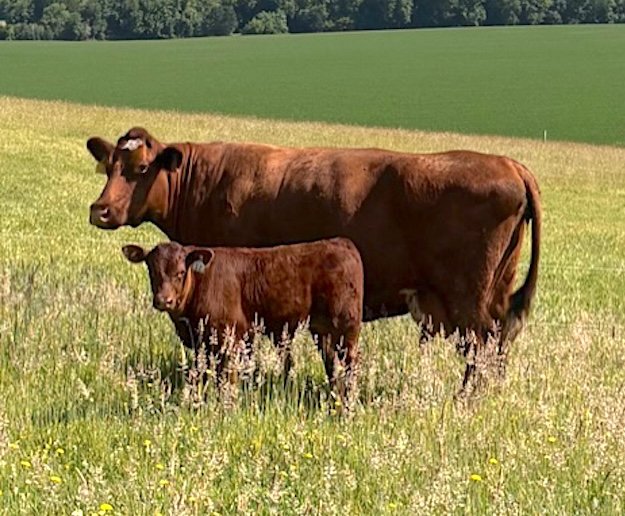
“Rose” in 2015 with her 5 week old bull calf.

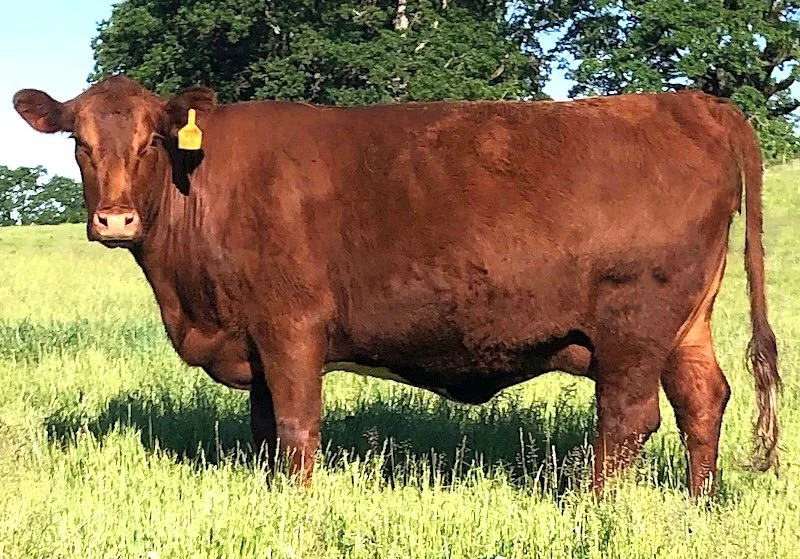
Her story begins on a farm in Kansas where she was born in April, 2007. Her dam was a 3 year old cow that was nondescript but produced a unique heifer calf that became Rose. I had purchased three yearling heifers from a Kansas Shorthorn breeder, who remains a well known Shorthorn breeder today, but when I arrived to pick them up in the spring of 2008 he informed me the best one “had suddenly died” never telling me before I left home. He said I could pick from a group of over a 100 red yearling heifers he had as a replacement for the one that I was supposed to receive. I was “boxed in” because I was already there and did not want to go home with just 2 heifers. He said he would run the group of heifers through a chute and I could decide which one I wanted as they moved through the chute setup. Probably about a third had gone through when a large framed heifer appeared that had a certain indescribable elegance about her and I said “I will take that one”. Her purchase price was $800 which in today’s (late spring 2025) dollars would be approximately $1200. Thus the saga of Rose began.

Once she arrived at our farm in Oregon it quickly became apparent she was quite apprehensive about her new home and was reticent to become a member of our small herd as she “did her own thing”. This often created difficulties when we were trying to work with our herd. Many times we contemplated selling her as she was heading in the opposite direction from the rest of the herd. After some thought we decided to give her a chance in hopes she would develop “a new attitude” that would facilitate her becoming a long term member of the herd. Little did we know how her value to us would evolve from a “cow project” to the “matron of the whole herd” 17 years later.

Her first calf was a 88# bull calf (all our calves are weighed on an electronic scale the day they are born—no guessing) that grew extremely well. She had him with no problems, was a good mother, and had a good udder. Her second calf was also a bull calf and weighed 96#. Her temperament was still a bit contrary but we were trying to build our herd and she certainly had produced good marketable offspring so we decided to keep her. Her third calf was a “shocker” because he weighed 131#. She delivered him with no help and no problems. By this time she had grown into a large cow at over 1900 pounds. Also she started to mellow and seemed to become an integral member of the herd assuming more of a “leadership role”.

I am a believer in the value of larger cows and recent research has indicated they are more feed efficient than smaller cows despite what has been preached for many years. Rose has always been last to the hay feeder and the first to leave in the winter which has caused me to tell visitors who have seen her that, despite her size, “she eats like a bird”. Rose is definitely the most feed efficient cow on the farm maintaining superior body condition throughout her life even though she is a totally grass fed cow. She doesn’t know what grain is. I always ask visitors now when they visit how old they think Rose is and the guess was usually 6-8 when in actuality she was well into her teens. They marvel at her body condition given her age and lack of supplemental nutrition.

As the years have gone by Rose has been bred to a wide variety of bulls both naturally and AI (11) so it is fair to say that the size of her calves is definitely attributable mostly to her genetic prepotence. She is the rare cow that imparts her good characteristics beyond expectations to all her offspring. She has never had what would be considered a 'bad calf”. I wish I could say that about all the cows we have owned over the last 20 years.

What has become apparent about Rose is that she is an extremely intelligent, calculating cow. She not only understands “what is coming” but develops a strategy in how to cope despite her distain for what may be happening. There is also no doubt she “understands English” as she responds to a wide variety of short phrases that we have utilized to move cows from location to location or convey what is about to take place. She consistently “moves” the herd in the right direction which has been an invaluable contribution to our management of the cow herd. Her value lies far beyond her ability to produce quality offspring.

Throughout her calving career she has been diligent about her maternal duties. She provides a tremendous amount of milk for her offspring while maintaining her body condition for breeding back on time to produce her next calf (calves). She epitomizes what Shorthorn cows are about and why they offer any cattle breeder the opportunity to make money. The picture of her at 18+ years with her latest calf, sired by Whisper Royal Chief II, validates all of the above. This calf weighed 112# at birth.

“Rose” in June 2025 at 18 years old with her most recent bull calf

The rationale behind Heritage Influenced Shorthorns has always been to encourage commercial cattle breeders to utilize Heritage Shorthorn bulls to produce superior offspring that can go to market rapidly, or in the case of heifers, add quality maternal capabilities to their cow herd. Many small breeders would like to register their cattle but do not want to pay the exorbitant fees, or do expensive, unnecessary testing on their own cattle. The Heritage Shorthorn Society’s Heritage Influenced Shorthorn program allows cattle breeders to do that. No better example, of the opportunities in the production of Heritage Influenced Shorthorn cattle, is available than Rose when I reflect on her career.

“Rose” and her twins in 2014

The remarkable numbers for Rose are her total number of calves raised to weaning is 20 (3 sets of twins), and with a grand total birth weight of 2037 pounds for an average of 102#/calf. She gave birth to and raised all the calves herself including the 3 sets of twins with the largest set having a combined birth weight of 182#. Rose and all of her calves have tested free of TH, PHA, DS, and myostatin.

Her bull calves have averaged 800# plus and her heifers 700# plus at 205 days of age (twins excluded). All this with only Rose, pasture, and hay to achieve these weights—no corn, no corn silage, no creep feed, no nurse cows, and no hormonal implants! I doubt there is a cow alive, let alone another Shorthorn, that can surpass those numbers. We have been lucky to own her. She is going into retirement later this year and will live out her life on our farm. She has developed mild arthritis in one hip, probably from carrying all those calves over our hills, and we do not believe it is fair to breed her again nor “put her on a truck”. Her last weight was 1930# this past winter so her salvage value in today’s market is well over $3000 but she has earned the right to enjoy a carefree life for as long as she lives.

Joseph Schallberger, DVM PhD
Whispering Hills Farm


The primary question in the HSS May 2025 Contest was to guess the total combined weight of Rose’s calves. If a tie-breaker was needed, the second question was about the total number of her calves. As expected, no one overestimated the numbers. The top 3 winning guesstimates were:

1st Place: Jake Bruton Total wt 1513 lbs, 17 calves

2nd Place: Alan Leap Total wt 1377 lbs, 14 calves

3rd Place: John Mullet Total wt 1200 lbs, 14 calves


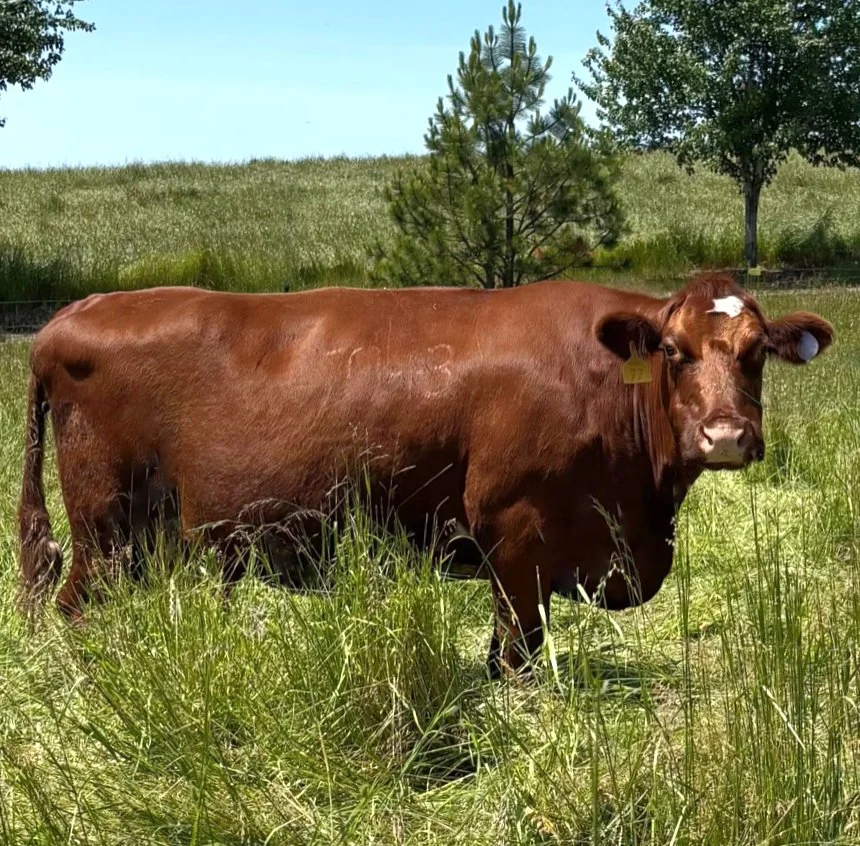
Addendum, late May 2026: Rose continues to do great as she moves toward her 20th birthday.  Her weight fluctuates between 1825# and 1900# although this spring she is little heavier because pasture and weather conditions have been optimum, and we did not allow her to get bred this past season.  She still is the leader of the herd and is in with our main group of cows going up and down hills.  Because we are retiring at the end of this year she will be moving to a “Bovine Retirement Home” to live out the rest of her life on a farm here in western Oregon.  

Rose pictured on 5/20/2026 at 19 years of age.