2024

2024

A Shorthorn Heritage (Part 8): Hodgepodge

Lonny and his sister Susan (Iowa Shorthorn Lassie Queen), hosting the Iowa Sh. Assoc. picnic & field day

The early 80s were certainly good to us as far as the Shorthorn herd was going. During a 5 year stretch, we had a champion and/or top-selling female at the Iowa Beef Expo each year. As usual, there was a constant search for that next great herd bull. It seemed as though the industry as a whole was determined to breed larger and larger cattle. The Continental breeds certainly played a major role in this movement and the long-established British breeds went along for the ride. At times it seemed as though cattle shows were simply placed from biggest to smallest. Since part of our cattle enterprise was showing cattle, we had to follow suit. In addition to 50-60 purebred Shorthorn cows on the farm, Dad started to use Simmental bulls on another 30 or so cows. We fed out the calves that were not kept or sold for breeding purposes, so this seemed to be logical at the time.

At the intersection of Hubbell and University in Des Moines is the AE dairy. At the edge of their property is a Guernsey-appearing cow/calf pair. The cow must be 15 feet tall and the calf is maybe 6 feet. I remember driving past the building once with Dale Studer and he remarked his goal was to someday produce a cow that big. I'm quite sure he was kidding, but in reality there was a headlong rush for extreme frame size. Our cattle were reasonably competitive in the Shorthorn shows, but when we got up against interbreed competition in the supreme championship drive, we, along with the other British breed champions, were dwarfed by the Continentals. The Simmentals were absolutely huge. They would be at least 2 frame scores larger.

Traditional Chianina Bull

Then there were the Chianinas. They were in a league of their own. It was not uncommon to see frame-score 10 cattle in some of the shows of that era. Breeders quite often cited hip heights and cannon bone measurements at birth in their ads emphasizing the increased frame size in their herd. A certain bull might be advertised as being 60 inches tall, the next one at 62, then one at 65, and maybe another up to six feet tall at the shoulder. It was very similar to the fisherman's story.

I certainly enjoyed touring the bull display aisles on my trips to Denver. The National Western always seemed to be the coming out party for the next generation of hot genetics. On one of my trips, Graham Land and Livestock of Minnesota brought out a bull named Ayatollah. He was a registered Milking Shorthorn but had some Australian genetics in his background and could not come into the ASA herdbook as a purebred and was labeled an Appendix Shorthorn. I remember leaning on the gate surrounding his display pen and absolutely having no idea what to think. He was big. Really big. But in my opinion, that's where it stopped. He didn't have much else that I liked. KaDel Urice, long-time Shorthorn breeder from Vinton, Iowa, stood next to me and we just stared and shook our heads. Speechless. Later on, we discussed what we saw and we were definitely on the same page. Ayatollah did work for many breeders, though, and sired numerous show winners. He was just not my cup of tea.

Rich and Dale Studer and I have been friends for many years. We talked for hours it seemed on the phone. This was long before cell phones and I know we ran up a huge phone bill every month. During one of my conversations with Rich, he mentioned that he had found a new bull I might be interested in. Bar-D Belle's Winner. Rich said he was one of the biggest Shorthorn bulls he had ever seen. Naturally, I had to take a quick trip to Wesley to see him. We worked out a deal and I purchased 1/2 interest. I took the trailer up in a week or so and brought him home. As we were loading, Mike Studer shook his head, looked at us, and said, "All you guys think about is size." Someone had done a poor job of dehorning the bull and he had small misshaped horn stubs on each side of his head. Neighbor Dan Sowers had ridden with me to pick him up and the first thing Winner did when we got home and turned him into the pasture was dig up an old tree stump. That should have been my first indication that he could not be trusted around humans. In fact, Winner was a walking safety hazard. You could not chase him. If you moved the cows, you chased the cows and Winner followed you. You didn't go out to the pasture without a big stick and you kept your eye on him all the time. Lloyd Jungman of Hawkeye Breeders did on-farm collections back then and I set a date for Lloyd to collect Winner later that fall. He was in a pen north of the barn and when Lloyd got there, I went out to move the bull into the barn. He didn't want to cooperate, so I tapped him on the rump with a stick. Fortunately, I was still thin and agile from all the basketball I played so I was able to put my hand on the top bar of the gate that was thankfully nearby and jumped as I felt his head grazing my heel. I looked around after clearing the gate to see Lloyd standing in the doorway of the barn and he said, "I think we'll wait for a better day to do this." I called Rich and told him that Winner was no longer to be at our place. We worked it out so Rich gave me 1/2 of his estimated market value and called it good. Rich later sold the bull to Carvin Guy, Hilltop Ranch, in South Dakota. Carvin introduced the bull to his cattle dogs and later said he had no problems.

Winner never really clicked with my cows. However, we did have a pretty good summer heifer calf out of a straight beef-bred cow that I took to the Polled Congress in Omaha the next spring. The heifer was maybe 8 or 9 months old and Dad decided there was no need for me to take the pickup and trailer. He had a topper for the pickup, not a stock rack, a camper-type topper, and said I should just use it. As you can imagine, I wasn't too excited about that idea. Everyone else was going to arrive in their new pickup and fancy trailer and I was supposed to show up to this national level show with my calf in a pickup topper. I guess it was fortunate I had a basketball league game that night so I didn't get to Omaha until maybe 2 a.m. when no one was there to see me. The heifer won her class in the show and sold to Popes in Illinois and later won her class at the Illinois State Fair. Despite the embarrassment of the topper, it had been a reasonably successful trip, and it was time to head home. My wife, Kathie, had gone with me to the event and Dale Studer was going to ride home with us, so we hopped in the half-ton Dodge 2-wheel drive pickup, with the topper, and took off on I-80. However, sometime during the sale, it had started to snow. This was one of those late March, early April Midwest snowstorms that soon turned into a full-blown blizzard. The flakes were the size of small snowballs and had to weigh a pound each. We made it to Des Moines, turned north on I-35, and headed to Ames. It had to be some kind of a miracle that we made it to Ames. We pulled into town and stopped at a Perkins. I called every motel in town, but they were all full. I finally remembered a small, somewhat run-down motel just across the street from the Perkins and behind a Holiday Inn. It was about 10:30 p.m. when I called, the manager said he did not have rooms at the time, but would after midnight. Somewhat bewildered, I relayed his message to Kathie and Dale. About halfway through it hit me. I hung up the phone. We were about 25 miles from home and decided we would try to make it. We took off on old highway 30. We had to dodge about 20 stranded vehicles but made it to Nevada. I still don't know how. I had called home earlier and Mom told me not to even try to get home. We got the last room at the motel on the west side of town and stayed there until morning. As is typical for April snowstorms in Iowa, as soon as it's over it climbs to 60 degrees. The snowplows went out and we were home by noon the next day. I don't know why, perhaps as a memento to an eventful trip, Dale left his worn-out pair of cowboy boots in the crotch of a tree at the motel. I haven't checked, but I don't think they're still there.
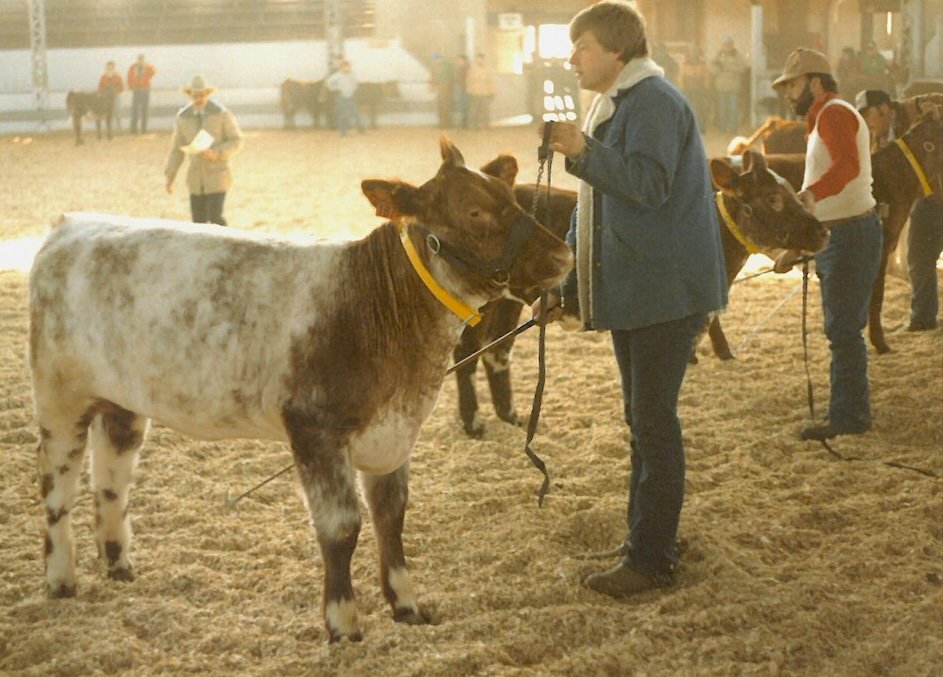
Oakview Irish Bess, daughter of Lazy D Ultimate Type. Top selling female at the Iowa Beef Expo.

I suppose it was the lack of success in my quest for increased frame size, but somewhere along the line I decided I needed to try something else. This is what drew my attention to the Irish Shorthorns and Lazy D Ultimate Type. I had some reservations because I knew there was no actual recorded ancestry on almost all of the Irish cattle. If you pull up Ultimate Type's registration paper, you will see there are no animals listed behind his sire, Deerpark Leader. It just says "foundation." I really didn't consider the lack of documented ancestry very much at the time. He was a tremendous bull, his relatives in this country were extremely successful, and he was in the herd book. His first heifer calf was the top seller at the Iowa Beef Expo and I remember ASA Executive Secretary Roger Hunsley was extremely complimentary of her. Ultimate Type was one of the best breeding bulls I ever used and have often thought of the fame he would have gained had he been in a more noted herd. He was recognized by the ASA as a Balanced Trait Leader for several years.

In spite of the relative success of the Shorthorn herd, the lingering effects of the 1977 total crop failure still lingered. Things just seemed to pile up. Sometimes it seemed as if the light at the end of the tunnel was a train. We had fed several loads of cattle for many years. The order buyer we used retired, and another took his place. We had never fed black cattle because at that time they just didn't grow. Well, the new order buyer got a hot deal on some black heifers for us. They were done when they got off the truck. They weighed maybe 450 pounds and were just finished. We typically successfully sold grade and yield to either Bookey Pack or IBP in Des Moines. Nobody would touch these heifers. We got them to about 800-850 pounds and that was it. We ended up selling them to a small packing plant in Mason City or Fort Dodge, I can't remember which.

Lonny’s granddaughter Katie Rouse “showing a high frame-score Hereford”.

The buyer also sent us a group of Polled Hereford heifers. These were big-framed, growthy heifers that weighed in the mid-600 range. About 2 months later, our well-trained eye determined that most of these heifers were bred. Definitely not the calves we were told they were. We calved them out and then later fed them as heiferettes. On the bright side, we truly learned to appreciate the milking ability of our Shorthorn cows. I had basically been working for Dad on the farm with a small herd of cows of my own. To help out I purchased the hog operation. It might have been a good thing had the hog market not tanked and the price of the corn I needed to purchase shot through the roof. I sold my steer calves as feeders and felt fortunate to get $.60/pound and hoped they weighed 500. Several of us sold bull calves at the Beef Expo for around $500 to a big Western outfit. After the sale, their agent told us we had to take the calves home, feed them for 2 months, bring them to Omaha on the first of April, and the big outfit would take them and send us the money when they got them sold. We were told we had to transfer ownership of the calves immediately. That didn't sit well with a couple of us and we refused to relinquish the little security we had. Lots of nasty phone calls, but that's exactly what we did. I think we got our $500 about May 1 and then transferred the papers.

I had two 3/4 brothers, both sired by Clark and out of Foxdale Favorite Robin cows, Admiral Halsey and Monaco Prince. I absolutely loved those bulls. However, I decided to sell Prince at the Polled Congress. I hated to sell one. The morning of the sale, Dale Studer came up to me and said that Admiral Halsey had jumped a gate at home for some reason, got hung up halfway over, and died. Kathie had called him and said Mom and Dad didn't want to tell me because they were afraid I'd pull Monaco Prince from the sale and they knew I needed the money. Both were true. I loaded Prince up and headed home, still broke. I'll never know what caused Admiral Halsey to jump that fence. There was nothing on the other side. Nothing. Of course, the gate had been hung correctly, not just wired to the post. If it had been just wired, it would have fallen and he would have been fine. I still have a few straws of his semen I'd love to use someday.

Of course, then interest rates spiked to 15% for farm operating money. All the money I had used to buy out the hog operation was borrowed. Try taking 15% off the top of everything you sell. I wasn't the only one. It was universal. If you didn't live through the 80s, it's hard to understand. It affected everyone in the rural communities, Farmers, ag businesses, local grocery and hardware stores, you name it. We were taught that if you worked hard, you would succeed. I think all of us were working as hard as we could. You relied on your faith, family, and friends to get through. I guess we were blessed to make it through to the other side. All the hogs were sold, so the only thing I had left was my cow herd. I made the decision to finish my last year of college and sell the cow herd. Duane Sicht of Missouri purchased the entire herd including Lazy D Ultimate Type.

Shorthorn-Simmental x being shown by Lonny’s daughter Betsy

I got my degree in Ag. Ed. at Iowa State and got a teaching job in eastern Iowa. My daughters, Betsy and Andrea, were old enough to start showing and Dad let us borrow a few steers and heifers. Most of Dad's calves were Shorthorn-Simmental crosses so we had a few of those along with a couple of Shorthorns. I eventually purchased a few Shorthorn heifers from him and we started slowly rebuilding the herd. I think we had 3 daughters of Lazy D Ultimate Type and a daughter of Prairie RR Babe Ruth my daughters purchased from Dean Fieser.

About this time the ASA herdbook was thrown wide open. About anything with size had been used in the Appendix program, now called Shorthorn Plus. The ASA board determined that once an animal reached the 15/16 level it was considered 'purebred'.  Black hided cattle were not to be considered purebred regardless of the percentage they reached.  The previously discussed bull Ayatollah was considered a purebred Milking Shorthorn, but not a purebred in the ASA herdbook because he had some genetics in his background that the ASA did not recognize.  Eventually the ASA declared him a 7/8 Shorthorn, eligible to sire purebred Shorthorn calves when mated to a purebred Shorthorn cow.

Mike Studer had a 7/8 grandson of Ayatollah, out of a 3/4 Shorthorn cow that went back to the noted Chianina bull Black Power Play, that we purchased. His name was MR Red Man and we had great success with him. His sire was Lefty 83rd, recognized as a purebred Shorthorn (15/16) since his sire was the 7/8 Ayatollah and Lefty’s dam was a purebred Shorthorn.  Red Man's dam was considered a 3/4 Shorthorn since she went back to Black Power Play and was out of a purebred Shorthorn.  Confused?  There's a reason why I entitled this article Hodgepodge.

Oakview Powerplant, “7/8” Shorthorn

Later the ASA determined that Maine Anjou had enough Shorthorn genetics in their development that they allowed full blood Maine Anjous into the herd book at the 3/4 Shorthorn level, and I took full advantage of that. I raised a bull, Oakview Powerplant, sired by the full-blood Maine Anjou bull Etula, and out of a granddaughter of another full-blood Maine Anjou bull, Dollar II. Here's where it gets even more confusing unless you lived through it.  He was considered to be 5/8 Maine, 7/8 Shorthorn, and he sired purebred Shorthorn calves.  Here’s how ASA came up with those numbers:  From the Maine Anjou standpoint, Oakview Powerplant  was a direct son of the fullblood Maine Anjou bull Etula, so he was 50% or 4/8 Maine Anjou on the sire's side.  On the dam's side, his mother was sired by a bull I raised named Oakview Sultan.  He was a direct son of the fullblood Maine Anjou bull Dollar II and out of a purebred Shorthorn cow.  Since Dollar II was fullblood Maine Anjou, Sultan was 4/8 or 50% Maine Anjou.  Sultan was bred to a purebred Shorthorn cow, so the resulting calf, the dam of Oakview Powerplant, was 2/8 or 25% Maine Anjou.  Add the offspring percentages together and you get 5/8 Maine Anjou.  From the Shorthorn view, Etula was considered 3/4 Shorthorn since he was a fullblood Maine Anjou.  Powerplant's dam came in as a purebred Shorthorn.  Her grandsire, Dollar II was considered 3/4 Shorthorn as a fullblood Maine Anjou.  His son, Oakview Sultan, sire of Powerplant's dam, was recognized as a 7/8 Shorthorn since his dam was a purebred Shorthorn. Powerplant's dam was considered a purebred Shorthorn (15/16) since she was sired by a 7/8 Shorthorn bull, Oakview Sultan, and out of a purebred cow.  So, Oakview Powerplant came in as a 7/8 Shorthorn. (3/4 bull X purebred cow.  Remember a 15/16 is considered purebred). Aren’t percentages amazing!

Son of Oakview Powerplant, Res. Champ. Steer. At left is Iowa Lassie Queen (Lonny’s daughter Andrea).

One of Powerplant’s calves was reserve champion steer at both the Iowa Beef Expo and Iowa State Fair. A daughter won her class in the tough feeder calf show at Des Moines. For small timers, we raised quite a few good show steers back then. I absolutely loved working on genetic combinations to see what I could come up with. Some of the results were quite unique to say the least. We had come a long way in 25 years. The first Shorthorns we had were probably 4.5-5 frame scores and in the early 90s they were perhaps 8+.

The genetics were not remotely connected with what we started with. In a span of less than 10 years, we had incorporated the Irish Shorthorns with little or no documented ancestry, and whatever genetics the cattle world offered through the Appendix Shorthorn program. By then Scotch-type Shorthorns had all but disappeared. The dual purpose type had been all but absorbed into whatever other genetics were in the breed. During that time period it was the same for every breed of cattle in the U.S. The Milking Shorthorns accepted Australian and New Zealand genetics and even Red & White Holsteins. The Angus basically accepted whatever blood produced 'typical Angus'. I knew a young man that claimed his class winning 'Angus' heifer at the Iowa State Fair had blood typed purebred Angus, but she was sired by a fullblood Maine Anjou bull.  He had registration papers from both the Angus and Maine Anjou Associations.  I was there as he loaded her on a trailer as he had sold her after the show in Des Moines and heard him ask the buyer if they wanted Angus or Maine Anjou papers or both.

The rat tails of the Herefords led to speculation of perhaps some Simmental blood? There are very, very few Continental breeds that resemble at all what their ancestors looked like when they were first imported into the U.S.: i.e. Black Simmentals, Maines, Limousins, Chianinas, Salers—now with black coats? Right. It happened. People used whatever they thought they needed to improve what they had. We might long for the good old days, but I guess the folks that 'invented' the first of every breed used whatever tool they had at their disposal to mold what they wanted. Things are no different today. I guess we're lucky there are some old-time, heritage genetics around, though, of nearly every kind.

Red Bull calf sired by Oakview Powerplant and out of a daughter of M R Red Man

2024

Longevity--The Forgotten Genetic Trait

This article was initially posted on the “The Shorthorn Bulletin” website and has been reprinted here with permission by it’s author: Joseph A. Schallberger, DVM, PhD


History:

Most readers will agree we have become a throw away society with little concern about the impact. Advertisers constantly promote the newest, improved, and beneficial product with the hope we will toss what we have and buy the new product. Many of us who grew up in the 50’s and 60’s can remember businesses, such as small appliance repair shops, that were predicated on fixing and maintaining the viability of a product rather than replacing it. Economics were the driving force but most consumers did not buy into the hype we are all confronted with today through the internet and cable television. Cows have become the throw away commodity of the cattle business. Today both dairy and beef producers don’t even give “lip service” to the fact that the productive life of a cow is an important consideration in the profitability of their operations. The average dairy cow barely gets through her second lactation and the average beef cow, depending on who’s statistics you trust, does not stay in a beef herd past her 6th birthday. Unfortunately most cattle breeders today, both dairy and beef, buy into the constant promotion by Artificial Insemination companies and Seedstock producers that there is an urgency to “upgrade” their cow herd through the latest greatest bull. The continual promotion of show ring cattle also has a negative impact because longevity is never a consideration in judging.

Profitable Longevity:

Guckian’s Betsy Pet Dawn (dam of “Columbus”), born 1964, pictured at 14 years of age.

The Guinness Book of World Records lists an Irish Friesian cow, Big Bertha, as the oldest cow to have ever lived. She lived to be 48 producing 39 calves during her lifetime. I would not call this profitable longevity. Profitable longevity can be defined as when the cost of maintaining a cow in the herd is less than the cost of replacing her. This metric includes her ability to wean a calf every year and breed back within herd parameters, while maintaining her health and feed efficiency. The lifetime value of a cow actually increases as she gets older if she continues to exceed herd culling criteria. A productive cow at 10 years of age has put more dollars in a farmers pocket than any “fancy” 4 year old because she has a proven track record. In addition, the 10 year old’s daughters have more value because their dam met the “show me” standard. Prolonging the date a cow needs to be replaced allows a breeder to sell more heifers and increases net profit. A healthy, mature cow that calves every year is a known quantity. while a first calf heifer carries risks that are uncommon in mature cows which have successfully and consistently produced good calves.

What Has Caused Longevity To Decrease?:

Cattle longevity can be attributed to many factors but the overriding factor is they have the right genes. Certainly environment, health status (proper vaccinations), nutrition, structural soundness, disease resistance, and owner management all play an important role in a cow’s ability to have a long productive life. Shorthorns have always had a reputation for being long lived cattle but that has been reduced by neglecting to actively select for this trait, and by the introduction of certain other cattle breeds into the Shorthorn gene pool.

There are innumerable reasons as why a beef or dairy cow may be culled. The most common issues would include reproductive problems, udder breakdown, disease (particularly Johne’s and Bovine Leukemia Virus), lameness, unthriftiness from dental disease, poor milk production, and bad temperament. Each of these reasons have their own permutations but a cow who is in a herd at 10 years of age has undoubtedly surmounted them all. Her genetics have great value because she has met the challenge of her environment, be it the winters of North Dakota or endotoxic affected fescue fields in Missouri. A breeder can spend all day looking at EPDs but no statistical analysis can match the real world productivity of that 10 year old cow. I would take her daughter for a replacement heifer over any spiffed up EPD selected heifer put forth by “breed fashionistas”. Many would call this approach old fashioned but just ask anyone who has seen the disastrous results from selecting offspring based only on EPDs whether they are having second thoughts about selection methodology.

Longevity has been “left at the barn door” because most breeders do not have a real breeding program that takes it into account. They are more concerned with the latest trends in cattle production and are wedded to the constant churning of EPD data from Enhance EPDs to the new Bolt technology. Certainly there has been some awakening to the longevity issue but I do not believe proper consideration is being given to how important profitable longevity really is. When culling is based on the belief that the heifer being born today is automatically better than the 10 year old cow in the field, average herd lifespan is being shortened and genetic selection for longevity disappears. It is more likely that the 10 year old in the field will have an enhanced genetic influence on the herd than a purchased 2 year old heifer who has no track record.

How To Improve Profitable Longevity:

TLC Erica X002 (dam of KAMILAROI MEAT PACKER), shown at 17 years of age in the Australian Outback.

Selection. Selection. Selection. Using bulls that have longevity in their pedigree when producing replacement heifers is the quickest way to instill longevity in the herd. Utilizing replacement heifers from cows that have been long-lived productive members of the herd enhances the rapidity with which a breeder can increase herd profitable longevity. I am not saying to ignore other selection criteria, but if everything is fairly equal, the older cow’s heifer calf has more value for replacement. There is no short term fix for the longevity problem but with sensible selection criteria and patience it’s a realistic economically rewarding trait to have in a breeder’s cattle herd.

The “Other Shoe”— Animal Rights:

I have always thought that the Animal Rights Movement in the European Union is the trendsetter for Animal Rights in the United States. Cattle breeders in general, dairyman specifically, should take heed from the warning that is being projected from the EU regarding the short lifespans of cattle raised in EU countries. The belief is that high intensity production methods, i.e. confinement operations, are the prime reason for the reduced lifespans in cattle. The goal of the Animal Rights Movement goes well beyond concern for cattle lifespans but it is being used to further drive a wedge between cattle producers and consumers. Being cognizant of the future implications should cause producers to re-think their de-emphasis of longevity and return to placing more importance on it in their selection process.


Realistic Goals For Longevity:

Personally my goal has always been for my cows to have average productive lives of 12 years. I realize that, given the harsh environments of many producers, it is probably not realistic for them though I still believe that selective steps can be taken to lengthen the productive longevity of their herds. For many beef herds a goal of 8-10 years and for dairy herds 6-8 years would be a drastic improvement. By ignoring this issue breeders are short changing themselves economically, doing a disservice to their cows, and opening up the burgeoning Animal Rights issue of shortened lifespans in cattle. Being proactive today will help mute criticism and produce happier cows and wealthier owners.

Whisper Rose, pictured at 17 years old, has produced & raised 18 calves and is expecting another calf in Spring 2025.


Joseph Schallberger, DVM, PhD
Whispering Hills Farm
Member Academy of Veterinary Consultants

2024

A Shorthorn Heritage (Part 7): "Glory Days" (and some not so much)

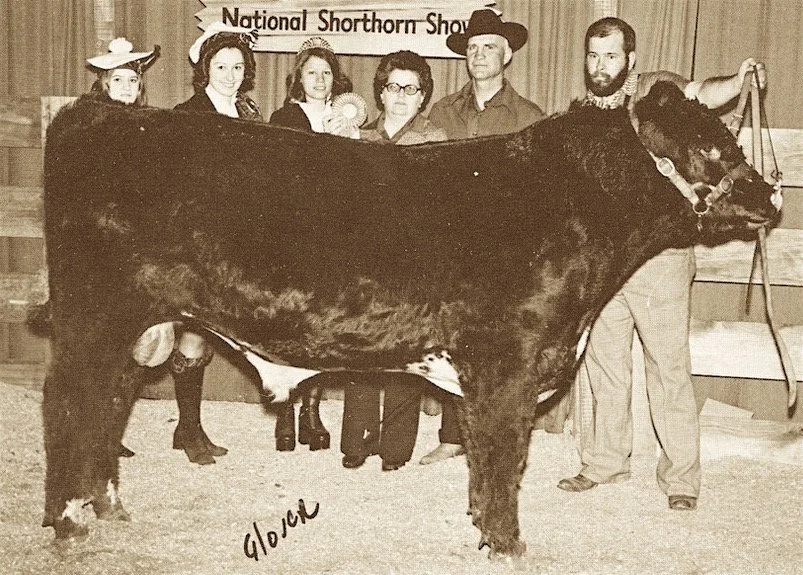
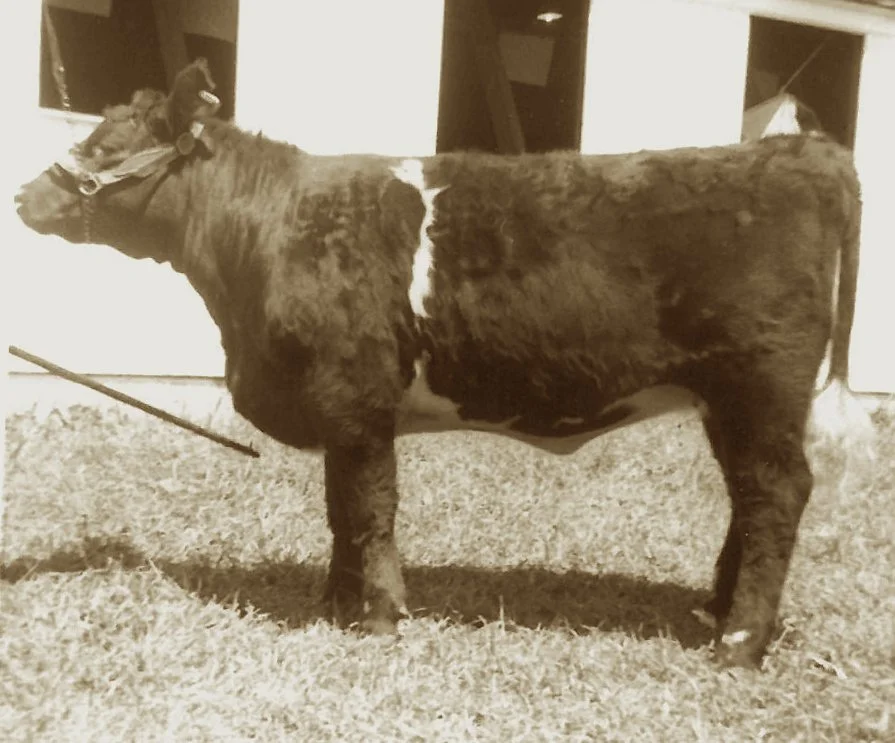
Everyone that breeds or shows purebred cattle has had a few that they remember for a long, long time.  Maybe it's the first calf you ever had, the first cow you ever bought with your own money, or for many Shorthorn breeders it's a white heifer.  I wish I had a dollar for every time someone told me they fell in love with Shorthorns because of a white heifer.  I've been at this for a long time, maybe that's why there are so many that have held a special place in the heart.  The first one, though, was that white Leader 21st heifer that I won the Iowa State Fair junior show with.  Then there was Justamere Todd.  Winning the Iowa State Fair open show was a thrill I'll never forget.  Maybe it was luck, maybe it was just being in the right place at the right time, it doesn't matter.  To find a bull like that and accomplish what he did was an unforgettable experience.  I bought Todd in late spring of 1975 and wanted to show him later that year so we bred only a very few cows to him.  We used him more heavily the next year and went into winter of 1977 with great anticipation.

Justamere Todd as Grand Champion at the Iowa State Fair, being held by Lonny

The fall of 1976 was extremely dry in our area.  There was no fall rain to speak of and absolutely no snow.  We had feedlots full of market cattle, about 50 purebred cows, 25 Suffolk ewes, and an 80-sow farrow to finish hog operation.  Our hog facilities were much different than those of today.  We had ten 24 X 48 buildings with a 24 X 48 concrete pad in front of each.  Two buildings stood side by side, maybe 50 feet apart, then another pair maybe another 50 feet away.  One building was used for an 18-stall farrowing house, another for a nursery and over run farrowing needs, 6 were used for finishing hogs, maybe 125-150 per pen, and 2 others for storage.  Each building had a water hydrant and the pens for market hogs had 4-way cup waterers.  It was so dry that by January of 1977 the underground water lines began freezing.  The cup waterers were warm, but the pipes that fed them were frozen.  Then the lines to the hydrants froze.  Soon I was down to three working hydrants.  To provide water to the hogs, I bought several metal hog troughs and pieced together up to 200' of garden hoses.  Every morning I would put the trough in the hog pens, one by one, and stand there with a hose trying to hit the constantly moving target of the water trough with 100+ hogs battling for what they thought was the last drop of water on the face of the earth.  After finishing the west half of the lots, I moved the hoses to the next working hydrant and finished the remainder of the pens.  I then pulled the hoses back into the warm farrowing house and rolled them up.  The process was repeated every evening, every day, until the last water line finally thawed in April.  Imagine, if you will, holding a garden hose in below zero temperatures for maybe 15-20 minutes, water splashing on you, every piece of clothing frozen stiff, then moving on to the next pen to repeat the process.  I suppose it took 2 hours, day and night, to finish the process every day for 3 months.  

I was so happy when that last water line thawed, but the problems were not over.  There was no snow, so there was nothing to melt in the fields.  There was virtually no spring rain.  We planted our crops into essentially dry dirt.  It was next to impossible to follow the row markers when planting.  Some crops germinated, most did not.  The corn that did germinate didn't last long.  The pasture was nonexistent.  A neighbor had quit feeding cattle then and he sold us his bunker silo full of silage from the year before.  That got us through for a while.  We finally got some rain just as the state fair started in mid-August, but it was way too late for the crops.  The pastures greened up, so we did have some fall pasture.  The only soybeans we harvested were on a rented farm 3 miles south of us and they yielded almost 6 bushels/acre.  We had no silage to chop and no corn or beans to combine at home.  Crop insurance was nearly unheard of at that time so there was no help.  Imagine investing all the money to put in your crop and getting no income.  It's hard enough to go without income from losing a job or for other reasons, but to have all the cash invested on top of it is something that is almost impossible to recover from.  Added to that is the fact that we had to buy all the grain to feed our livestock.  I wouldn't wish that experience on anyone. A very small area around us was the most affected.  I had several friends within 5 or 10 miles that got a few small showers that allowed them to get 1/3 to 1/2 a crop.

Justamere Todd daughter which was the dam of a Minnesota St. Fair reserve champion bull

We got our first real sampling of Justamere Todd calves in 1977 and they were everything I had hoped for.  We didn't start calving back then until about April 1st, so there were obviously no problems with spring mud that year.  There was an early spring yearling heifer that was always in the top 2 or 3 of her class, but could never get around Greenley's Millvale Prairie Pearl heifer that won the National Junior Show.  Oakview Swamp Fox (a son of Justamere Todd) won his class every time shown including at Denver and was later named an All American.  Others included a reserve champion bull at the Minnesota State Fair, the top selling female at the Iowa Beef Expo, and many others that represented our herd well.  Later on, I was able to purchase several cows from the Jones Family of Washington, Iowa, the breeders of Todd.  They included four half-sisters to him, Roan Beauty, Justamere Staci, Justamere Clarabelle, and Justamere Monica 3rd.  The other two were Justamere Hildegard and Justamere Missy.

All were tremendous producers and the real dual-purpose kind.  I bought Staci and Clarabelle at the Iowa State Fair following the Milking Shorthorn show and stalled them with my beef string when I brought them to Des Moines.  There was a young man there that had sold the Des Moines paper in the barns for as long as I could remember.  He came by my stalls twice a day saying, "Lonny.  When you gonna milk those cows?"  I did take them to the milking parlor twice a day and we had a good time.  Everyone in the barn knew the story, but a few asked me if I was going to show them in the beef show.  I told some them, "Of course."  I knew full well all the time I couldn't for a variety of reasons including they had not been transferred to my name and were not yet double registered with the ASA.  Virgil Wegener of Hub's Shorthorns finally came over and asked how I was going to show those cows.  I smiled and told him of course I couldn't and we had a good laugh.

Now I had to figure out the next step in our genetics.  Dad had purchased Weston Garrison, a son of Weston Goliath, plus a son of Mandalong Super Flag, but I was not too interested in using them because I felt they didn't have enough growth for the time period.  I had always admired the Graham cattle, so the logical choice for me included Clark, Columbus, and Great White Hope.  Clark and Great White Hope seemed to work best on my cows.  I didn't seem to have a very good conception rate with Columbus, so I had very few calves by him to compare.  Several of the best cattle I had raised up to that time were sired by Clark and out of the Foxdale Favorite Robin cows I had purchased.  Admiral Halsey, out of Justamere Clarabelle, was Iowa Champion and reserve overall at the Iowa State Fair, reserve Senior Champion at the Illinois State Fair, and a two time All American.  Monaco Prince, out of Justamere Monica 3rd, won his class at both the Iowa and Illinois State Fairs and teamed with Admiral Halsey to win the pair of bulls class at Des Moines and Minneapolis.  Justamere Staci produced the champion and top selling female at the Iowa Beef Expo.  We used Great White Hope on several Todd daughters with great success, too, producing a member of the champion pair at the Iowa Beef Expo and other good show cattle.

Beef Expo Champion pair. Bull (Great White Hope son) won his class, and heifer (Clark daughter out of Justamere Staci) was grand champion. People L to R: Steve & Linda Haywood, Lonny Flack, Flack’s daughter Andrea (Lassie Princess), Susan Flack is the Lassie Queen, and nephew Derek (prince).

Artificial insemination allowed us to use several bulls that we otherwise couldn't afford at that time. Soon, though, I began searching for a bull that I liked to turn out in the pasture.  Bob Miller in North Dakota had several Hilltop Lancer 457 sons that I wanted to see, so one evening Dale Studer and I took off for Fordville.  We drove all night and finally stopped for a brief nap at a rest area somewhere around Fargo.  We pulled into Bob's driveway around 10:00 a.m. and he showed us his bulls.  The two I liked best were named Mr. Majestic and Jubilation.  Bob was especially proud of Majestic and just went on and on about how he looked down his top.  I could see that, but he insisted that I climb into the hay mow to get a bird's eye view.  I finally relented and up the ladder I went.  I was interested in the bull, but didn't think I could afford the price tag. On our way home we drove to Waverly, Minnesota, to see what the Grahams had.  It was maybe 11:00 p.m. when we got there, but they had lights on the round barn and we were told to make ourselves at home and look around.  I had driven the entire trip, but when we got just south of Mankato I had had enough.  Dale took over the driving.  I don't think we'd driven a mile when we met a semi coming towards us with a deer standing on the dividing line of the highway.  Fortunately, it didn't move and both vehicles just missed it.  Needless to say, I was awake then and drove the rest of the way.  

Soon after that trip, Rich Studer and I set off for Plains, Kansas, to visit Dean Fieser.  Nelco McLeod was one of my favorite Lancer line bulls plus he was polled.  I didn't buy a bull there, either, though there were several I liked.  That, too, was an interesting trip.  Rich had spent time in Vietnam and wasn't as nervous about spending the night at some stops I wasn't too sure about.  I decided to use Admiral Halsey on my cows and it turned out to be a good decision.  The Admiral Halsey calves, in my opinion, were just right for the times.  Good growth, excellent conformation, correct, stylish cattle with adequate depth and thickness.

Admiral Halsey (Justamere Todd son) was Iowa Champion and reserve overall at the Iowa State Fair, reserve Senior Champion at the Illinois State Fair, and a two time All American.

I couldn't help but notice the rising popularity of the Irish Shorthorn cattle (which are not Heritage Shorthorns).  Since they had become accepted into the ASA herdbook, their use became widespread.  The Alden family from Missouri made a huge splash in the breed with their offspring of Deerpark Leader 13th (Dividend) and Deerpark Improver, the very bulls I had seen on display in Denver several years earlier and passed by because their calves could not get fully into the herdbook.  Dividend became the most popular in the United States perhaps because he was the larger framed, more extended bull of the two.  I had not used any Irish breeding up to that time, but thought perhaps they could improve the rump structure and feet and legs of some of the other popular cattle of the day.  Richard Dolginow had founded a new herd near Excelsior Springs, Missouri, and had imported several full Irish cows.  I called Richard and he said he had some bull calves I might be interested in.  Kathie and I drove down to take a look and I immediately picked out two calves that stood out from the rest.  Lazy D Ultimate Type and Lazy D HL Quane.  Richard and his manager, Larry Moorehead, told me earlier that Ultimate Type was so named because of his impeccable structure and appearance.  They weren't kidding.  Quane was almost as impressive to me due to his substance, growth, and bone.  I ended up selecting Ultimate Type because, in additional to his tremendous eye appeal, his sire was the original Deerpark Leader, his dam, Highfield Una 3rd, was a faultless cow, and his full sister, Lazy D Deerpark Una, was one of the top heifers I had ever seen.  Quane's dam, Ballyart Snowflake, was a legendary show cow overseas, but I just couldn't resist Ultimate Type after I had seen him.  With Admiral Halsey and Lazy D Ultimate Type roaming the pastures, I thought I was set for years.

Oakview Ad from 1983 highlighting some of Lonny’s cattle which he talks about in this article.

2024

A Shorthorn Heritage (Part 6): Show Tails

Story County Fair outdoor arena in 1960’s

Our family started showing cattle almost 60 years ago. Along the way, we have also shown sheep and even a few hogs. We started at the Story County Fair in Nevada, Iowa, and have shown at many junior and open shows across Iowa, several state fairs, and at Kansas City, Louisville, Chicago, Denver, and Fort Worth. Someone in our family exhibited at the Iowa State Fair for 52 consecutive years until 2020 when Covid put a stop to the streak. It was something we always looked forward to. From the early days when we spent much of our time sitting on the tractors in the machinery displays, sliding down the newfangled gravity flow wagons, learning how to play penny poker on the show box, or slobbering snow cones, there were always new things to explore and new people to meet. It may come as a surprise, but going to a show is not all business. It’s also no surprise that things don’t always go smoothly at the fair. There’s always something that comes up which changes your plans or makes you shake your head. The one thing you can always count on though, is that no matter how much cash you take with you, it’s always gone by the time you go home. For the following, please remember the statute of limitations has expired for these occurrences and names may have been changed to protect the “innocent”.

We always tried to have our cattle well broke and tame before going to the county fair. There are always some ill-tempered animals that you have to deal with. I can remember several instances where a calf got loose and ran through the grounds, even leaving town on some occasions. Calves might get loose in the show ring and the ring men would be there to help grab the halter. This seemed to escalate when Chianinas became popular in the 80’s. The championship drive was often held at night in an outdoor horse arena. There were no tie outs at that time, so the calves were confined to a hot, humid barn and got little exercise for several days. Naturally, when they entered the outdoor arena, it was like being turned out to pasture. More than one kicked up its heals and went skipping across the arena. One particular steer got spooked and was finally captured at a farm over a mile way. On the other hand, a neighbor had a Hereford steer that had been treated with tranquilizers and laid down in the show ring and would not get up. He had been the breed champion and they had to continue the show around him for awhile until he finally stood up. Of course, we never had an animal act up at the fair. Wrong! My sister, Susan, took a pretty good Simmental cross steer one year. He was always calm at home and never caused any problems. We took the cattle in one evening, bedded them down, and went home for the night. The next morning, when I walked into the barn, his halter had been pulled so tight that I could not get it untied. He was blowing smoke, as they say. I brushed him for a while and he seemed to calm down. As a precaution, I decided I better lead him to the scales for weigh in. He seemed a little more alert than normal and we got to the scales with no issues, but then ran into trouble. After you leave the scales, there’s a somewhat narrow alleyway between two building to go through before you go across the grounds and back to the barn. When we got to the end of the alleyway, there was a loud noise, and he was gone! We followed him as he left the grounds and headed towards the northwest bridge. We thought we had him. Terry Robinson climbed up the west side of the bridge and I got on the east side. He charged at Terry and he had to jump off the bridge. The steer then streaked north on the blacktop. About a quarter of a mile north, he turned onto a gravel road and ran into the first farm yard he saw. When he ran into a corn crib, we shut the doors behind him. I got the trailer, backed it up to the door, and we carefully loaded him. I hauled him home and turned him into the feedlot. The next morning, I walked up to him at the feed bunk and casually removed his halter. I found out later that after we had left for the evening, two young girls would hide behind the stall divider, jump up, and throw water balloons in his face. I guess I’d have been a little excited too.

We started consigning cattle to the Iowa Royal Shorthorn Sale in the early 70’s. Our first consignment included two bred heifers and two heifer calves. None had ever been shown, but I had them broke pretty well and they were reasonably quiet. I had been washing, brushing, and clipping in the farrowing house and had them all ready to go. There were no livestock trailers then, so we had Charlie Henson haul them to Des Moines for us and had used a loading chute to unload the cattle. Someone was clipping cattle right at the bottom of the chute and one of the bred heifers lunged a little as she came off the end, like they always seem to do. I slipped on some ice and dropped the halter. The heifer wasn’t spooked, I just dropped the halter when I fell. She walked from the west end of the main cattle barn into what is now the tie out area. Of course, the snow was two feet deep. There were a few security guards there doing a wonderful imitation of Keystone Kops. I asked them to just stay away, trudged through the snow, and led her back to the barn without incident.

Lonny with his family enjoying the Olde Mill ride at Iowa State Fair.

I almost never went to the midway at the Iowa State Fair. The furthest north I usually made it was Ye Olde Mill. It was relaxing, cool, and a highlight of the fair for me. I later took our kids and grandkids on a ride every year. After the show, we would go to the Iowa Cattleman’s booth for prime rib and head straight to the Mill. In the old days, most everyone washed their cattle with Orvus. It came in a gallon jug and was a white, somewhat solid substance when cold and a clear jelly like material when it was warm. I heard once of a group of young people that decided it might be a good idea to take some plastic bags full of Orvus to the Mill, empty them in the water, and see what happened when it hit the giant paddle wheel. I can’t say if it ever really happened or what effect it might have had, but I’m pretty sure there is an anti-sudsing agent in the water now!

There was a small grocery store on the grounds just east of Ye Olde Mill. One year, to save money, I decided to buy a loaf of bread, sliced cheese, and a package of bologna. I had a sandwich or two and put the rest in my suitcase in the FFA dorm. It never got below 110 in the FFA dorm in those days. I was ready to go to lunch the next day and told our neighbor lady, Wanda Carlson, what I was doing. She informed me it might not be such a great idea for reasons obvious to her, but not to me at the time. I opened the suitcase and noticed a somewhat foul odor and discovered the bologna was about twice the size as it had been when I bought it. Lesson learned.

I also heard a story about three guys, let’s call them Moe, Larry and Curly. They ventured into the midway one evening and Curly started to play a game of chance. The object was to toss a ping pong ball into a mug or something. If successful, you won a prize. Somehow, Curly won a prize which turned out to be a gold fish in a plastic bag of water. As they headed back towards the livestock barns, the discussion centered on what in the world Curly was going to do with the stupid goldfish which, by the way, was impossible to determine if it was even still alive. Larry accidentally knocked the bag out of Curly’s hand and it fell to the concrete, splitting the bag and leaving the poor goldfish on the side walk. Quick thinking Moe grabbed the gold fish, lifted up the flap on a concession tent, and put the fish into a jug of lemonade, perhaps saving its life!

One particular year at the Iowa State Fair it was absolutely scorching and for some reasons the flies in the barn had to number in the billions.  Gallons and gallons of fly spray didn't seem to do any good.  It was almost unbearable for humans and cattle.  Kevin Lamparek decided he wanted to take a nap on a reclining lawn chair, but spent so much time fighting flies he finally gave up and completely enclosed himself in a sleeping bag.  Tom Adams and I decided we should take the opportunity to loosely wrap twine strings around him and the chair, slowly pull them tight, and then loudly yell that the cows were out.  Kind of a mean trick, but everyone except Kevin thought it was funny.

I started going to the Minnesota State Fair in 1975. It soon became one of my favorite places to go. It was a couple of weeks after the Iowa State Fair, always seemed a little cooler, had great cheese curds, and the Olde Mill ride was longer. In the early 80’s, I travelled to Minnesota in a caravan with Dale and Craig Studer from Wesley, Iowa, and Duane Harms from Crystal Lake, Iowa. I had a much overloaded 16-foot bumper hitch trailer with six head of my own. Dale had purchased Dayspring Buttercup 2nd from David Castle from Eldora, and wanted me to pick her up. So, I stuffed her in and off I went to Wesley. I probably drove in excess of 100 miles out of my way, but it was fun to travel together. We were rolling into St Paul, maybe two miles from the fairgrounds, when I heard a squeaking noise. I thought it couldn’t be me, but as I slowed down for the next stop light, the squeaking slowed down right with me. I turned into an abandoned gas station lot and sure enough, the right rear wheel fell off the trailer—the whole wheel. I sent Duane and Dale on to unload at the fairgrounds so they could come back for my cattle and tack. I tied three cattle on each side of the trailer. It wasn’t more than two minutes later until I was completely surrounded by community residents from 2 to 40 years of age and from probably all over the globe. It was a blast! Everyone wanted to touch the animals and could not believe how soft they were. I seriously doubt if any of them had ever seen a live animal other than a cat, dog, or a rat before. It was a once in a lifetime opportunity. Dad brought up a new bearing when he came up for show day.

The Minnesota State Fair is absolutely relentless regarding ring worm and warts. The state vets constantly monitor the cattle and any animal showing signs are immediately placed in a quarantine barn, making them ineligible to show. I don’t know if any cattle have ever died from ringworm or warts, but they shouldn’t be at the fair. One year, a particular breeder, let’s call him Stanley, had a very light pigmented heifer that broke with a very slight ringworm the day he left for the show. He had six head entered and needed all six for the prestigious six head class. Oliver was there when Stanley started to unload and suggested that he leave the heifer in the trailer in the parking lot and bring her over the night before the show. The entire Shorthorn show contingent was very aware of what was going on and decided to help pull it off. The fair vets came around and were always given the excuse the that heifer was at the wash rack, someone was clipping her, or whatever excuse someone could think of. Same with the tattoo inspection crew. Show day finally arrived and Oliver brought the heifer over in the trailer about 3am. Stanley led her into the show ring and fair personnel immediately walked up to Stanley and informed him they never got a chance to check her tattoo. They read the tattoo and that was it. I think the heifer was 2nd or 3rd in the class, but Stanley did win the best six head class.

Students in the livestock judging team taking notes during a practice session.

I was always thankful that I attended a small school where I had the opportunity, and responsibility, to be in everything.  My days in 4-H and FFA provided so many chances to be involved in public speaking, group activities, and individual and team contests.  Among my favorite events were livestock judging contests.  We participated in local, state, and national events.  It was only natural, then, that I tried out for the Iowa State livestock judging team in college.  The first course was basically an introduction to livestock evaluation and at the end of the term, Doc Warner, the coach, encouraged me to continue on with the team since I had done quite well in the introductory class.  We spent countless hours judging cattle, hogs, sheep, and horses.  We not only placed the animals, we had to give an oral set of reasons explaining and defending our placings.  I will readily admit my biggest challenge was horses.  Dad had a few Arabians, but all the horses at ISU and in the contests were Quarter Horses.  Kind of like the difference between an Angus and old style Limousin.  Our first official trip was to Denver.  We left well in advance of the Denver contest and made numerous stops along the way to hone our skills.  I was the only one on the trip that did not chew tobacco.  We drove a 15-passenger van and a pop bottle was passed around to collect the tobacco juice. Not my favorite part of the trip.  We stopped at Gene Doran's near Beaver, Iowa.  Gene had been on the ISU judging team previously and Doc Warner told us he was the only member he had ever had that did not take notes during contests.  That was no small accomplishment considering you had to give oral reasons from memory on most of the classes you judged.  We then stopped at Wiese Herefords in Southwest Iowa and traveled on to Eastern Nebraska to several horse ranches.  It seems like all I saw for three days were horses.  I think I was more mixed up when we finally moved on than before we got there.  I certainly had seen enough Quarter Horses.  We had an all species practice contest at Lincoln, Nebraska, visited a few more horse ranches, and then moved on to Colorado.  There was another practice contest at Colorado State in Fort Collins and it went well.  Then it was on to Denver.

We stayed at the Albany Hotel in downtown Denver and our rooms were on the top floor.  There was a rickety old fire escape right outside the door to my room and I made the mistake of mentioning my absolute fear of heights.  One night the fire alarm went off.  I was almost in a panic.  I immediately ran to the elevator.  Once I got there, I remembered that the last place you wanted to be during a fire was on the elevator.  Then I thought of the rest of the guys.  I ran back to the rooms and pounded on each door telling them there was a fire and we had to get out.  Several of them were sitting in their room playing cards.  When they didn't move and kind of smiled, I realized I'd been had.    One of the highlights of the stay was when a member of the Harlem Globetrotters, I think it was Theodis Lee, gave me change for a quarter at the pop machine.  The stockyards in Denver were almost still in their glory days in the mid 70's.  I spent hours walking on the catwalk just looking at the pens full of Hereford bulls, one after another.  Part of our group participated in a carload judging contest which required them to place groups of bulls.  The next day, Joel Brinkmeyer, Ken Rossman, Roger Boatman, Jim Venner, and myself competed in the livestock judging contest.  It was a long day.  I can't remember how many classes of cattle, hogs, sheep, and horses we evaluated.  We then congregated in a room to prepare our oral reasons.  A list was drawn and you gave your reasons, in that order, on one class, then came back into the room to prepare your next set of reasons.  Our team did not win the contest, but did quite well and it was good preparation for the upcoming contest season.

Deerpark Improver

I spent a lot of time wandering around the National Western grounds and loved seeing all the display bulls.  There were young club calf sires and breeding bulls of all shapes, sizes, and breeds.  I came across two new Shorthorn bulls, Deerpark Improver and Deerpark Leader 13th, later known as Dividend.  These bulls had recently been imported from Ireland and I thought they had something to offer the breed.  We had been using a lot of Dual-Purpose blood in the US and Improver and Leader 13th appeared to have a little more substance, muscling, and rear quarter structure than a lot of the bulls in use.  I took several photos of each.  I was probably more impressed with Improver at the time.  He seemed to be a thicker kind of bull, though some of it may be due to the fact he was a little older and I don't think they had been out of quarantine for too long.  I ordered two canes of Improver and one of Leader 13th.  Shortly after I got home I found out that even though the ASA had started an Appendix registry, Improver and Leader 13th were not considered purebred and their descendants would never be allowed into the herd book as purebreds.  I cancelled my semen order.  They were later accepted into the herd book as purebreds, even though they had no real recorded ancestry—more on that in a later article.
The day after the contest, we left for home.  It's about a 10-12 hour drive from Denver to Ames, Iowa, remembering the nationwide 55 mph speed limit at the time.  We arrived in Ames fairly late at night and after Doc dropped off several folks at their apartments we arrived back at Kildee Hall.  We were gone for maybe 10-12 days.  It was a memorable trip, lots of fun, opportunities to meet people, see a lot of cattle, and very enjoyable to attend the National Western.  As I exited the van, there was a Toyota parked halfway across the parking lot.  My wife, Kathie, and young daughter, Betsy, were in that Toyota—in the snow, waiting for me to get home from the trip to Denver.  Somewhere along that walk across the parking lot, I figured out that there were probably other places I should be rather than on a judging team trip to Denver.  I retired.

2024

Artificial Insemination Guide To Using Old Bull Semen

This article was initially posted on the “Shorthorn Select Genetics” website and has been reprinted here with permission by it’s author: Joseph A. Schallberger, DVM, PhD


Historically artificial insemination (AI) of cattle really began to be significantly employed by farmers in the 1950’s as both breeding cooperatives and private companies developed successful and profitable methods of preserving bull semen. Convincing skeptical cattle owners as to the value of AI and developing the infrastructure to get the semen into the cow so she became pregnant quickly evolved. The author is aware of semen frozen back as far as 1950 that exists and is viable. Properly frozen, and constantly maintained in liquid nitrogen tanks, bull semen may not have an expiration date.

Preservation of bull semen has been done by a variety of methods over the years. Each method had both its idiosyncrasies and its advantages. In chronological order the use of Ampules, “Magic Wands”, and Straws were the primary types of storage containers employed in the preservation of bull semen.

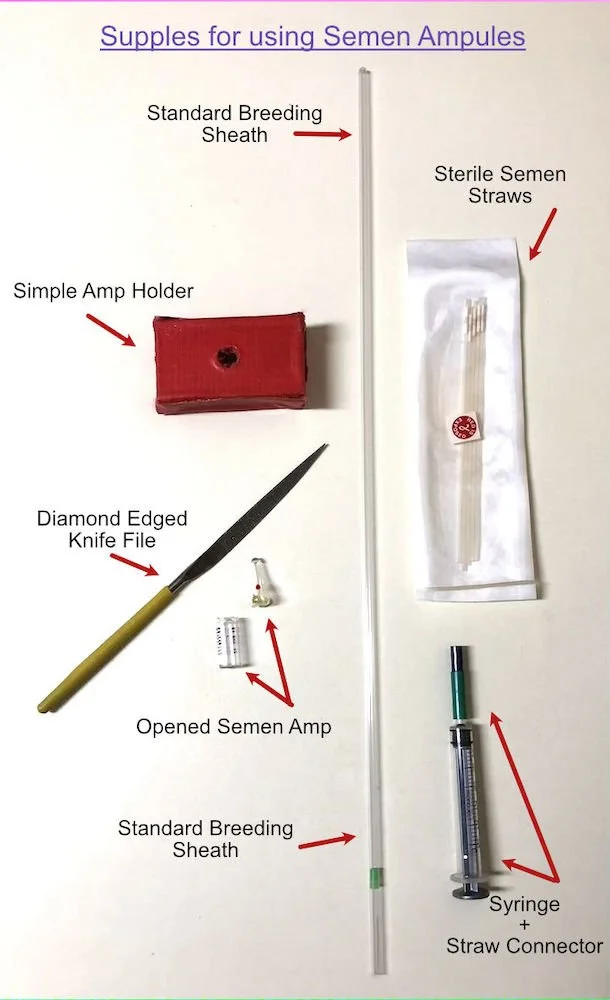
Homemade amp holder: small block of wood with appropriate size hole drilled in it.

Ampules were the primary frozen preservation reservoir for bull semen from 1950 to the late 1970’s when straws replaced them. Some bulls born in the 1970’s may have semen preserved in both ampules and straws. Most ampules contained 0.75 ml-1.0 ml of semen but American Breeders Service started using 0.5 ml ampules because 8 could be stored on a cane instead of 6. This resulted in an increase in the storage capacity of semen tanks. The number of sperm in most ampules exceeded 30 million which far eclipses the number in modern straws which may contain only 5 million. The excess semen in old ampules facilitates the splitting of amps to breed more than one cow. Ampules were frozen at a 45 degree angle so that when they were ready to be thawed it was easy to tell if they had been previously thawed (ie. horizontally level) which would make them worthless. It should also be noted that semen from different bulls stored in amps may have different colors (green, yellow, white, etc) as a result of the use of different semen extenders. The color differences in no way reflect on the quality of the semen.

Originally ampules were thawed in ice water baths. Four to six minutes for 0.5 ml amps and 10-12 minutes for 1.0 ml amps. Research has shown that they can be thawed in modern warm water (95 degree) baths for 2 minutes with comparable breeding success. A note of caution in that ampules being thawed can occasionally explode which can result in injury if one is not careful. It is a rare occurrence but it does happen. Most ampules after 1970 had a dot (red or yellow) on their stem that indicated the side which the user should apply pressure to “pop the top”. They were pre-scribed. Holding the amp with a paper towel minimizes shattering risks. For amps that do not have a dot (prescribed) a scribing device or a quality diamond/knife edged file can be used to scribe them so that the top can be removed/broken off. Specifically designed pipettes, to which a rubber squeeze ball could be attached for suction, were used to withdraw semen from the ampule. The pipette was then used to breed the cow. Pipettes are still available through different bovine reproductive supply houses to use with amps. The bulb can be replaced by a syringe and straw connector using the syringe to expel the semen in the cow. A simpler method is to purchase conventional sterile breeding straws (0.25 ml or 0.5 ml) and use a syringe (3.0 ml) attached to it to draw the semen from the amp into the straw. Syringe straw connectors are available through Reproduction Resources (www.reproductionresources.com). This method can also be used to split ampules to breed more than one cow. When the semen is drawn up to the plug in the straw this provides a seal so that the semen does not drain out. It is also important to remember to cut the end of the straw just as you would with a commercial breeding straw or it will not properly fit in the sheath because it is too long. Done properly, with the required number of cows available, one ampule can be used to breed 2-4 cows successfully, in rapid sequence.

Some old bulls had their semen preserved in “Magic Wands”. This method was originally developed by Dr. W. H. Dreher who managed Badger Breeders Cooperative in Shawano, Wisconsin. The Magic Wand was essentially a frozen breeding pipette that contained 1.0 ml of semen. Conception rates were generally higher (5-10%) but the increased space needed to store them in semen tanks hastened their demise. They were replaced by the “new” straws which took up less storage space in semen tanks. The Magic Wands were thawed at room temperature (3-4 minutes) and one end was nipped off with a toe nail clipper for the semen to be delivered. Connectors were used to extend the length of the Magic Wand for breeding the cow. Connectors available from the aforementioned Reproduction Resources can be used to attach a 3.0 ml syringe to deliver the semen through the pipette. Refer to the different figures to view the proper usage. Alternatively, by using a sterile warmed test tube the semen from a Magic Wand can be placed in it to then be split like amps. Using sterile straws and then a conventional breeding gun facilitates this method.

It is wise to check old semen for viability when using a bull for the first time. How the semen was handled and stored over the years can have a tremendous impact on its viability. All that is needed for semen to be evaluated by a qualified person is a small drop examined under a microscope for semen motility. A semen sample examination is well worth doing because it may prevent a breeding disaster. There is no quality check comparable to the 45 degree tilt in amps that can be used in Magic Wands or straws to confirm that it’s never been thawed and then refrozen.

Given that old bull semen is a precious commodity, and using it properly is important to breeding success, thoughtful planning is imperative in its usage. Understanding the nuances that are part of using old bull semen can easily make the difference between breeding success and breeding failure. Seeing live calves from quality bulls from 50 years ago that can be used to diversify and perpetuate quality cattle genetics can be very rewarding both personally and financially. started to become the dominate method of storing bull semen in the mid-1970’s because of ease of storage and simplicity of use. Semen concentration in straws was less than amps but the thawing process for straws was less damaging to the sperm so conception rates were generally comparable. The original straws contained 0.5 ml versus most straws today are only 0.25 ml in volume. The utilization of older straws is similar to what is done today with no additional necessary steps.

The methodology detailed below in this article has been used successfully by the author for many years. There certainly are other methods for using old bull semen stored in ampules or Magic Wands that may work equally well but each method can have its own idiosyncrasies as a word of caution. Producing a live calf is the ultimate measure of success.


Using Ampules

  1. Thaw in warm water bath for approximately 2 minutes or in an ice water bath for 4-12 minutes depending on the size of the amp.

  2. Remove the top of the ampule carefully using pressure on the pre-scored side or a scribe/file to score the the narrow neck before carefully snapping off the top.

  3. Use a breeding pipette with a syringe attached to draw up the semen or transfer the semen to a regular straw using a syringe attached to a sterile straw.

  4. With a breeding pipette breed the cow in a normal fashion. If a straw is used then a conventional breeding gun can be used. If the amp is 1.0 ml, and only one cow is being bred then a second straw can be filled and used to breed the cow a second time to maximize the chances of conception.

Using Magic Wands

  1. Use a dog or cat toe nail clipper to cut off a 1/4” of the sealed end of the Wand.

  2. Keep Magic Wand level to prevent any semen leakage.

  3. Attach coupled end of the extender tightly to the cut end of the Wand.

  4. Thaw semen semen for 3-4 minutes at room temperature.

  5. Before semen completely thaws attach an air-filled syringe to the rubber tube connector to the Magic Wand.

  6. Put slight negative pressure on the connector with the air filled syringe to hold semen in the the Wand.

  7. Insert Wand and extender into the cow for breeding. Semen should be deposited slowly over 5-8 seconds by pushing on the syringe plunger.

2024

A Shorthorn Heritage (Part 5): On the Road

TPS Coronet Leader 21st

The entire beef industry was seeking increased growth in the late 60's and early 70's, and Shorthorns were no different.  It is my opinion that the mating decisions over the next decade or two had a profound influence on the development of the Shorthorns we have today.  Perhaps it was the introduction of Charolais or maybe producers just got tired of marketing cattle that matured at 900 pounds.  TPS Coronet Leader 21st led the charge in Shorthorns for some time.  I leafed through a 1971 issue of The Shorthorn World and the vast majority of the cattle advertised were Leader 21st descendants.  It wasn't even close.  As always, breeders were searching for the next generation.  Several Australian bulls, Dandaloo Royal Duke, Kelso Ignition, Bogan Yalta, Merriwong Smuggler, and Lone Pine Grand Society were among the bulls that were used, but with limited success.  It wasn't until Mandalong Super Flag came along that the Australian bulls made a significant impact, in my opinion.  It could be argued that he became accepted after he won a major show.  

There was an obvious quick solution to satisfying the demand for increased growth rate.  That was the Milking Shorthorn.  There had been cattle shown for several years that seemed to be entirely different than their pedigree would suggest.  Rumors that Milking Shorthorn blood had found its way into the ASA herd book were rampant.  Soon it became legal.  I will not debate whether the ASA opened their herd book to let Milking Shorthorns in or the AMSS allowed cattle recorded in their registry out.  In some cases that is an argument similar to the one between citizens of neighboring towns after their schools consolidated.  Fifty years later and there are still hard feelings.  Some breeders adapted, some didn't.  I have no argument with either.  One of my youth Shorthorn heroes was Billy Anderson.  He had some of the best Scotch type Shorthorns anywhere.  My wife, Kathie, met Billy's daughter a few years ago at a Bible study meeting.  She said Billy got out of the business because he couldn't deal with the type change.  He was not alone.  I came across a large ad in The Shorthorn World a year or two after the ASA/AMSS arrangement and a noted breeder spent some time stating that he would never use anything but straight beef breeding.  Two or three years later he had several Milking Shorthorn bulls.

If you wanted to compete in the show ring, your odds improved if you used some Milking Shorthorn genetics.  We had had some success at that time, but thought that a little new blood would help.  The Mysha Herd of Noren and Marcia Shaver-Floyd was about 15 miles from us.  They had one of the more noted Milking Shorthorn herds in the Midwest.  Their herd bull was Ridgewood Tracy, a bull advertised to weigh 2,700 pounds.  Marcia and Noren told me the story of how they had purchased him as a young calf in Missouri and brought him home in the trunk of the car.  I was told he didn't look like much then, so they hid him from Noren's wife until he looked presentable.  Their faith in him turned out to be more than justified.  We purchased a son of his, Mysha Mollie's Model, not long after the herd books were opened.  I believe the AMSS charged $850 to trace and release the pedigree of bulls and $250 for cows.  Ridgewood Tracy had already been double registered, so we paid the $250 fee to record his dam and then followed with Model.  Model was more of a dairy type as opposed to what I considered dual purpose.  He was big framed and long bodied.  He worked well on our beef type females, the majority of which had some Leader 21st breeding.  I have always thought that some of the best Shorthorns we raised were the original dual/beef type crosses, combining what I considered to be the best of both worlds.  Model's daughters were excellent producers in our herd for a long time.

Mysha Mollie’s Model

Oakwood Augusta’s Secret (daughter of Leader 21st, and her bull calf out of Model.

Lonny with Oakwood Model T

We had been attending the Milking Shorthorn show at the Iowa State Fair for a couple years just to see what was going on.  One year we watched a Belgian horse show while we were waiting.  There had to be 15-20 mares in the class we watched.  The judge made his trip down the line from the rear of the horses, then back down in front of the horses.  As the judge finished his walk past the front of the mares, the ring announcer stated that in spite of their size, draft horses were extremely docile and rarely kicked.  No sooner were those words out of his mouth than the mare at the end of the line planted a hoof directly into the thigh of the judge.  He went tumbling backwards, but didn't appear to be severely hurt.  He completed the class like a trooper.  I can't remember where the inconsiderate mare placed, but it would have been understood if the judge moved her down the line a little bit.

“Clark”

It was evident that some Milking Shorthorn breeders were striving for the 'dairy' look and others were content with the dual-purpose type.  The AMSS had opened their herd book to outside genetics, most notably the Illawara from Australia, so the selection of dual type breeding was shrinking.  When we went through the barns, it was impossible to ignore the show string of Graham Land and Livestock Co. from Minnesota.  Clark was the star of the show as he was advertised as weighing nearly 3,000 pounds.  They also correctly promoted the polled factor.  They had the right cattle at the right time and promoted them the right way.  Soon they came out with a bull named Great White Hope that had tremendous success as a young calf in the beef Shorthorn show.  Grahams were at the top of their game and history shows they were greatly rewarded for their efforts. I attended the Graham dispersal in 1975 in Waverly, Minnesota.  There was a tremendous crowd evaluating the cattle on offer and it was apparent it was going to be a successful sale.  The only question was just how successful.  It was also obvious that I would not be able to afford to buy anything.  I climbed into the loft above the sale ring in the round barn and watched in amazement.  I won't go into all the details, there are plenty of sale reports available, but the average of $3,200+ was shocking.  This was a time when it took a pretty good one to bring $1,000.

After the sale I drove to the Milking Shorthorn herd of Thomas McCammon in southwest Minnesota.  He was scooping out the milking barn when I got there after forgetting to turn off a water hydrant.  It wasn't all water in the barn.  We spent some time looking at the cows and he had an impressive herd, though I didn't purchase any.  I was nearly out of gas when I reached a small town in northern Iowa.  Of course, I was out of cash and didn't have a credit card.  I did have a check book and talked the gas station owner into taking a check.  I told him he could hold my driver's license and camera in exchange for taking the check if he wanted and I also only needed to buy enough to get home.  He took my check and I got to keep my license and camera.  Try that today!

Not long after the Graham sale, Marcia Shaver-Floyd called me and said she knew of a family that had a dual-purpose type bull I might be interested in.  The Bill Jones family of Washington, Iowa, had a bull named Justamere Todd for sale.  I called them and made arrangements to see him.  Maybe I was young enough that love at first sight was still an option.  They priced him to me, but it was a little out of my range.  I was honest with Bill and told him I only had so much to spend and we reached an agreement.  He delivered the bull, weighing in excess of 1,600 pounds, in a pickup with a stock rack.  The bull's rear feet were on the open tailgate.  This was a deal that was made by a young person with no consultation with the owner of our farm—My Dad.  He was not impressed and said we had Model and didn't need another bull like that.  Fortunately, he allowed the bull, and me, to stay.

Todd's sire, Foxdale Favorite Robin, had been purchased and registered with the ASA by some relatively new Shorthorn breeders, K & K Shorthorns, owned by Kay and Kevin Lamparek, of Swisher, Iowa.  I scratched together the $250 to register Todd's dam, Justamere Jane, and then Todd with the ASA.  I entered Todd along with two offspring of Mysha Mollie's Model in the Iowa State Fair.  I also showed in the FFA show, so my stalls were along the south wall of the beef barn at the fair while the rest of the open show Shorthorns were in the three or four aisles at the north end of the barn.  I had a constant stream of visitors to the stalls to take a look at Todd.  

Hilltop Lancer 457

The bull show was very strong that year.  K & K Shorthorns had won the Illinois State Fair with Duke of Swisher, another son of Foxdale Favorite Robin, and they had a younger bull that had also won his class there.  Bar 4 Shorthorns had Hilltop Lancer 457, a son of Nodak King's Tradition, that would eventually be National Champion.  


Lonny’s daughter Betsy holding Grand Champion Bull Banner from 1975 Iowa State Fair

Marcia Shaver-Floyd stopped by my stalls and told me the other breeders were worried.  Todd showed as a senior yearling, won his class, and was named Senior Champion.  Hilltop Lancer 457 had won the junior division and Duke of Swisher was reserve junior champion.  As I entered the ring to show for Grand Champion honors, my brother, Randy, muttered to me the tried and true show business phrase, "Break a leg." Todd won the show, but I really can't remember any feelings or emotions I felt.  I guess I was numb.


Then it was off to the Minnesota State Fair.  It was my first trip to Minneapolis, we didn't have a trailer, so I borrowed one from a neighbor.  It had to have rained 5 inches and the trailer was still full of water when I got to the fairgrounds.  All the tack, hay, straw, feed, and show box, was in the back of the pickup.  No tarp.  What a mess.  The first thing I did at every show I attended was to go to the office and find out where my stalls were.  I walked into the office, introduced myself, and they told me I was in the annex and go find some stalls, which were not assigned.  The annex was full.  There were no unoccupied stalls.  I had the same three cattle that I had shown in Des Moines, and I needed to find a spot for them.  I finally talked some people into letting me crowd in.  Todd was towards the northwest end of the barn and the other two were near the northeast corner.  The show box, feed, etc., was in the aisle.  There were no tie-outs at the Minnesota State Fair at that time, so I slept on the show box and mucked out the stalls every morning.  Show day mercifully arrived.  The judge was Lloyd Hatch of Pleasant Dawn Farms in Canada.  Many of the top cattle from Des Moines were there in addition to some pretty good ones from Minnesota.  Todd was named Grand Champion again and Hilltop Lancer 457 was reserve.  Winning the show was of course the best thing about the trip, but a close second was being introduced to deep fried cheese curds.  I think Dad even started to like the bull.

After winning two shows, I was considering going to the 'Big Ones.'  Jack Ragsdale, manager of Sutherland Farms in Kentucky and one of the founding fathers of the North American International Livestock Exhibition, attended the Iowa State Fair and encouraged me to show at Louisville.  So, I entered at the American Royal in Kansas City, the NAILE in Louisville, and the International in Chicago.  K & K Shorthorns had several Foxdale Favorite Robin offspring and I had gotten to know them at the Iowa State Fair, so we decided to travel together.  They had 5 head, I had 1, so I helped them with their string in exchange for part of the travel expenses.  

Great White Hope"

I had only read about these shows in The Shorthorn World, so it would be an understatement to say that I was really looking forward to the trip.  Kansas City was first.  I will admit I was a little disappointed when I got there.  The facilities were a little dark and dingy, not what I had imagined.  The cattle were outstanding.  The first bull I looked up was Great White Hope since he would be in my class.  He was impressive.  He had been purchased in Graham's sale by Mrs. Miller of Hannibal, Missouri, and was being shown by Weaver Angus Farm of Peoria, Illinois.  He won the class and I was second and beaten out for Reserve Senior Champion by a 2-year-old, Heckland Superman from Colorado.  I was not disappointed to be beaten by Great White Hope, but really thought I should have won the reserve banner.  Hilltop Lancer 457, the reserve champion at the Iowa and Minnesota State Fairs, was Grand Champion.  Steve Torgerson of Minnesota was handling the Bar 4 show herd and had done a masterful job.

Then it was off to Louisville.  We met Kathie and my young daughter, Betsy, along I-70 and soon pulled into Louisville.  Jack Ragsdale met us even before we were unloaded and promptly made motel reservations for us.  I can't say enough about how much Jack helped turn that event into what it is today.  The facilities were first class and the cattle were even better.  I spent many hours just walking through the barns in amazement.  There was again a big class of impressive bulls in the senior yearling class.  I think there were 5 bulls that had won at least one State Fair.  Great White Hope again won the class and Windholme Farm was second with a son of Melbros Stronghold, and I was third.  All the cattle were so well presented, I did the best I could.  Perhaps even more impressive was the after-show party.  I had never seen anything like it.  A group of us, Bill Marsden, Mike Studer, Floyd Frederickson, and a few others, went to the Executive Inn later for dinner.  Everything was served ala carte.  Quite different than what a young, inexperienced farm boy from central Iowa was used to.  One of the participants smashed his baked potato on his plate and smothered it with butter and sour cream.  He promptly passed out, his head landing on the plate, blowing little bubbles in the potato topping.  Something I had never seen before!

Chicago's International was the next stop.  This was the trip I was looking forward to most.  Every fall we would wait impatiently for The Shorthorn World to arrive with the International show report.  I couldn't wait.  My first impression of Chicago was not good.  We drove along city streets to the stockyards and I was perplexed by the steel bars on the windows of all the buildings.  Another first experience for me.  The facilities were even less impressive than what I saw in Kansas City.  I believe it was the final International, so I was still glad to be there.  The first place we went was to a cafe located close to the stockyards that was famous for their 'sizzling steak.'   The waitress warned us ahead of time that it wasn't what it used to be.  She was right.  Todd won his class and was named Senior Champion.  Great White Hope was not there.

In January it was off to the National Western in Denver.  I had not seen the mountains since a trip to California when I was 3 years old.  I didn't remember them.  The trip had been worthwhile even just riding there in the truck.  Popping over the hill on the interstate and seeing the majestic mountains in the distance was awe inspiring.  I had seen almost all of the cattle in the show before, but I always enjoyed how the cattle changed from show to show.  They all had hair, even mine because of the cold weather.  I believe there were 6 bulls in the senior yearling class.  Again, almost all of them had won a state fair.  Great White Hope was first and ended up being Grand Champion.  I was second and won the reserve Senior Champion banner.  Packards were third with Kahoa's Charmer 19th.  In the final line up, Peter Packard leaned over and told me I should have won the class.  I thanked him, it made me feel good, but I don't know as if I agreed with him.  Great White Hope was extremely good, he was fitted by some of the best in the industry, and was shown in the ring by noted cattleman Roger Worthington of Weaver Angus Farm.  Justamere Todd was shown and fitted by me.  I am not ashamed to admit that all the honors Todd won were because of him and in spite of me.

Lonny with Justamere Todd (Reserve Senior Champion Bull) at the National Western Stock Show


Next Shorthorn Heritage Article: Show Tales

2024

A Shorthorn Heritage (Part 4): Growth and Development

A purebred Shorthorn herd and showing cattle at the fairs was certainly something different for our family.  It was no secret that I developed a keen interest in Shorthorns at an early age.  The Shorthorn World was printed twice monthly and I couldn't wait for its delivery.  I think I had it memorized before night fall every time. My involvement with the breed has lasted over 60 years.  There has to be a support system in place for something like this to occur.  It doesn't happen by itself.  If you're lucky, you have parents that provide a sound base to build on, and you have a supportive and caring family, even if they get on your nerves once in a while.  We were taught the three Rs, religion, respect, and responsibility long before we learned any Rs at school.  I don't think I ever saw Dad sit down.  There wasn't much he couldn't do.  Typical farm work plus welding, electrical work, carpentry, you name it.  Mom didn't spend a lot of time helping with work around the farm, but she was the busiest person on the place.  If we ate it, we either raised it in the garden or picked it off the trees.  She either froze it or canned it.  She dressed the chickens, rendered the lard, and made everything from scratch.  She still found time for Garden Club and I think she won the top award for flower arrangements every time.

Lonny is the one on the right.

As I got older there were other positive influences on my life.  I had Mr. Cole for my baseball coach from the age of 9 through my sophomore year in high school.  He had high expectations, was a stickler for detail, maybe even a taskmaster, but it was the most fun I ever had.  We didn't win almost all of our games because we were such great baseball players, we just knew what to do.  We had a very active 4-H club, but when I got into FFA in high school things jumped to another level.  Mr. Harper was our Ag. teacher and FFA advisor.  At that time the Colo FFA was among the very best in the state.  He also had high expectations and expected much from us.  It was a blast.  The chapter had won numerous state and national awards prior to my arrival, so we had high standards to live up to.  I was on the parliamentary procedure team that won a gold medal at State.  We also won a gold at state and the national FFA contest with our program of work display.  I was the high individual and a member of the champion team in the state FFA dairy and dairy products judging contest.  I wish I had a photo of the look on the Waterloo newspaper writer's face when he asked me how many dairy cows were in our herd and I replied, "None."  Our team was 3rd in the state FFA soils judging contest.  We were the high team in the state FFA livestock and carcass judging contest.  It was pure joy to be a part of those activities.  The successes were “extra”.

After having done well at the county fair and the Iowa State Fair, I decided I would enter some other shows.  The beef show at the National Dairy Cattle Congress in Waterloo was towards the end of September and Dad said if we got done chopping silage in time I could go.  I entered our two Leader 21st heifers and Charlie Henson, a local trucker, hauled them to Waterloo.  It was just me, two heifers, and a show box.  The Cattle Congress held a herdsman’s dinner the first night in a huge house on or near the fairgrounds.  All the cattlemen were there for a grand family style meal.  It was at least two days until show day and I was all by myself and didn't know very many people.  There were free rodeos daily in the Hippodrome.  I think I got to know the personal names and habits of every bucking bull.  There was a high diving mule on the grand concourse right outside the cattle barns.  Several times a day a mule climbed stairs, maybe 20 or 30 feet high, and dove into a large pool of water.  A dog ran up the stairs and jumped with the mule in the grand finale.

Show day arrived and our heifers stood 2nd and 3rd in a large class.  My white heifer was in first place the entire time until being switched to second at the very end.  Our neighbor Leland Kellogg came up to me as I left the ring and said, "Someday we're going to have to take you to the back of the barn and make a showman out of you."  I did start meeting other people at the show and probably the first folks I met was the Studer family.  One of them, probably Mike, had come to look at our heifers earlier and asked where we got them.  I told him we had raised them and then went to look at their string.  They were showing their first calves sired by Sutherland Prospector, a bull they purchased in Kentucky.  Of course, I knew all about him.  The calves were impressive.  The Studer boys, Mike, Rich, Dale, and Craig, were about my age and we became pretty good friends over the years.

The next spring Dad and I took a trip to Wesley to see the Studer herd.  You have to remember I had no experience with purebred cattle or showing them until I joined 4-H, about 6 years prior.  At home our first show barn was a converted 6 stall farrowing shed.  When we started showing more than 2 head, we confiscated a small corner of a barn.  All of our pens were used for feedlot cattle or hogs, but Dad built 2 pens on the east side of the barn for our show calves.  We picked out the steers about January 1 and the heifers in March or April.  They ran with the rest of the cattle until then.  We tried to have them broke to lead about 30 days before the fair.   I can't begin to describe my thoughts as we turned in the Studer farm driveway just south of Wesley.  Houses everywhere.  Barns everywhere.  Groups of cattle everywhere, all in immaculate condition.  The main house was like something you'd see on the cover of a magazine.  The show barn was absolutely amazing!  Room for 15 or so cattle to be tied with box stalls on the opposite side.  There was a staircase to the hay mow instead of a ladder.  And there was another barn full of maybe 20 box stalls right beside the show barn.  There was another barn to the north.  As you came up the lane, there was another barn full of cattle with small paddocks surrounding it.  It was in this barn I got my first look at Sutherland Prospector.  He looked like he had just stepped out of a show ring.  Absolutely stunning.  I don't think I said ten words the whole trip.  I was simply awestruck.

The older of my two sisters, Jane, started showing about then.  Our show heifers that year included Lo Rex K's Lily, a heifer I had purchased from the Beecher Family of Union, Iowa. Randy and Jane showed heifers we had purchased from Glen Struve at Manning, Iowa.  Those two heifers were daughters of 7M Coronet Leader, a TPS Coronet Leader 21st son raised by Glen Moeller.  He had been the champion bull at the Iowa State Fair earlier and Glen had purchased him from Dale.  The first show of the season was the beef show at the National Dairy Cattle Congress in Waterloo.  I believe that was the year the show was moved up to June due to some flooding work on the nearby Cedar River.  Lily ended up being the reserve champion heifer.  The champion was shown by the Zinnel family of Rockwell City.  After winning the county fair, I just knew I was going to win the state fair, too.  Wrong.  My brother did with a 7M Coronet Leader daughter.  All three of those heifers matured into some of our best producers.

Jane Flack with Lo Rex K’s Lily

Daughter of 7M Coronet Leader

Up until the early 70's there was virtually no mention of performance in cattle magazines or at shows.  There were a few advertisements that mentioned growth, but not many.  One of the first I remember was Melbourne Farms and their ad mentioning calves sired by their new Canadian bull, Remitall Captain Jim.  They claimed his calves weighed 50-75 pounds more than the calves by their other bulls.  There started to be more and more articles about performance testing, so growth rate soon became the buzz word at the fairs.  We had used Leader 21 for several years and his calves were the growthiest we had.  The Fair Acres Emblem calves were very good, but really didn't have the performance we needed.  Dad had grown up near Lohrville, Iowa, and there was a long time Shorthorn breeder, Otto Johnson, who lived just east of town.  We drove right by his place every time we visited the grandparents.  He had entered a bull in the IBIA (Iowa Beef Improvement Association) bull test that had gained over 4 pounds per day on test sired by Nugget's Max 3211082.  He was polled and actually weighed in excess of a ton which was almost unheard of at that time.  Dad was able to talk Otto into selling him to us.  The performance of his calves compared to our others was like night and day.  

I had gotten married in the summer of 1972 and one of our first trips together was to the All Iowa Fair in Cedar Rapids.  How romantic.  Nothing says I love you more than a trip to the tie outs.  Kathie was raised in town, but really couldn't be called a city-girl because the population of Colo was about 650.  She really wasn't a country girl early. I suppose her claim to fame in town was a high school science project.  The assignment was to reconstruct the skeleton of an animal.  It just so happened that someone in town had lost a horse.  She and her partner "stewed" the horse on the edge of town so they had a skeleton for the assignment.  The odor hung around town for days, but they got a good grade.  

Jane with a cow that was a daughter of Nugget’s Max

Our first Nugget's Max calves did quite well at the show, though we had no champions.  The last class of the day was for a group of 6 head owned by one firm.  I talked Kathie into holding a very tame heifer in the middle of the group.  What could go wrong?  Within 10 seconds of her taking the lead strap the heifer coughed and blew cow snot all over the front of her shirt.  She just dropped the lead strap and left the ring.  Didn't say a word.  She never showed another one though she did learn to prepare tails during the time when we cranked them up into a little ball and glued them together forming a ball hard enough to knock you out if you got hit by one.

Later that year I Helped Larry Reap, Willow Crest Shorthorns, show at the Illinois State Fair.  The anchor of Larry's string was Kenmar Leader 13B, a son of Kinnaber Leader 9th he had purchased from Harvey Fulton in Canada.  The year before Larry had shown 13B as a junior yearling along with a 2-year-old bull, Kenmar Leader 21A, owned by Ralph Stirm.  Both were very impressive.  I think I remember that Illinois State Fair as being named the National Shorthorn Show.  I had never seen so many Shorthorns in my life.  The spring yearling heifer class circled the entire ring and then some.  R. Lee Johnson won both the bull and heifer shows with offspring of Kinnaber Leader 6th raised by Thomas Farms of Canada.

The demand for more and more performance seemed to be here to stay.  Advertisements in the Shorthorn World stressed size and performance more than anything else.  One noted breeder said he was more concerned with the second 1,000 pounds on a bull than the first.  Bull nicknames followed suit.  Names such as George the Giant, Big Gene, Massive Major, Big John, and Wilt the Stilt were common.  As the desire for size and performance reached an all-time high, breeders were constantly searching for more.  There were rumblings that some Milking Shorthorn blood had found its way into the ASA herd book.  The Steens had won the Iowa State Fair heifer show two years in a row with heifers purchased from the Haumonts in Nebraska.  More and more breeders were turning to Canada to get their size fix.  Many breeders were wanting to use the Milking Shorthorn influence, legally.  Soon they got their wish.


Stay tuned for A Shorthorn Heritage (Part 5): Growth and Development