2023

2023

A Shorthorn Heritage (Part 3): Change is Coming

The second half of the decade of the 60's brought about much change to our family and farming operation.  At the beginning of 1965 I was 10 and just beginning to learn about the real world.  By the end of 1970, I was 16 and, of course, pretty much knew all there was to know.  The biggest change was the purchase of a nearby farm.  As I understand it, the family we purchased the farm from was closely related to the family we currently were farming on shares with.  There was some disagreement between the two families as to whether it was proper for them to sell land, so we were not allowed to continue to farm on the original property if we moved to the farm we had purchased.  No one really wants to give up 600 acres, so we continued to live at the previous home and rented out the two houses on the newly purchased property.

There were about 70 acres of timber pasture on the new farm, so it was obvious that we needed to expand the cow herd.  Our herd prefix had been Circle F, but we changed it to Oakview due to the many oak trees in the new pasture. We added some cows from a few sales around the state and it wasn't long before the cow herd had doubled in size.  LKS Shorthorns, Leland Kellogg & Sons, had a sizable Shorthorn herd not far from us.  Ron Kellogg was the herd managing son and it wasn't long before I started going to shows and sales with him.  There were many consignment sales around Iowa at that time and two of the biggest were at Hawkeye Downs in Cedar Rapids and the Central States sale in Oskaloosa.  Each site had two sales per year, one in the spring and one in the fall.  The Kellogg’s consigned to both sales and I would help Ron load the cattle and tack, and we would leave for the sale at the crack of dawn.  No one had stock trailers then, so everything was hauled in a straight truck and loaded/unloaded with a cattle chute.  I suppose parts must have been quite expensive for those old trucks because they came with a sun visor only on the driver's side.  It was 90 miles directly east along highway 30 from Colo to Cedar Rapids.  I had to squint or shut my eyes the entire trip.  After the sale, it was another 90-mile trip home.  Directly west.  Directly into bright sunlight.  The trip to Oskaloosa was almost exactly the same, only slightly south which helped a little bit.  I don't think we ever made a trip on a cloudy day.

I also helped Ron at several shows.  We normally hit the All Iowa Fair in Cedar Rapids, North Iowa Fair in Mason City, and the Iowa State Fair.  I suppose I got paid for the help, but it didn't matter.  I was doing something I loved.  I so enjoyed seeing the cattle, meeting the people, and treasured the entire experience.  The Kellogg’s were competitive, but never really dominated the shows like a few herds.  One year, though, Ron had an exceptional senior yearling bull, LKS Archie RP sired by Louada Rothes Prince, full brother to the dominant bull of the time, Louada Rothes King.  Archie won the show in Mason City and after cleanup was done, we led the show string to the tie outs.  I was proud to lead the champion bull of the show that night.  We tied the cattle to the posts of a chain link fence using both the halter and the neck strap.  The next morning, Archie was loose and had bred a polled Hereford heifer down the line a ways.  He had slipped out of his halter and the neck tie must have been too loose.  The joys of a cattle show!

Dad gave my brother and me the proceeds from the sale of one of our steers at the county fair to “pay us for our help on the farm” I guess.  Billy Anderson had one of the top herds around in the mid 60's and one that I admired.  He always sold a few cows at Cedar Rapids and Oskaloosa, and one year I used some of the money I had saved up and bought one of his cows.  WL Princess Roma 5th.  She was a daughter of Louada Aristocrat, Billy's herd bull at the time, and her dam was Saltoun Princess Roma 11th, a direct Scottish import.  I finally did it—I had a 100% Scottish pedigreed cow.  She had a bull calf at side by Scottsdale Arrogant, a bull Billy had purchased from Scottsdale Farms in Canada.  Billy agreed to take my cow home and rebreed her to Arrogant.  She calved the next summer.  She was a true belt buckle cow.  If you weren't around in the mid 60's, just imagine a cow that just comes up to your waist.  As you can imagine, her udder was also quite low to the ground.  I don't know if the teats were 4 inches above the floor.  We tied her in the barn and had to put some pressure on the calf's head to get it low enough to nurse, although once it figured it out, it was fine.  While we were working on the calf, Dad said that the cow acted like she'd been through this before.

SV Caesar 25th had been our herd bull for several years and did a pretty good job for us.  We tried out several bulls after him, none of which really clicked.  JB Keynote 53rd was purchased from the Johnson Brothers at Atlantic, Iowa.  We turned him out with a group of heifers the first year we used him.  A neighbor was feeding out about 50 heifers in a timber pasture that adjoined ours.  He had a self-feeder and was feeding MGA (daily hormonal feed additive) to keep the heifers from coming into heat.  As luck would have it, the creek rose after a heavy rain and the heifers didn't cross the creek to eat for several days.  They all came in heat and we could never keep that bull in again and had to sell him.  We purchased Hi View Royal Cameo from the Raisbecks in Wisconsin and had high hopes for him.  However, he got a twisted gut and didn't live long.  A son of Louada Aristocrat, LKS Talisman, was purchased from the Kelloggs and he did okay, but not great.  The Acadia Napoleon 66th son, Colomeadow Silver Cloud, was used some, but the calves out of these bulls just weren't as good as we had hoped for.  If you look back far enough in the pedigrees of these bulls, they all go back to the Scottish type Calrossie herd.

As I went to the shows and sales, I began to notice a demand for more growth and productivity in the cattle.  Our county fair started to weigh the steers as calves and compute the average daily gain and provide that information to the judge.  Dad was more than a little upset when, after going to all that work to include performance in the show, the champion steer was an Angus with an average daily gain of 1.67.  At least the seed was planted.  In the purebred shows, performance was mentioned more and more and polled cattle began to come into favor.  When we first got involved with Shorthorns, the polled cattle seemed to be almost second-class citizens.  The Iowa Beef Improvement Association came up with a program that allowed a youth producer to identify 5 cows and they would weigh the calves and compute 205 day weaning weights.  I enrolled 5 cows and the results were interesting to say the least.  At that time, 450 pounds was a good goal at weaning.  Needless to say, I did not enroll our worst cows, but my weights were about 440 pounds.  We needed to add some performance.

An A.I. Breeding Certificate from 1970

TPS Coronet Leader 21st x was just beginning to make a name for himself about that time.  We AI’d some cows to him in 1968 and got 2 very nice heifer calves.  The semen was shipped by Greyhound to a bus stop in Colo and we picked it up there.  Gerald Kangley was an AI tech with Carnation Farms and he AI’d the cows and filled out a breeding receipt noting the date, owner, and cow and bull ID.  In the spring of 1969, Oakview Augusta's Secret and Oakview Lady Anna were born.  Secret was white and from the day she was born I had my heart set on showing her.   Unfortunately, Randy had first pick of the heifers that year and I had first pick of the steers.  To this day, I don't know if Dad 'suggested' to Randy that he let me have the white heifer or if my older brother was just being nice to me—I really don't want to know.  I literally jumped for joy when he took Lady Anna with his pick. I also chose OV Augusta Jealousy, a daughter of SV Caesar 25th, with what was actually the 4th pick.


OV Augusta Jealousy

Secret won the county fair and she and Augusta Jealousy were champion and reserve in the junior show at the State Fair.  The judge at the county fair was the manager of Pioneer's beef cattle division at the time and said over the loudspeaker that if he could find 50 Shorthorn heifers like Secret, he would have a Shorthorn herd.  By the way, I had no pity and picked the best steer with my first pick and he won the county fair, too.  That year we almost couldn't show our heifers.  Leader 21st's owner decided to charge a steep fee to record calves out of him right when we were ready to register them.  Dad either called Mr. Gordon or wrote him and since we were junior members, we were spared the extra cost.

Beyond the county fair, I had dreamt of showing in the open show at the Iowa State Fair ever since I started attending the show before I was 10 years old.  I was certain Oakview Augusta's Secret was going to be the heifer of my dreams when she hit the ground.  She developed exactly as I thought she would.  After doing quite well in the junior shows I took the plunge and entered her in the state fair open show.  We took our FFA entries to the fair on a Tuesday, 2 days before the fair officially opened.  We showed in the junior show on Friday and were released on Saturday.  My entry in the open show posed a few problems.  The open show was not until the following week, Wednesday I think.  Football practice also started as soon as the FFA show was over.  I had to decide if I was going to play football or show my heifer.  I decided to retire from football.  I liked baseball and basketball better anyway.  My dad had played semi pro football and he may have been disappointed, but I don't think the team needed a linebacker that stood 6 feet tall and weighed 145 pounds. 

OV Augusta Secret

During the FFA show you were required to stay in the fair dormitory.  No one had heard of air conditioning.  It was at least 100 degrees with no air movement whatsoever.  After a shower you were wetter when you put your clothes on than you were in the shower.  I spent a couple days alone at the fair before I could move to the open show barn.  Corn dogs were a quarter and I ate a ton of them.  It took about 20 years before I could eat another one.

During the open show you slept in the barn.  You took the cattle to the tie outs, cleaned the stalls, fluffed up the straw, and hopped into your sleeping bag.  With the fan on.  There I was—in the open show barn, rubbing elbows with the Shorthorn breeders I had admired for years.  Burr, Penningroth, Struve, Anderson, Studer, and many others.  I crawled out of my sleeping bag and started down the aisle to get Secret from the tie outs.  As I got to the east end of the barn I could not help but notice one of my heroes, half in half out of his sleeping bag, taking a swig of Southern Comfort from a bottle in his show box.  He looked at me with my jaw on the floor and said, "Just need a shot to get me going in the morning."  After I stood there for what seemed to be a long time I continued on my way to the tie outs.

Show day finally arrived.  In those days there were often 20+ heifers in every class.  Secret was second in her class to the reserve grand champion.  It took a week for me to come down.  Who needs football anyway?

A daughter of Fair Acres Emblem

About this same time, we started the search for a polled bull.  Dad and I went to Kaehlers in Minnesota and found a few I really liked.  Dad pretty much let me make the selection and I narrowed it down to two, a son of TPS Coronet Leader 10th and a son of Clipper King of USA.  I studied both of those bulls and could not decide.  Dad was talking to the gentleman showing us the bulls while I looked and I heard him tell Dad about the time he took two horses to the field to plow one morning and came back that night with a different set.  There was little talking after that and Dad said we needed to go and he would let them know what we decided.  We didn't get out of the driveway before Dad said, "I don't do business with horse traders."  To this day, I don't think anything was really wrong, Dad just loved horses and I know he would have never sold or traded away one of his.  We ended up purchasing a yearling bull from Miles Mann at Woodbine, Iowa, Fair Acres Emblem, a son of the Canadian Bull Boa Kae White Tornado.

2023

A Shorthorn Heritage (Part 2): Early Days on the Farm--The Herd Begins

Our family's first farm was between Churdan and Farlin, Iowa, northwest of Jefferson. The farm was owned by Dad's uncle, Ralph Flack. He owned a substantial amount of farm ground in Greene and Calhoun counties at that time. Ralph and his wife, “Aunt Lizzie”, lived in a brick house in Jefferson just west of downtown. Ralph died when I was young, but we visited Aunt Lizzie often. There were no young children in the house, so her toy collection was quite limited. I found a small, tin car to play with once and sliced my finger on it. She took me into the bathroom and poured alcohol on it. I screamed quite loudly. Years later, when she moved to the nursing home in Jefferson, she may not have remembered a lot, but she always remembered me "You're Lonny. I poured iodine on your finger."
I don't have many recollections of that farm since we moved when I was 3. I did ask my mother once if there was an attic door at the top of the stairs in that house. There was. I also fell down the basement stairs when I was 2 and got burned severely by extremely hot water at the bottom of the stairs. Mom was washing clothes and evidently, I thought I needed to visit her. I was burned on my upper left chest, arm, and underneath my chin. Skin was taken from my thighs and stomach for grafts. The wound was treated with Aureomycin. I still have a copy of the bill. $18.

The farm we moved to in the late 50's was just west of Highway 65 north of Colo, Iowa, but had a Nevada, Iowa address. Numerous implements were hitched behind either the Farmall H or M. The tractors made their way towards our new farm mostly along Hwy. 175. There were several pieces of machinery trailing each tractor for nearly 100 miles. What a sight that must have been. Trucks were used to haul the other equipment. There was a loading dock 1/4 mile west of Hwy. 65 that was used to unload the items and it was then moved to our farm another mile west. The dock is still there on County road E-29.
We farmed about 550 acres, fed out 2-300 head of cattle, had a 50 head farrow to finish hog program, and grew mostly corn with hay, oats, and a few soybeans. Dad was on a 50/50 basis with the land owner which was quite common at that time. There were three farmsteads. We lived at the main farm, the hired man lived about a quarter mile west of us, and another half mile west was what was referred to as the Apple farm. The feedlot cattle and sows were kept at our site, the hog feedlot was at the hired man's place, and another feed lot for cattle and a building for hog overrun was at the Apple farm. There was a house there at one time. I remember helping tear it down when I was quite small. I was given a pry bar and instructed to remove lath from the wall. I was not very successful.

My brother, Randy, and I were assigned chores as soon as we could carry half a bucket of feed (if not sooner). We each had a list of chores to do and alternated our responsibilities each week. I absolutely hated gathering eggs. We visited both sets of grandparents often on Sunday afternoons and it seemed like it was always my turn to gather eggs at 9:00 at night after we got home. The lone light bulb in the building was always completely covered with who knows what and there were always at least 5 stupid hens that wouldn't get out of my way. The topper was the night I reached into the nest and grabbed a soft-shelled egg. I do not eat eggs to this day.

Feed Bunkers

Every fall an order buyer would purchase a couple semi loads of Hereford yearling heifers from out west. They were delivered by rail to a stockyard just east of Boone and trucks would transport them to our place. The cattle always came during the middle of the night and I always rode along to Boone to pick them up. The stockyards were supposed to be open when we got there, but I don't think they ever were. We had to drive to the main office in downtown Boone and find somebody to unlock the gates.
Another order buyer would purchase a couple loads of Shorthorn heifer calves from an auction located in Gregory, South Dakota. These cattle were started in the lots at the Apple farm and moved to our farm after the yearlings were sold. The yearling heifers usually weighed in the low to mid 600's and the calves were about 425 pounds. The cattle were started on grass hay with the yearlings changed to green chop and then ground ear corn and silage. There was a bunker silo at both locations and an upright silo at the home place where we blew in high moisture ground ear corn each fall. The corn was all picked by ear and ground as needed when the feed in the silo ran out. There were two full size corn cribs at the home place, one at the hired man's place, and a single sided crib at the Apple farm. We also shelled corn which was ground for the hogs. We usually sold the fat cattle to either Bookey Pack or IBP in Des Moines. It was actually fun to get up at 4:00 a.m. and ride the semis.

Dad purchased his first registered Shorthorn, Collynie Queen x2698-460, in 1955. She was hauled home by John Patterson, I still have a copy of the bill. Some of you old time show people may remember his name as the operator of Patterson Supply Company, long time show livestock equipment dealer at all the Midwest fairs. I do not remember the heifer, although I do remember a red cow in with a group of feedlot cattle shortly after we moved to the Nevada area. I always assumed that it was her.

The Apple farm had some pasture land which was unused for the first few years after we moved. There was a lane along the road which led from the barnyard where we fed cattle to the pasture. In 1963, we purchased the small registered Shorthorn herd of the Jim Fitzgerald family from State Center, Iowa. We attended the Story County Fair and watched the cattle show every year and I remember the Fitzgerald cattle as not doing too well at the fair. They were larger framed than most of the cattle there and were more of a dual-purpose type as opposed to the Scotch type that seemed to be winning the shows.
The first cow actually registered in my name was Lady Anna 2761-109. She had the first Shorthorn calf born on our farm from that group. We were returning home from a 4-H meeting and drove by the pasture to check the cow. She had just calved. It was dark, but we could see the outline of the cow and calf with the help of the headlights. Dad drove down into the ditch, I was just sure we were going to roll over, and put the lights directly on the pair so we could get a good look. I remember being extremely disappointed. The calf did not have a good head. Yes, that was the first thing I noticed. That cow never had a good headed calf. At that time, a calf's head had to be short and broad. This head was long and narrow. How awful. Since that time, I've witnessed cattle with a head wider than it was long and ones that could get every last drop of water out of the bottom of a 5-gallon bucket. At some point I did realize that the length of an animal's head was not the most important factor to use in selection.

SV Caesar 25th, in 1968

Dad purchased our first herd bull, SV Caesar 25th, about then. We bought him at the Iowa Royal Shorthorn Sale for $325. He was more of a Scotch Type, so we were on our way. I had been studying the Shorthorn World for a few years, so I knew the grandsire of our bull was my first Shorthorn hero, Bapton Constructor. Every bull that was anything in the Shorthorn industry had to be a son or grandson of that bull. All the winners seemed to trace directly to him. The other thing I looked for in the magazine ads was “imp” which stood for imported. If an animal wasn't out of Constructor lineage, then imp. was the next best thing.

Lonny with Angus steer at the fair.

My brother was old enough to show in 4-H the next year and I started my show career in 1965. The first calf my brother showed was a Milking Shorthorn steer raised by Grandpa Flack and didn't do too well at the County Fair. When I started, Dad went to a club calf sale in Story City, Iowa, and purchased an Angus steer for each of us—the only black calf I ever showed, by the way. He paid $125 for one and $135 for the other. We also each showed a Milking Shorthorn steer raised by Grandpa Flack. The Shorthorn steers got red ribbons, but both Angus steers won their class. The Angus steers weighed in the 925-950 pound range. The classes were shown during the morning and the grand championship drive was in the horse ring later that evening. We toured the barns scouting the competition during the afternoon. We came upon a steer weighing 1,035 pounds, the only calf in the barn over 1,000. Dad said he would be tough to beat and he was. He ended up being the grand champion.

I'm not lying when I say that we had absolutely no clue what we were doing at the fair. We broke the calves to lead using nylon type rope halters with metal fasteners and a chain under the calf's jaw. The halters stayed on all the time. There was a loop on the end of the chain that we would fasten a lead rope to when we wanted to catch the calves. We tugged and pulled and twisted tails to get them to lead. It was tough work for young boys, but we got it done. No one in our family had ever shown cattle. Dad helped us get started, but he was so busy with the rest of the farm Randy and I did most of it ourselves. I had an old booklet on showing beef cattle and it suggested that you wash the calves once before you take them to the fair to get them used to the water. That's what we did. When we got to the fair, we had no idea what to do, so we just tried to imitate what everyone else was doing. I was given $1 to spend at the fair and I had it figured I could get bacon, toast, and a carton of orange drink (I hate milk) for breakfast and a hamburger, fries, and a cup of pop for dinner and supper. We learned several valuable lessons at the fair such as how to lose a quarter playing penny ante poker. We didn't know how to do that either, but we got educated.

Clara 141st

In 1965, our herd was expanded when Dad had Ted Aegerter, ASA fieldman, purchase several registered heifers and steers at the sale in Gregory, South Dakota. The Thede and Miller families sold registered stock there and he bought five heifers for us. They ranged in price from $125-200. Randy and I alternated first selection of the heifers and steers each year. this was our first year showing heifers and we picked our show heifers from this group. Randy had first choice of the steers, I got to pick first from the heifers. There was no doubt which one I would pick. I had my eye on her since the day they stepped off the truck—she was an actual granddaughter of Bapton Constructor! She was the most expensive heifer of the lot. On the sales ticket, someone had written small red. On her pedigree Dad had written smallest red. She was all that. But she had a good head. I was absolutely thrilled to have Clara 141st as my first show heifer. We had a large group of heifers at the county fair, probably a dozen or so. Clara and I were 3rd. Randy won his class and had Champion with Badge's Duchess, another heifer that made the trip from Gregory. She was one of the cheaper heifers. She went on to be one of our best cows for many years, while poor Clara never had a calf.

My steer project that year was a home raised son of the Caesar bull. He was a very good steer, but didn't quite make the required 850 pound minimum. The scale operators told me to take him to the barn, give him some feed and water, and try again. It was a very hot day, but the calf was obviously not used to the new surroundings and in particular did not care for the taste of city water. He wouldn't eat or drink. I weighed him again, but he still didn't make 850 pounds. I was told to try again since I still had a few hours before the deadline. On my way back to the barn, a member of an experienced show family, one that had dominated the Shorthorn show for years, put his arm around my shoulders and said, "Sonny, you tie your calf over here and we'll get him to make weight." He had me tie him to a post on the outside of the wash rack on the north side of the cattle barn. He disappeared into the barn and came back with a garden hose. He fastened the hose to the hydrant, inserted into my calf and turned on the water. I remember screaming as I knew my calf was just going to explode before my very eyes. After a very brief 'drink’, he shut off the hydrant and told me to weigh my calf. He made weight. Randy and I were pretty much on our own at the fair since there was so much to do at home, but I do know if Dad had been there, things would have been different.

The next year, Dad bought a heifer from Roger Applegate, Brentwood Village Ramsden 9th, at a Shorthorn sale in southwest Iowa. She was the first heifer we showed at the Iowa State Fair. She was 6th out of 6, but it was exciting just to be there. We also purchased our second main herd bull from Colomeadow Ranches in Colorado. Dad's favorite bull was always Acadia Napoleon 66th. John Shuman, owner of Colomeadow, had purchased him from Cyrus Eaton's Acadia Farms and Dad just had to have a son. Ted Aegerter again helped us out by buying Colomeadow Silver Cloud at Shuman's sale.

Colomeadow Silver Cloud

Lonny & Lavender B 10th at ‘68 Iowa State Fair

Randy had the second choice for heifers when he had the champion, but I got him back the next year. I had my eyes on Lavender B 10th, a white one. I think every Shorthorn breeder I know was drawn to the breed by a white heifer. Bob Robinson had the champion heifer, but I won my first banner with reserve. A neighbor, Fred Nichols, had a very good white bull at that time, HF Centurion. We bred a few cows and one of them produced a white steer that was the best steer I had up to that time. I showed the prize-winning heifer at the State Fair and got 2nd in my class. Bob had the reserve champion. That was about the time people started clipping the bellies of their show cattle and Dad told me if I had clipped my heifer, she might have won. I did learn about tie outs that year. I was perplexed when I watched everyone lead their cattle out of the barn and tie them up overnight in an area east of the cattle barns in Des Moines. I didn't understand why, but when in Rome...Another thing I couldn't understand was why everyone put a rope around the neck of their calves to double tie them. They had a halter, why did they need a neck tie? I found out the “why” the next morning. All that was left in my stall was an empty halter. I caught the heifer and bought a neck tie.


Part 3: Change is Coming.

2023

A Shorthorn Heritage (Part 1)

Lonny, at Story County Fair, Iowa, showing a Milking Shorthorn steer raised by his Grandpa Flack.

Our family has been a member of the American Shorthorn Association for over 60 years. The relationship with Shorthorn cattle, however, goes back much further. Both of my Grandfathers had Milking Shorthorns dating back to the 1920's. To the best of my knowledge, their Milking Shorthorns were not registered over the years, but they were purebred. These were true farmer's cattle. They were dual purpose and used for milk and meat for the family and farm income.

Grandpa Flack farmed about 4 miles straight north of Lohrville, Iowa. Today he would be referred to today as a tenant farmer. I was told he never wanted to own land because his brother lost all his land in the 1930's. The land was not lost because he had no money, it was because the bank where he had his money went under. He was able to purchase more land later in life and at one time my Father and his two brothers farmed land their uncle owned in Calhoun and Greene Counties. My brother, two sisters, cousins, and I alternated spending a week with our grandparents at their farm when we were kids.

The Flack’s house near Churdan, Iowa

I was born and initially lived near Churdan, Iowa. Later when we moved to near Nevada, Iowa, in 1957 or 58, we would meet them at either Harcourt or Pilot Mound and ride to their farm. On one occasion, we stopped at a small cafe on the east side of Main Street in Dayton and I had my first fountain Coca Cola. It was REALLY good. I remain partial to Coke to this day, but I've never had one that compared to the first.

Grandpa and Grandma Flack had no running water on the farm. In fact, they never had running water until they retired from farming and moved to Lake City in the late 60's. There were two hand pumps in the front yard, one perhaps 20 feet from the house and the other right next to the house. Grandma would send me out for water and occasionally instructed me to get it from the pump by the house. I suppose I figured out why in college. They burned corn cobs in the house. There was a cob house about the size of a two car garage. I would get a bucket of cobs and it was used in the stove in the kitchen. A three hole outhouse was located through the yard fence about 50 feet into the pasture west of the house. Some early mornings it seemed it was 50 miles away.

Lonny in 1959, not quite 5 years old, at the Nahnsen farm.

I learned to drive a tractor on their farm. I remember the new corn crib with the ears of corn hanging down in the alley way. Grandpa told me he was going to save the kernels from the middle of the ear to plant for next year. I was totally perplexed. Was Grandpa just planting the inner kernels in hopes of raising corn with no ends? Did he think if he only planted the middle kernels he would eventually grow longer ears? I suppose his reasoning was another thing I learned in college.


Grandpa Flack was down to milking just a handful of Shorthorns by the time I was old enough to help with the chores. The cows were milked by hand and Grandpa spent some time teaching me how to properly milk them. The time spent outside with Grandpa was truly treasured and I was determined to make this work one way or another. There were just two problems. One, I could never understand how the cow could always hit me in the side of the face with her tail. I was taught milking a cow was a two hand job. Every time things started going properly, I was smacked with a tail. I tried putting my left arm up to protect my face and milk with only one hand. Of course, the cow never swished her tail when my arm was up. As soon as I lowered my arm, whap, right in the face. I finally gave up and just lived with it. The second problem, perhaps the most difficult, was staying balanced on that stupid one legged stool. My skinny little hind end was not made for a one legged stool.

Grandpa and Grandma Nahnsen lived northwest of Jefferson, near the town of Churdan. He milked maybe 20 Shorthorn cows and had electric milking machines. This solved the problem of getting swatted in the face with a tail and there were no one legged stools to deal with. There were always plenty of cats in the barn. A couple of tin pans were filled with milk and the cats waited impatiently for them to be filled. Maybe it wasn’t nice, but I would occasionally squirt them in the face with milk directly from the cow. Not nice, but kind of fun for a little boy.

Corn, hay, and oats were raised on the farm. This was typical for most area farms since soybeans had not become popular and nearly all the farmers had livestock. There was a lane outlined by electric fence from the barn to the various fields and pastures. We would walk down the lane, open the pasture gate, and follow the cows towards the barn surrounded by corn and hay fields. After milking, the cows were moved through the lane back to their pasture. A few cows were used as nurse cows and raised the calves born throughout the year.

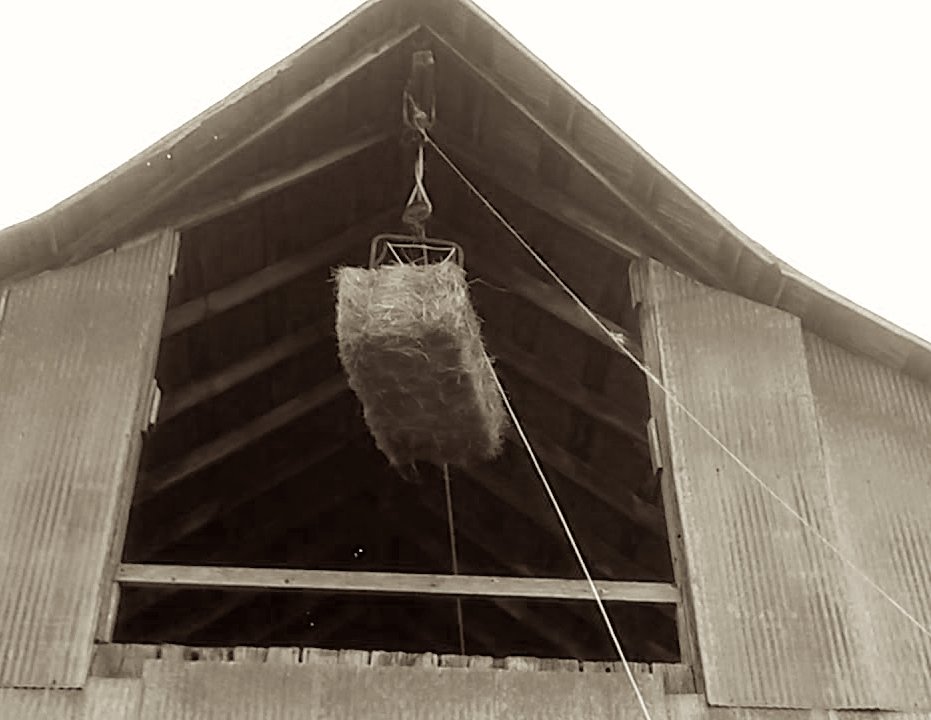
Example of pulley system to load hay into barn loft.

Grandpa Flack’s barn was filled with loose hay. Since Grandpa Nansen had more cattle his hay was put up all in square bales. We would drive the baler down the same lane used to move the cows and enter the hay field instead of the pasture. The hay would be stacked on racks and moved to the barn for storage. Grandpa worked on the rack, securing a claw like apparatus at the end of a rope. The rope stretched to the top of the barn and then down the middle where it would “trip” and drop the maybe 10 bales of hay lifted from the rack. My uncles were still in high school at this time and they would stack the hay in the barn. My job through all this was to drive the Allis Chalmers D-17 back and forth, raising and lowering the rope through a series of pullies over and over again until the rack was empty. I think my little legs were sore for a week after working the clutch for a few hours.

The Farmstead where Lonny was born.

Most farms in central Iowa were similar to my Grandparent’s farms. There really wasn’t much specialization. The people, land, and livestock worked in unison. Our lives of today have been greatly influenced by the past generations and I am proud that Shorthorns have played a significant role in that heritage.


Author Profile: Lonny Flack

I have had a life-long first hand relationship with Shorthorn cattle.  Both of my Grandparents had grade Milking Shorthorns.  My father purchased his first registered beef Shorthorn in the late 50's and we have been ASA members ever since.  The purebred herd has been expanded over the years and at one time numbered over 100 cows.  We had no experience showing cattle, but my brother and I started showing our calves at the Story County Fair in Nevada, Iowa, in the early 60's.  We tried to learn on the go and eventually showed cattle at several fairs around Iowa and from Louisville to Denver.  Our family showed at the Iowa State Fair for 52 consecutive years, finally coming to an end when Covid hit in 2020.  We have been blessed to meet so many wonderful people over the years and fortunate to witness the development of the Shorthorn breed for over 60+ years.  Over the next few months I will be sharing my recollections of this experience.

2023

George Washington and Shorthorns

Visitors to President George Washington’s home Mt Vernon today see Milking Devons grazing in the fields. During his lifetime, however, Washington began to raise Shorthorns, thanks to a gift from an admirer. The enthusiast was Baltimore businessman Harry Gough of Perry Hall, who imported the first Shorthorns (or “Teeswater cattle” as they were known) into the United States in 1785. He stated in a self-congratulatory article in the Federal Gazette and Baltimore Daily Advertiser of 10 May 1798: “In the year 1785, I imported from England three cows and a bull of the best kind then to be procured. The cows were all in calf when exported and calved after they arrived in this country. About three years later a friend in England sent me another cow, with which I was like fortunate.” His neighbor Richard Parkinson, who leased nearby Orange Hill Plantation, added in his A Tour in America, in 1798. 1799, and 1800: “Gough, at Perry Hall . . . has procured some imported cattle from near York, in England, something of the Teeswater kind.”

As members of the colonial aristocracy, Harry Gough and George Washington moved in similar circles and Washington’s stepson John Custis had played truant from school in order to attend Gough’s wedding to Prudence Carnan in 1770. Both men also understood the value of money and neither could be described as extravagant. Late in 1785, Washington asked his old comrade-in-arms Tench Tilghman to inquire of Harry Gough about an interior fabricator named Mr. Rawlins who had given an estimate for some work to be done in Washington’s home at Mt. Vernon, the cost of which the general thought was too high. In his reply dated 30 December 1785, Tilghman stated that he had several interviews with Gough who assured him that the price quoted to Washington was better than the one quoted to him. Washington’s response of 7 January 1786, suggests that he thought Gough had been cheated.

Gough and Washington also shared an interest in agricultural improvement. Washington had long been a proponent of agricultural progress and looked for new strains of livestock to improve his flocks and herds. He corresponded with agricultural pioneer Robert Bakewell, famous for his “Dishley” sheep (now known as Improved Leicester’s) and Longhorn cattle as well as the agricultural writer Arthur Young. We have some idea of Gough’s cattle from paintings. Wealthy individuals commissioned landscapes of their property and this included animals. A famous painting is in the collection of the Winterthur Museum and it shows Gough with his family as well as cattle and sheep (acc. no. 1957.0670A). In another painting, shown below, “Federal Home with Figures & Cattle in Landscape,” probably by Frances Guy who painted other scenes for Gough, the cow herd is grazing by the banks of the Gunpowder River. The mixed nature of the animals is evident from the variety of colors, but several cows definitely have characteristics of Shorthorns. The date of the painting is unknown, but probably about 1800, several years after Gough and Washington’s correspondence.

“Federal Home with Figures & Cattle in Landscape” —picturing Harry Gough’s estate

As the end of Washington’s second term as president was approaching, he became concerned about the state of his farms. Acknowledging that he had ignored them for the eight years of his presidency, he wanted to restore his herds and flocks, as noted in a letter to Gough of 23 August 1797: “My stock of all sorts has been much neglected during my eight year (sic) residence from home, and will take more time than in the usual course of nature will be allowed me, to improve them much . . .” He was correct to be worried because he was much less well-off than many of his contemporaries. The modern myth that Washington was one of the wealthiest presidents ignores the fact that while much of what had been his property is valuable today, during his lifetime it was almost worthless. His land speculation tract of 35,000 acres in what is now Western Pennsylvania and West Virginia was inhabited by penniless veterans who refused to leave and who he had to support by building a grist mill. At the time of his death, George Washington was making plans for a distillery in order to market his grain.

Even though they were not President Washington’s greatest interest, cattle were one aspect of his enterprises that he wanted to improve. Washington had more than 300 head of cattle (cows, bulls, steers, and oxen) across his farms, which was a large number for the time; of these about 100 were brood cows. Nonetheless, his cattle were doing poorly and he noted that despite having a large number of cows, he had to buy butter for his family. More worrisome was the low fertility rate and only about 30 calves a year were born, which he blamed on aged and weak bulls. On 8 January 1797 in the last months of his second presidential term, he wrote to his estate manager James Anderson: “A Mr. Gough near Baltimore has the imported breed and sells them high; the bulls especially; but I should not stand so much upon the price, provided the breed’s to be depended upon”. A second letter on the 29th of that month to Anderson returned to the topic of Gough’s cattle: “By next post I will myself write to Mr. Gough to let me know whether he can spare me some of his best breed of Horned Cattle and on what terms”.

Washington was encouraged in his attentions to Gough’s Teeswater cattle by his former aide de camp John Eager Howard who wrote to him in April of that year: “Some of our farmers have greatly improved their breed of cattle by purchasing bull calves of [Gough], and we have young farmers who are eager to purchase, many of them before they have the means of taking proper care of them, however there is such a demand for his cattle that he can always get his price for them.” Howard’s comments, it should be noted, were not disinterested; he was a friend of Gough’s and the two men had marched together in Baltimore’s Constitution celebration parade of 1788.

The negotiations to purchase a calf from Gough were not successful. Washington confided to his friend and Maryland lawyer Gustavus Scott in a letter of June 19: “[I] had enquiry made of Mr. Gough of any young bulls of his English breed for sale. The result was that he had only one (except calves) of about 8 months old for which he asked $200. Thinking this high for one so young, I authorized another purchase”.

Gough was aware of the prestige connected with Washington and apparently reconsidered the matter. Two months later, he gave a bull calf to the former president who, in a letter of August 23rd, thanked him for an animal from his improved breed. This was not the final transaction and later Gough would sell to Washington a Longhorn bull calf. Washington died a year and a half later, before much could be achieved. In the inventories and notes on the dispersal of his cattle after Washington’s death there is the identification of individuals by color, but which of those were descended from Gough’s bull is not clear.

As this footnote to cattle history shows, livestock improvement was not a seamless exercise in progress. False starts and regressions were all parts of the day to day reality of production. As the dealings of Harry Gough and George Washington reveal, however, progress was made and Shorthorns were a part of the story.


Author Profile: Dr. Benjamin Hudson

Benjamin Hudson is professor of history at the Pennsylvania State University, where he specializes in British history. He is a member of the Maryland Shorthorn Association as well as the Heritage Shorthorn Society. Coming from a family associated with Polled Shorthorns since the First World War, he showed Shorthorns in 4H and FFA. His grandfather B.C. “Brownie” Hudson’s Highland Polled Shorthorns showed throughout the Midwest while his father John Hudson judged Polled Shorthorns at the International Livestock Expo, the National Polled Shorthorn show, and the San Antonio Expo as well as numerous state fairs and regional shows.

2023

"Shorthorns"--What's in a Name?

(This article is reprinted from the April 2021 post of “The Shorthorn Bulletin”.)

When I started my Shorthorn herd many years ago I did not understand the differences in the types of Shorthorns and the terminology that was used to describe them both historically and today. For some readers parts of this article will be redundant but for most I believe I can clarify what type of Shorthorn is characterized by a particular name. I will take a chronological approach as I discuss Shorthorns in the 1790’s versus Shorthorns today.

Teeswater and Durham Shorthorns:

Initially Shorthorns started as a landrace which means that they were bred to fit a particular localized environment and market. The first Shorthorns were developed in the Tees River Valley which was in the Teeswater District of Durham County, England. They were referred to as Teeswater or Durham cattle. Eventually the descriptive term Shorthorn was added.

Killearn Max Juggler 2nd

Shorthorns Versus Longhorns:

Historically there were Longhorn cattle in England prior to 1800. They differed from the typical Longhorns associated with Texas today. Naturally the term Shorthorn emerged as cattle with shorter, curved horns became more popular during the late 18th century.

Scottish Shorthorns:

Scottish Shorthorns can be described as “beefy” beef Shorthorns. The famous Scottish Shorthorn breeder, Amos Cruickshank, was the real pioneer in the development of this type of Shorthorn. Many Scottish Shorthorns were imported into both the USA and Canada from Scotland in both the 19th and 20th century. The term “Scottish topped” emerged which simply means that the sire on a pedigree is a Scottish Shorthorn.

Dual Purpose Shorthorns:

I debated with myself where to insert the term Dual Purpose because it essentially goes back to the origins of Shorthorns when great cattle breeders took sides debating the merits of various Shorthorn bloodlines. Perhaps the most iconic statement about the emerging duopoly in Shorthorns was “Bates for the pail and Booth for the butcher”. In one sense this statement encapsulates both the versatility and uniqueness of Shorthorns from the day they were developed. Dual Purpose Shorthorns are simply Shorthorns that can be used for efficient production of both milk and beef. Shorthorns rose to fame around the world as they became family cows, milk cows, beef cows, and oxen. No other breed of cattle can match the diverse capabilities of the Shorthorn breed.

Irish Shorthorns:

Confusion reigns when having a discussion about what constitutes Irish Shorthorns. The Irish Shorthorns brought to the USA in the 1970’s came primarily from the Deerpark and Highfield herds in Ireland. They had very short pedigrees which could only be traced 2-3 generations. What their total genetic makeup was is unknown but they were primarily of Shorthorn breeding. There was much interest in them particularly in 1980’s as Shorthorn breeders in the USA saw them as “breed changers”—adding size and thickness. The American Shorthorn Association eventually gave them 100% Shorthorn status even though they had a somewhat murky background. As time went on they fell out of favor although there is still a fair amount of semen available from Irish bulls today.

Kamilaroi MeatPacker—a homozygous polled beef Shorthorn

Beef Shorthorns:

Beef Shorthorns are as described phenotypically. This term is used in many countries around the world including Australia and the UK. There was some discussion in the USA to use this term but it never came to fruition. Instead the more generic word Shorthorn was used.

Polled Shorthorns:

All Polled (lacking the genes to grow horns) Shorthorns trace to a single polled cow in Minnesota in the 1890’s. Her offspring became the foundation of hornless or Polled Shorthorns that were eventually incorporated into the American Shorthorn Herd Book in 1923.

Dairy Shorthorns vs Milking Shorthorns:

The term Dairy Shorthorn is used in many countries instead of Milking Shorthorns because it is thought to be more descriptive and defining. When Shorthorn breeders in the USA met in 1920 to form a dedicated group to oversee Shorthorns there was much debate about the term milking versus dairy. At the meeting in 1920 Milking Shorthorn was chosen as the name for this type of Shorthorn. Milking Shorthorn is also used in Africa and Australia. When the split within the USA Shorthorn organization between the beef and dairy enthusiasts occurred in 1948 the American Milking Shorthorn Society came into existence and persists until today. In retrospect if Dairy would have been used it may have propelled this type of Shorthorn to the forefront of the Dairy Industry instead of being buried by Holsteins and Jerseys today. Unfortunately the term “milkers” became a derogatory term used by many commercial Shorthorn breeders to heap scorn on this type of Shorthorn.

Modern Shorthorns (Beef Type):

Almost all beef type Shorthorns today, except Heritage Beef Shorthorns, are essentially an amalgamation of other beef breeds with varying degrees of purity. Most Beef Shorthorn breed registries around the world acknowledge this fact within their registries either through grade up or percentage programs. Certainly Beef Shorthorns, as constituted today, dominate the breed numbers in most countries relative to Dairy or Milking types.

Modern Shorthorns (Milking Type):

Modern Milking Shorthorn

When the upgrade program was instigated at the American Milking Shorthorn Society in 1945 the definition of a Milking Shorthorn instantly changed with the resultant dilution of the breed. Today Modern Milking Shorthorns are often mostly Red and White Holsteins with a smattering of other breeds including Shorthorns. The term Milking Shorthorn is actually a misnomer because the Shorthorn part has gradually been replaced with other types of dairy cattle-thus the “Modern” title. This fact can be found on the AMSS website by viewing the complicated percentage rules that apply when trying to register an animal.

Native Shorthorns:

AMSS started their Native program in 1998 to recognize Shorthorns which had their complete parentage trace entirely back to the 1822 Coates Herd Book. It was an opportunity for Shorthorn breeders to capitalize on their dedication and investment to maintain breed purity. Societal changes have resulted in the term Native becoming a pariah.

Durham Red:

The Durham Red classification of Shorthorns was designated by ASA to create marketing opportunities in commercial markets utilizing the red color seen in Shorthorns. Durham Reds must be at least 25% Shorthorn up to 75% with the rest Red Angus. The term Durham Red has really never “caught on” even though it was initially heavily promoted.

Shorthorn Plus:

Shorthorn Plus = Crossbred

The American Shorthorn Association has embraced a new type of Shorthorn crossbreed called Shorthorn Plus. To qualify as a Shorthorn Plus an animal only has to be 25% Shorthorn. The other 75% of the animal could be Galloway, Devon, Dutch Belted, Angus, etc. Currently ASA allows these animals to be upgraded to “purebred” status over time by breeding them to purebred Shorthorns. The only caveat is that no percentage Shorthorn Plus is eligible to to be upgraded to purebred status, as defined by ASA, if they are black or partially black. The term Shorthorn Plus is a great marketing ploy but the reality is they are actually just crossbreds.

Heritage Shorthorns:

The name Heritage Shorthorn first appeared in 2015 as a way to encompass all Shorthorns (Dual Purpose, Beef, and Dairy) that trace their ancestry only to the 1822 Coates Herd Book. All Native Shorthorns are Heritage Shorthorns but the term Native has fallen out of favor because of its linkage with many negative connotations in today’s society. As the heritage livestock movement has ballooned, associating Heritage Shorthorns with it has created tremendous new marketing opportunities for Heritage Shorthorn breeders and allows for bypassing the negativity surrounding the usage of the word native.

Conclusion:

Hopefully I have successfully explained the nomenclature associated with various types of Shorthorns around the world. As new technology continues to emerge in the cattle industry the terms that will ultimately dominate are composite beef and composite dairy cattle. There is no stopping this crossbreeding train so I believe it is extremely important for Shorthorn breeders en masse to comprehend what is different about their cattle through terminology, phenotype, and genotype, what terms refer to crossbred vs purebred Shorthorns, and to strive to maintain the qualities which make Shorthorns “special”.

2023

Develop a Marketing Plan

By: Bill Engelbrecht

(Mr. Engelbrecht had a Masters Degree in Marketing, and he was a breeder of Angus cattle in Illinois. This article was originally published in a slightly longer version in a 1980 edition of “Drovers Journal”, but his ideas are still quite relevant.)


The marketing of purebred livestock is unlike many of the other activities that occupy our time. Many purebred livestock breeders in the Midwest make their money from corn and beans. Very, very few make their living from purebred cattle and, if the truth be known, most don’t make any money at all in the purebred cattle business. One reason for this may be a lack of emphasis on proper marketing.

Some people buy cattle to make money while others do it to lose money. Some buy cattle just to keep the kids busy during the summer and others to start them on a lifetime career. Some buy cattle because they like them big and ugly while others like them because they’re pretty. Some buy them based on reams of facts and figures, while others buy them not knowing a ratio from a ration. Some buy them to show and some buy them to perform, while still others buy them for no good reason at all.

When faced with this complex marketing environment, we often rely on our instincts as farmers. We become preoccupied with production and avoid the marketing function. Statements are heard like: “Our cattle sell themselves”; or “I’m not one of those promoters” or “our best ads are born, not written”, and “a good product sells itself.” Most of those statements hold little water when it comes to marketing purebred livestock and are pure “bullwash”.

Lets assume for the moment that you have your production—your product— in order. Naturally, you are going to try to improve it year after year, but today, your cattle are what they are and you are faced with marketing them. Let me then encourage you to put together a plan—to put it on paper—to stick to it—to work at it and to execute it on a long term basis.

Some of the things to consider in your marketing plan are as follows:

(Modern Photo by Diane Robertson)

1. State the Facts About Your Operation.

Before you do anything else you must accurately state the facts about your cattle. It is critical that you do this in a formal way—put it on paper. If the formality of doing this bothers you—keep in mind that it’s the “seat of the pants plan” that rarely works. Now, try to answer these questions about your product:

*Who has been buying my cattle for the past five years? List them by commercial, junior, purebred, niche market, etc.

*Where do they live? Put dots on a map.

*How much did they pay relative to the market and competition?

*What do other people think of my cattle program? (Get some help on this one—ask your spouse, a relative, your regional manager, state secretary or a fellow breeder who will tell you the truth.)

*Who are your competitors? By breed &/or end market. Where are they located?

*Who has been selling cattle in your area? How do their herds compare to yours?

*What do they have to offer that you don’t?

*How would you describe your program today? How do you want it to be in five years?

The end result of all these questions is that you have a thorough understanding of your product, your operation, your competitors, and your customers. All of your marketing, advertising, sales and promotion activity must stem from these facts. Nothing else is more important.

Now—and only now—you are in a position to identify the real opportunities and problems that exist for marketing your cattle.

2. How Much Should You Spend?

Quick now—how much did you spend in promotion last year? If you know what your last herd bull cost, what your new baler cost and what your feed cost, then you should know the same about this kind of expense.

You need a plan—a budget. You need to determine how much you want and need to spend ahead of when it’s time to spend it. Setting the amount to spend has a lot to do with whether you are getting started or are an established breeder. Whether you are aggressive or conservative. Whether you are investment spending now, hoping it will pay out at a future date.

There are a few basic guidelines to help determine a budget. The simplest one is based on the past. If you have been doing a real good job in the past, then simply take last year’s figures and adjust them upward to reflect the increased cost of inflation or the increases in advertising rates. This is done to make sure you get the same promotion impact as you had last year. Another way is to estimate how much your most successful competitor is spending and then for you to match him dollar for dollar.

Still another method is to base it on a per cow or per unit base. Tell yourself that if these cows are worth keeping, they are worth $65 per cow per year to go toward merchandising their offspring and your program. And finally, a more sophisticated method is to base your budget on anticipated gross sales.

Generally, this should be somewhere between 3% and 10% of gross for an average breeder. If you expect to sell $50,000 worth of breeding stock, then you should plan to spend between $1500 and $5000 to advertise, promote, and merchandise them. Keep in mind that this is a guideline and some really aggressive breeder may spend up to 20%, while the very large herds because of economics of scale may get it done for a lower percentage.

Also, think about when you should spend this money. Always spend it well in advance of when your product is actually to be purchased. Consider spending it also on a fairly consistent basis.

To run an ad each year in August to announce your sale in September is hardly being serious about the event. And, just because you don’t have anything for sale right now or the market is depressed is hardly a reason not to present your program to potential long term customers. Some of them don’t make up their mind for 3 or 4 years to come see your cattle. But, when they do it may pay back all those ads that never seemed to draw a response.

The crucial factor here is that on Jan. 1 you put this money into your budget and plan to spend it. Start by putting 10% of it into a reserve for special opportunity and then divide the other 90% among your field day, show ring, magazines and newspapers (and online media) that you feel will work best.

3. Where Do You Spend It?

With your budget firmly in hand, you will now start to feel that you “have a plan” and that you are in command. Where to spend it is not an easy choice, but again there are some basic principles that can help.

Your first task is to list the options and places you can spend this marketing money: field day, brochures, road signs, a judging contest at your farm, county fair, state fair, sale advertising, or general advertising, etc.

Your next step is to go back and re-look at the facts about your herd—who were the people that purchased your cattle the past five years? Where do they live? Where do you realistically think they will come from?

The best return on your investment is to “spend your money where your market is”. There is a great likelihood that if people within 100 miles have bought all of your cattle the past five years, they will constitute your market for this year as well. Pouring all your marketing dollars to reach and influence people within that 100 mile radius would be a sound strategy. To spend your money taking animals to an adjoining state fair 300 miles away may not be a good investment at this time if you are just getting started. It may be fun, and educational and it may be social, but it may not be a good use of a limited budget in a plan that is designed to show a profit. Or, it may give your ego a big boost to see your expensive ad in a national magazine, but it hardly gives your marketing plan a big boost.

A more expanded approach may make sense when you have reached and influenced all the people in the 100 mile radius and it’s time to develop an additional market. Now each dollar spent is stretched and has to work harder because you are attempting to change peoples’ minds about where they should buy their bulls and heifers. And changing peoples’ minds and habits is difficult to do and demands a major commitment in time and money on your part. You are asking customers to trust somebody who is a long way from home, to travel further and spend more time and effort.

New markets are not developed overnight, so don’t get discouraged early on if you don’t see results. It may require from 5 to 10 years or longer to develop these new markets.

Take care to evaluate the universal temptation to become “a nationally recognized” herd. It’s extremely difficult to do for the average breeder; however there are excellent national publications that can help you accomplish this. Remember, too, that just because you like to go to certain shows or read certain magazines does not mean your customers do. Find out where they go and what they read and then spend your money there.

In summary—find the customers you believe will buy your cattle—then concentrate on them with repeated efforts—again and again until it works. Resist a scatter plan that splits up your dollars into bits and pieces and attempts to cover everyone. To attempt to market to everyone is to market to no one.

4. What Do You Say?

If you hold a field day you should attempt to leave people with a specific impression about your operation. If you go to the expense of showing cattle at a state fair, then your conversation/display/handouts should all be geared to deliver that exact same impression. If you run some advertising then hopefully you’re once again trying to convey that same impression or fact or image about you and your cattle. All your promotion efforts need to work in concert.

Your problem now is to determine what you would like to have your farm stand for. Once again you need to go back to the facts you stated about your operation—“what you say” must be rooted fundamentally in your cattle operation and you. For long term success “what you say” must be an accurate refection of what you have. You can commit no greater error than to have people expect a certain amount of quality or performance and then be disappointed when they don’t deliver. You may never see them again as customers.

Therefore, in one short sentence, how would you describe your cattle operation? How would your fellow breeders describe it? How would your customers describe it? You know you have the right answer if you all use a similar set of words.

How many times have you seen an ad run that has the following: “Come see Engelbrecht’s Angus—we have popular bloodlines, performance cattle, big strong bulls, good milking cows, show heifers and friendly people”. They wasted some of their money running that ad.

Now consider this as a possible alternative: “Come see Engelbrect’s Angus—they are the only place within 100 miles where you can find performance tested bulls with 1200 lb. yearling weights”. That may not be perfect, but I think you get the idea. The first ad is a laundry list of things every purebred breeder probably has and the other breaks you away from the crowd and single mindedly tells people what it is you are trying to accomplish.

There are many things you can become known for: performance cattle, show cattle, price, reliable people, reliable pedigrees, central location, club calves, fancy facilities, exclusive source of certain bloodlines, line breeding, no-nonsense commercial bulls, volume of selection, a small select herd, cows that milk, bulls with frame, and the list goes on and on.

You may, in fact, excel in nearly all of the above traits—the problem, is that it is hard to convince your customers that you do. To be all things to all people is not to be believed. With a hundred breeders in your area all saying the same thing, it causes a blur unless you are able to set yourself apart with your communication.

What you say is far and away more important than where you said it or how much money you spent saying it.

5. Conclusion:

My emphasis on promotion in no way was designed to imply that you can use promotion to sell an inferior product. To the contrary, promoting an inferior product is the fastest way to go broke. But, once you have your production phase in relatively good shape, don’t simply wait for the buyers to drive in. It won’t happen. And if you develop an aggressive, common sense “marketing plan” you won’t be one of these buyers who goes back to corn and beans because he didn’t know how to market his purebred livestock.

(Modern photo, not part of original article.)