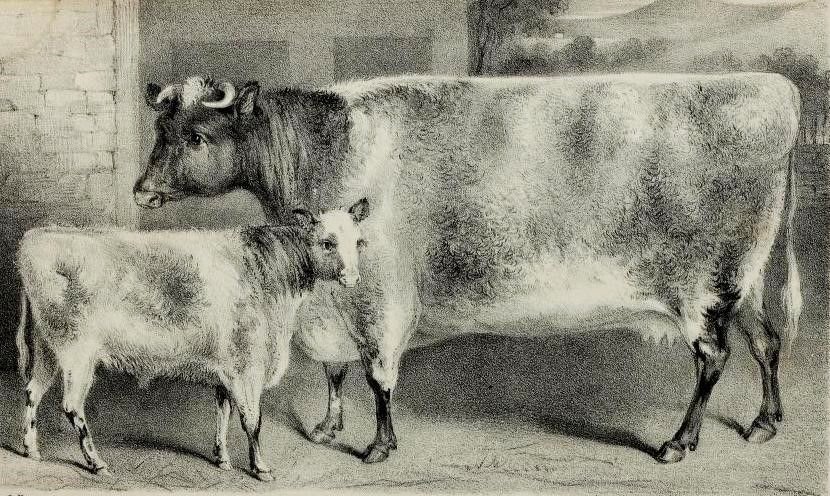
2022

2022

Cow Eye Appeal and Functionality

By R. E. Hodgson

(This article was originally published in Milking Shorthorn Journal, Dec. 1955 under the title: )

“Are We Trying to Design Animals to Make Meat and Milk or Are We Building a Pretty Machine and Hoping It Will Work?”

The cows were coming up from the pasture, led by a big flat-backed roan. Her head was up, her eyes shining, her ears pointed ahead while she decided whether this two legged stranger rated fight, retreat or complete indifference. Her straight legs carried her 1700 pounds easily, as though she walked on air. When she came closer it was obvious that she packed a big square udder, so turgid with milk it seemed about to burst.

It was a sight to make an owner’s chest swell with pride and a visitor ache with pleasure, tinged with envy. She just fitted my mental picture of what a Milking (Dual Purpose) Shorthorn should be and a lot of good judges seemed to agree with me as she made a great show record in the next few years. The owner was Myron Stoner of Albert Lea, Minn., and the cow was Hannerette.

“Myron, she’s going to have a roan bull calf, and I want him.” So her son headed our herd, and as Blackwood Chief won top honors at the International. Better still, he sired a fine group of heifers—which never had a chance to show what they could do because an epidemic of brucellosis sent them to the shambles. In the 35 years since that cow led her string up from the pasture I have seen many good cows but never one that so impressed me as a perfect specimen of Milking (Dual Purpose) Shorthorn pulchritude (beauty).

This story was told to indicate that I appreciate bovine beauty as much as anyone but after years of observation I wonder whether we have over emphasized it. Sometimes I think we have bred for looks first and production second. Of course we want both, but we seldom get everything we want.

As a kid I went on the fair circuit with my dad, showing hogs and horses. He would start out with a full string and come home with the “remnants”. I couldn’t figure why he would sell the stuff that won the blue ribbons. Why not keep them to raise more blue ribbons? When I asked him about it he said, “Did you ever notice that we had papa and mama at home?” His best producers weren’t in the show string.
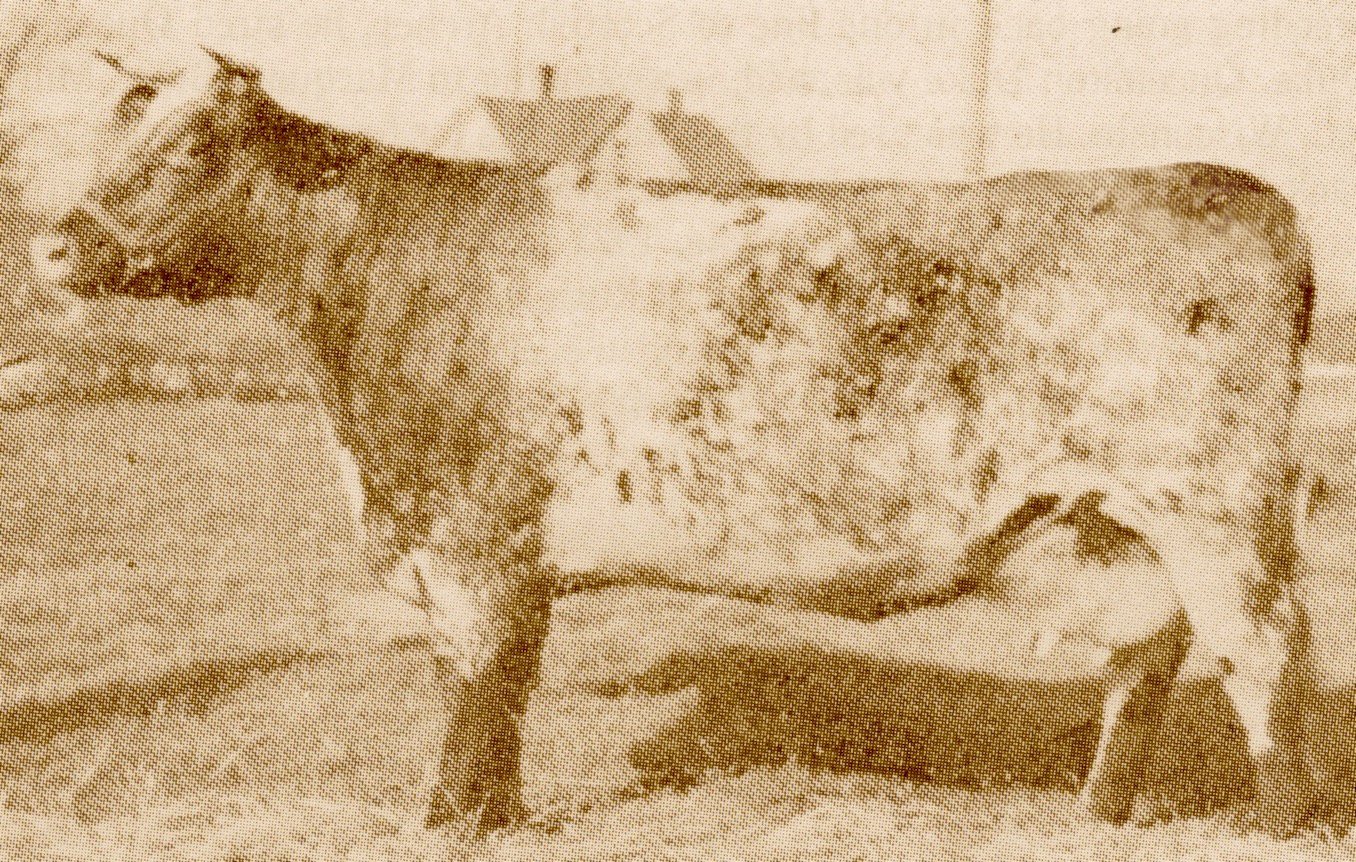
Over and over again, I have seen it. The most productive animals are hard workers. They may not take the prize for beauty, at least not very long, because they are working too hard to have that finish and bloom necessary for the show ring. Of course there may be exceptions but it is rare to have both. If we can’t have both, which is more important?

As I turn the question over to look at all sides, who knows what a cow should look like? The books describe “perfect” animals but where did the writers get their authority? Are all of the things we “judge” for, associated with production? Are we trying to design animals to make meat and milk or are we building a pretty machine and then hoping it will work?

Some breeders may keep cattle for the pleasure of their company (I like them too), but on the whole our purpose is to change hay, pasture and corn stalks into meat and milk. We use corn and concentrates to finish the job or to hurry it up, but hogs or chickens will make meat more efficiently than cattle on the higher priced feeds. We keep cows primarily to market our roughage. If that’s the job we want done, we want the machine which will convert the feed most efficiently. Do we build a tractor for comfort & beauty or for what it will do?

I’m not opposed to shows or showing. That is a game played by experts, but sometimes the farmer who is trying to pay off a mortgage gets confused. There is always the inference that a blue ribbon animal is also able to fatten on rough feed or make 10,000 pounds of milk on silage and hay. How much connection is there between a top show animal and a cow which will go into Tom, Dick or Harry’s barn and pasture, producing a profit under “rough” conditions?

Of course there is always the possibility of teaching Tom, Dick and Harry to give their cattle better care. I’m all for that if you mean better management, sanitation and improved pastures. If by “better care” you mean that Tom, Dick and Harry should use more concentrates, pamper their cows and forget feed costs, it may not pay. With most of us, profit comes first and looks second.

Look around a bit. Some of our beef friends have bred cattle with extremely short legs and early maturity. They may look like little fat nuggets of gold, but put one out on the ordinary range and he’d starve. Some people have bred for beef and lost the udders. Some have bred for fabulous milk records and forgotten all about costs. They represent wonderful achievements in cow designs and art, but neither one would pay bills for the ordinary farmer. He has to sell meat and milk for more than his feed and labor cost, or go broke. He’s not selling fancy breeding stock.

Our Milking (Dual Purpose) Shorthorns are perhaps the most versatile breed known. They are not so specialized as to lose either the beef or milk function. They have done the job on thousands of farms and their owners have stuck with them because they turned hay and pasture into meat and milk at a profit. They haven’t had too much help from some of the “breeders” who have been more interested in trying to beat Holstein milk records or win ribbons at the shows than in turning out efficient machines. Sometimes I suspect that our attempts to “improve” cattle have been more hindrance than help.

Isn’t it about time to set our sights on another target? If we want farmers to use our cattle, shouldn’t we be trying to build a machine which would do their job more effectively? Shouldn’t we be aiming at weight for age on a diet which is at least 90-95% roughage after the first 6 months? A cow that makes 8000 lbs of milk on such a diet, lives a long time and calves regularly, should show more profit than the pampered darlings who get a pound of expensive concentrates for every 2 or 3 pounds of milk they give.

We have such high powered cows but they would seldom take the prize at a beauty contest. They are the worker, not the bovine aristocrats. Sometimes the owner apologizes for their looks. Why does he keep such rough looking cattle? They pay. Our best breeding stock (from the roughage conversion angle) often go through life unnoticed and unhonored because they didn’t quite meet our standards for looks. Again, who knows what a profitable cow looks like?

I don’t pretend to be a skilled judge and the answers to all questions are not in my little book. Nevertheless, I have kept records on a herd of cows for almost 40 hears and they still fool me. I know what I like for looks but records are more reliable than my eyes. A big production for one year doesn’t impress me. How was she fed? How long did she last? Was she a shy breeder? What kind of a carcass did she hang up? What did her steer calves do? Her heifers? Those are the things which mean profit or loss to Tom, Dick, Harry—and me.

We know that one cow can make more meat or milk from a given amount of feed than her sisters. How she does it I don’t know and I can’t spot her by her looks. There is also evidence that efficiency in food use is inherited, not from one gene perhaps, but the inheritance is measurable. Are we capitalizing on this information in our cattle breeding operations? Do you have heifers that will weigh from 800 to 900 pounds on their first birthday, and do it almost entirely on roughage?

I’m not looking down my nose at carcass quality, conformation or milk production. I’m just asking whether they are enough without efficiency. Within our breed we have cows which will grow well and produce well on roughage and ordinary care. That kind pay the bills. Let’s put them on the pedestal and aim to reproduce their kind. I’ll bet they will average up in looks with those we have selected largely for beauty. A profitable cow looks good to me anytime. Let’s find and increase our efficient cows before their good qualities are lost in the shuffle.

Way back in 1915, W.D. Hoard, founder of Hoard’s Dairyman, said, “Milk is the fundamental question in a diary cow. It is an internal, not an external proposition. It is not indicated by color of the hair, nose, tongue, or tail. It is something deeper than these surface characteristics.” It is evident that the same statement applies to meat. Let’s look deep, measure accurately, and find those qualities.

2022

Heritage Dairy Shorthorns or Heritage Milking Shorthorns

With the growing interest in family cows the Heritage Dairy/Milking Shorthorn cow has come to the forefront. The ongoing discussion regarding the proper terminology for this type of cow has inspired me to try to differentiate the myriad of name options.

Historically, when the initial formation of the USA Milking Shorthorn Group occurred in 1912, it was a close call as to whether to call them Dairy or Milking Shorthorns. Milking won by one vote. Throughout the first half of the 20th century many breeders continued to use the term Dairy Shorthorns rather than Milking Shorthorns in their advertisements.

The reason the Milking moniker was adapted was because many Shorthorn breeders wanted to take the breed in the beef direction which obviously conflicted with the goals of the dairy/milking and dual purpose breeders. Certainly money entered into the equation because of different paid advertising venues that would be used in promoting Shorthorns. Beef Shorthorn breeders wanted to tailor promotions to commercial beef producers while Milking Shorthorn breeders wanted to concentrate advertising toward the milk producers.

A breakout of the different permutations are as follows:

Heritage Dairy Shorthorn:

Utilization of this terminology generates maximum name separation from crossbred Modern Milking Shorthorns. It dovetails with the emergence of Micro-Dairies that want to capture a new market niche that Modern Milking Shorthorns are unable to embrace. Beyond that it is consistent with the name used in many parts of the world to identify a specific type of Shorthorn. For example the British Rare Breeds Trust uses Dairy Shorthorn (Original Population) as the comparable term for Heritage Dairy Shorthorn. They consider Milking Shorthorns to be crossbred Shorthorns.

Heritage Milking Shorthorn:

Up until the American Milking Shorthorn Society (AMSS) opened the Herdbook to crossbreeding, Milking Shorthorn had a specific meaning that delineated both their breed purity and historical ancestry. Opening the Herdbook brought confusion and blurred the definition of what constituted a Milking Shorthorn. With the increasing mixing of other cattle breeds to produce Modern Milking Shorthorns the value of Milking Shorthorns as a distinct breed decreased. This has resulted in their almost complete disappearance from milk production in today’s dairy industry. The value of Modern Milking Shorthorns revolves around showing rather than dairy functions. Because the original designation of Heritage/Native Shorthorns was done by AMSS it was quite reasonable to use the Milking term. Traditional Heritage/Native Shorthorns (beef, dairy, and dual purpose) have all been called Milking Shorthorns. at different historical junctions. Unfortunately they were often referred to as “milkers” with a negative connotation within the cattle industry and this obscured their value as a dual purpose breed. It is understandable that some traditional Heritage Shorthorn breeders may want to continue to refer to them as Heritage Milking Shorthorns as they have done since the inception of the terms Native Shorthorn and Milking Shorthorn.

Heritage Dairy/Milking Shorthorn:

By embracing this term Heritage Shorthorn breeders have an all encompassing compromise. Utilization of this term optimizes internet search results while conveying a sense of tradition within Heritage Shorthorns. With the progressive march of search technology it is important to bring both “eyeballs and clicks” to Heritage Shorthorn breeders in the competitive marketplace. As Heritage Shorthorns become a worldwide symbol of both the virtues and purity of traditional Shorthorns, breeders interested in the milking type of Heritage Shorthorn may find this terminology (Dairy/Milking) the most customer friendly and most searchable.

Dual Purpose Shorthorn:

There is definitely a faction of Heritage Shorthorn breeders who prefer this designation because it truly defines what historically made Shorthorns the dominant cattle breed in the world for over 100 years. Even 50-60 years ago many Shorthorn breeders were splitting their herd with half the cows raising two calves and the other half used for commercial milk production. Many family cow owners today milk their cow once a day to use the milk, and let the calf nurse the rest of the time. The calf can then be used for either the production of locker beef or the sale of a heifer. Again it demonstrates the versatility of Heritage Shorthorns and why there is such an increasing interest in them.

In conclusion, ultimately each Heritage Shorthorn breeder has to decide for themselves what phraseology they are most comfortable with, while marketing their Heritage Shorthorns. There is not a wrong or right answer, but it is extremely important to make a distinction from Modern Milking Shorthorns. With the availability of the Heritage Shorthorn Milk logo to HSS members the possibilities are numerous no matter which descriptive term they decide on for their milk producing Heritage Shorthorns.

Further information about Shorthorn terminology can be found in an article from “The Shorthorn Bulletin” Volume 6 Issue 1 called “Shorthorns: What Is In A Name?” or at the Livestock Conservancy information page for Heritage Shorthorns.

2022

The Coates Herdbook (A Lesson in Persistence) – 200 Years and Counting

Robert Bakewell

The Shorthorn breed had taken form by the late 18th century with the earliest representatives reaching the shores of Virginia as early as 1783. This was achieved with the application of breeding principles initially developed by Robert Bakewell, the recognized “Father of Animal Breeding.” His methods of carefully selecting foundation stock of desired type and then using a well-defined system of breeding “like to like” regardless of relationship (linebreeding/inbreeding) could create a group of similar individuals that were fixed in type and would breed true. Stock belonging to “breeds” created using this breeding method then could have economic value. These principles had created in the fledgling Shorthorn breed… cattle which could contribute increased growth for production of beef, add scale to the local cattle strains for use as work oxen, as well as improve the ability to fatten and increase milk production. By the early 1800s these useful traits combined with strong promotional efforts in exhibits and sales made Shorthorns popular and well recognized throughout Great Britain, Continental Europe, and North America.

At this time in Great Britain, much of a person’s position in life was determined by their social class and heritage. A small portion of the population which included the British nobility and a British social class referred to as the “landed gentry” owned a major portion of the land. They could live entirely on rental income or at least had a country estate. Land ownership would be passed on through generations. This system also prompted the issuance of many long-term leases which could also be passed on to succeeding generations. Those who held these leases were still referred to as “tenant farmers” but had control over large tracts of land with many employees. This social system with the importance of family lineage was certainly a driving force behind the establishment of a herdbook for the Shorthorn breed. This maintenance of records and documentation of ancestry was an important step in their improvement and expansion.

The first herdbook for any livestock species to be published in Great Britain was The General Stud Book for Thoroughbred horses first printed in 1793. Its intended purpose was to be a public registry system for pedigrees to identify those horses that qualified for specific races. Although slightly different in their intentions from the General Stud Book, the first cattle breed herdbook published in the British Isles was for Shorthorns. In 1812 a meeting was held including respected Shorthorn breeders Sir Henry Vane Tempest, Col. Totter, and George Coates to discuss the publishing of a herdbook. These same breeders met later that Fall in a second meeting which included several more prominent Shorthorn breeders. Among those present were members of the Colling family, the Booth family and Thomas Bates, all who had already figured prominently in the founding and expansion of the breed. All those in attendance endorsed the idea of a herdbook and since many of these Shorthorn breeders also raised horses, they looked to The General Stud Book as a model.

The attendees also agreed that George Coates was the person to gather the information and lead the task as editor. It was believed that he was fitted for the duty by his large knowledge of pedigrees, great interest in the cattle, knowledge of the breeders and confidence they placed in him. Sir Henry Vane Tempest who had extensive land holdings and coal mines in northeast England agreed to offset the expenses of gathering the data and printing the book.

Coates immediately got to work on the project, only to be stymied nine months later with the unexpected death of Tempest. Although, the loss of “Sir Henry” delayed the project indefinitely, Coates continued his work of gathering data that would one day be needed to publish a herdbook. Alvin Sanders described Coates’ work in his book, Red, White, and Roan: “This difficult task was successfully undertaken by a well-known character of his day and generation, old George Coates, who rode up and down the valley year after year in quest of necessary data. His familiar figure, old white nag and saddle bags, traversing the highways and by-ways of that historic region. Coates also attended the “fairs” or market days, held at Yarn and Darlington and other points, where the Shorthorn fathers were wont to gather to exchange views and discuss ways and means of promoting improvement in the local cattle stock.”

Sir Henry Vane Tempest

“Fashion” and a calf, bred by Sir Henry Vane Tempest

Another gathering of Shorthorn leaders occurred after Robert Colling’s sale in 1818. Printing of the book had remained on hold, but it was decided to move forward with the project. Robert Colling and Jonas Whitaker agreed to defer the expenses to print the book. Their money would then be recouped through subscriptions. However, Colling died in March 1820, which further delayed the project for lack of funds. After these delays, in 1822 Whitaker, who had become a large breeder and a leader in exporting cattle to America advanced the monies necessary to publish Shorthorn’s first herdbook. The book got printed in the autumn of 1822 with 505 subscriptions, at a guinea each per book paid on delivery for a total of $2,525. At this subscription cost, it was reported that it was not a profitable enterprise for Coates.

The first edition contained entries on 710 bulls, with about an equal number of cows. The early herdbooks sometimes had meager pedigrees because the ancestry of many foundation animals was unknown. Coates had to depend on information from private herd records, which were frequently “sketchy,” and simple recollections and stories of many years distant from people who lived during those times. The earliest birthdate of an entry into this edition was the red and white Studley Bull (626) calved in 1737. Bulls and cows were cataloged separately. Bulls were assigned a registration number and arranged alphabetically by their name. Cows were not given a registration number and were cataloged alphabetically by name with some of their progeny listed below. In reference, cows were identified by the herdbook volume and page number where they were listed, ie. (Lavina v.1, p. 373). Bulls and cows were cataloged separately until well into the 20th century. It was published under the title The General Short-Horned Herd-Book: Containing the Pedigrees of Short-Horned Bulls, Cows & c. of the Improved Durham Breed. It became known as the Coates Herdbook and still bears this name today. As future books were published, the pedigrees could be traced back through the various editions.

As indicated, the first editor of the Shorthorn herdbook, George Coates, was also an early breeder of Shorthorn cattle. Unlike many of his contemporaries involved with the formation of the breed, Coates was not a man of means. Still, it would be Coates who relentlessly undertook the monumental task of gathering pedigree information for the contents of the first Shorthorn herdbook. It appears that it had to be a “labor of love” because his compensation was very meager. After the publication of the first Coates Herdbook—which reportedly provided Coates with no renumeration—he nevertheless started collecting information for the second edition.

“Patriot” (486), bred by George Coates

The second volume would not come out until 1829, with volumes after that being edited by Coates’ son and then Henry Strafford. In 1874, the Shorthorn Society purchased the herdbook, moving it out of private hands. It is hard to find fault with anyone who worked so hard for so little financial reward as the elder Coates. Still there were some who felt that there was benefit when the society took over the herdbook.

Shorthorns were among the first breeds to be improved but also had public pedigree information that was available earlier than for any other cattle breeds. Breeders of other breeds utilized similar breeding strategies at the fountain head of their breeds, yet they had no public herdbooks until later dates. Shorthorn ancestral information was available because of the publication of the Coates Herdbook which also set a precedent to establish herdbooks for most other livestock breeds, regardless of specie. This was useful in developing expanded world-wide markets. With the obvious expense and time involved in the importation of cattle, ancestral documentation surely had significant value. This was borne out when investment trips were taken to the British Isles to secure improved cattle breeding stock in the early part of the 19th century. With no specific breed designation or preference in mind, in most cases they came back with Shorthorns that were offered to eager buyers. This coined the Shorthorns as “The Great Improvers.”

The Coates Herdbook also provided a model and information source for the American Short-Horn Herdbook to be first published in 1846. All these events, no doubt provided an important encouragement to the ultimate popularity throughout the British Isles and expansion across the globe. They became the most numerous breed in Britain, North America and Australia well into the 20th century and have had major influences as foundation stock for many other breeds.

Shorthorns have a unique history in that breeders can retrieve pedigree information as far back as the founding herdbooks of the breed. Shorthorns that trace in all ancestral lines to these herdbooks have the designation of Heritage/Native Shorthorns and are identified and promoted by The Heritage Shorthorn Society.

“Sir Thomas Fairfax”, bred by Jonas Whitaker


Author Profile: Dr. Bert Moore

Bert Moore proudly admits that he “grew up on Shorthorn milk.” Raised on a north central Iowa farm the only cattle that he knew were the red, white and roans. His first Milking Shorthorn came as a gift from his grandfather to his sister and him with the provision that they would receive every other calf and their father would receive the alternating year’s calf to pay for feed. With ten stanchions in the barn, when eleven cows were “fresh” it was Bert’s job to milk that eleventh by hand. This did not enamor him to the dairy business. Beef Shorthorns were added and comprised all his 4H projects. Shorthorns were the only breed both of his parents and both sets of grandparents raised making him a third generation Shorthorn breeder (on both sides of his pedigree).

Bert has a degree in Animal Science from Iowa State University, and MS and PhD degrees from North Dakota State University. As a faculty member at NDSU for over forty years he taught a wide variety of courses, advised students, conducted applied research and coached the livestock judging team. He has judged livestock shows from local to international levels in 29 states and 4 Canadian provinces and has given presentations in Great Britain and New Zealand. After leaving North Dakota State he served as the Executive Secretary of the American Shorthorn Association. He and his wife Millie currently live in Indianola, Iowa where they maintain a herd of Shorthorn cattle, a portion of which are Heritage Shorthorns. Because of his deep interest in beef cattle history he has amassed an extensive collection of reference materials, authored numerous articles, and co-authored a book on the history of Shorthorn cattle to commemorate the 150th anniversary of the founding of the Shorthorn Association—“Shorthorn and the American Cattle Industry”.